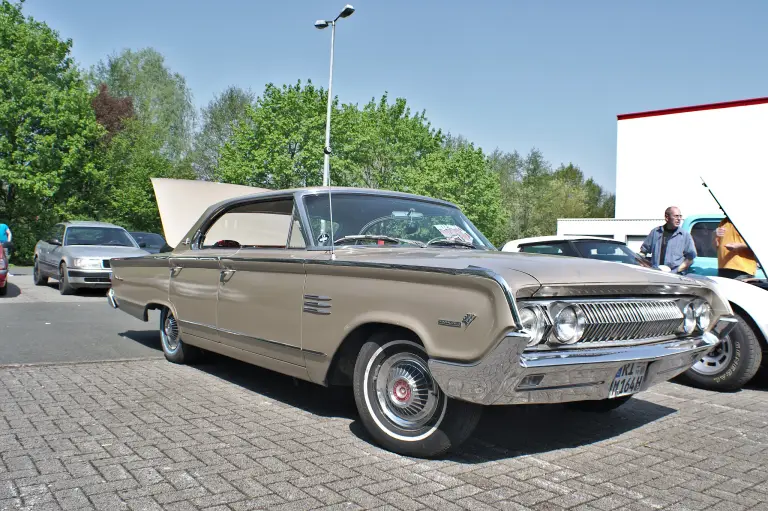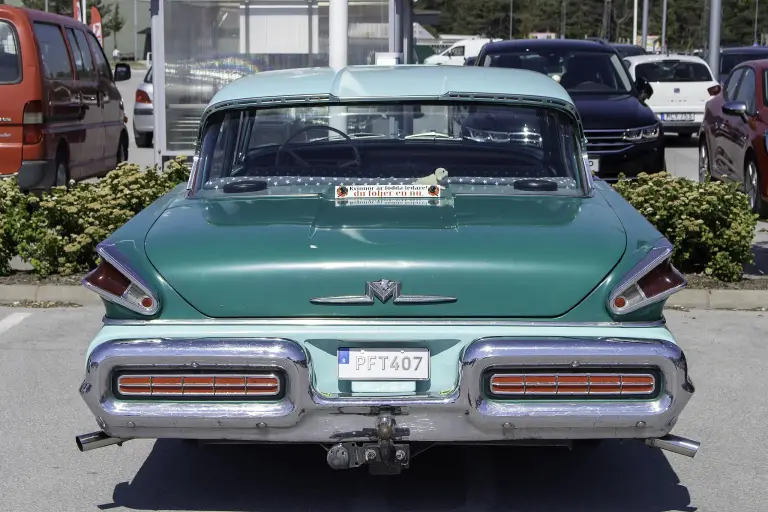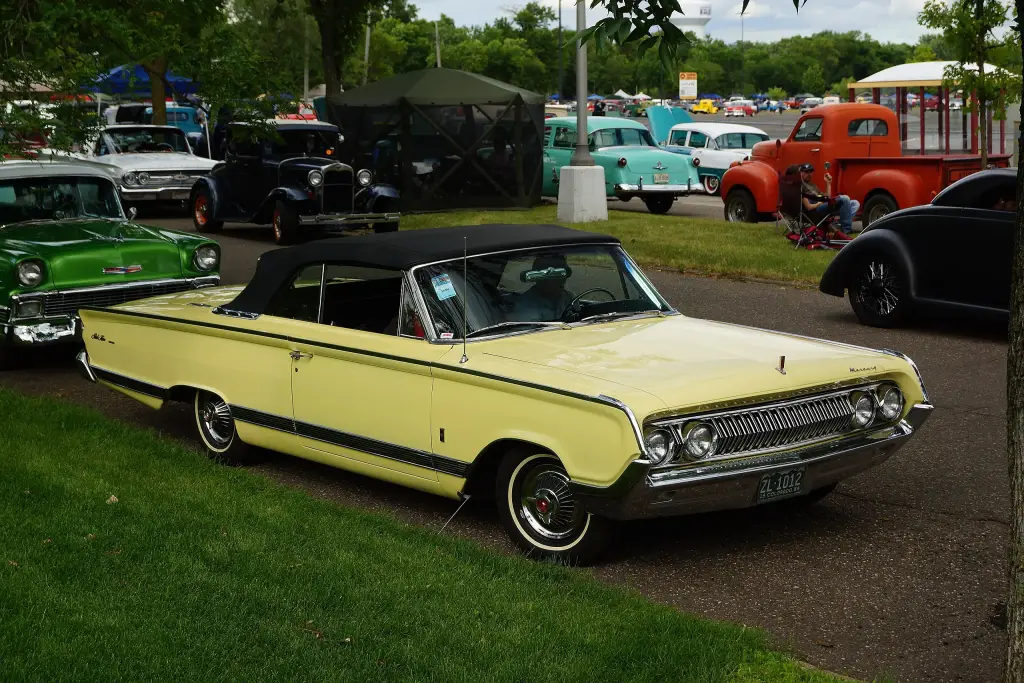
The Mercury Park Lane was a full-size car built in two periods, 1958–1960 and 1964–1968. It began as Mercury’s flagship, conceived as a Super Mercury to take on the Buick Limited and Chrysler 300D, and it ended its life above the Monterey and Montclair.
Mercury Park Lane at a glance
| Production | 1958–1960 and 1964–1968 |
|---|---|
| Position | flagship in 1958–1960, top model again from 1964 |
| Bodies | two- and four-door hardtops, convertible coupe, sedan |
| Chassis | body-on-frame, shared with the Colony Park |
| Wheelbase 1958 | 125 inches, three longer than a standard Mercury |
| Wheelbase 1959 | 128 inches |
| Wheelbase 1960 | 126 inches, as standard Mercury |
| Engine | 430 cu in Ford MEL V8 |
| Output | 360 hp in 1958; 400 hp with Super Marauder; 345 hp in 1959, 310 hp in 1960 |
| 1958 price | US$3,867 coupe, US$4,118 convertible |
The article is based on one source, the English Wikipedia page on the Park Lane; the record formerly filed under the Brougham trim is covered here because Brougham was a Park Lane version.
History of the Mercury Park Lane
A Ford Parklane first
The Park Lane name was first used by the Ford Division in 1956 for a two-door station wagon built to compete with the Chevrolet Nomad. Based on the Ford Fairlane, the Ford Parklane, spelled as one word, outsold the Nomad almost two to one, but Ford’s marketers felt it had missed its target market and it lasted a single year.
The 1958 flagship
The Mercury Park Lane arrived for 1958 as a premium model line, conceived as a Super Mercury to compete with the Buick Limited and Chrysler 300D. It came as two-door and four-door hardtops and a convertible coupe, the same body styles as the Turnpike Cruiser it replaced in effect, although it was not officially its successor. Its distinctive Breezeway rear window was later adopted by the Continental Mark line. As the flagship, the Park Lane took a luxury approach similar to the updated four-passenger Ford Thunderbird, at US$3,867 for the coupe and US$4,118 for the convertible, and unlike the unibody Thunderbird it was built on a separate frame.
The Park Lane shared its chassis with the Colony Park wagon and the Edsel Citation and Corsair, and used a 125-inch wheelbase, three inches longer than a standard Mercury, with an extended rear deck seven inches longer than standard cars for 1958 only. In 1959 the wheelbase stretched to 128 inches, two inches longer than other Mercurys, and for 1960 it matched the 126 inches of the standard range. One engine was offered: the 430 cu in Ford MEL V8, rated at 360 hp for 1958. The Super Marauder option raised the output of any Mercury with the 430 to 400 hp, the first mass-production American engine so rated. For 1959 the Super Marauder was dropped and the standard engine rated at 345 hp, retuned to 310 hp in 1960. All Park Lanes had a three-speed Merc-O-Matic automatic; the 1958 cars used Multi-Matic transmission controls, and from 1959 there was a steering-column selector. For 1960 the Park Lane received new tail lamps, rear fender skirts, five chrome bars ahead of the rear wheel openings, wide rocker mouldings and a padded dashboard. The name was dropped in 1961 along with the Montclair as Mercury concentrated on the Monterey and introduced the Comet compact.
The second generation
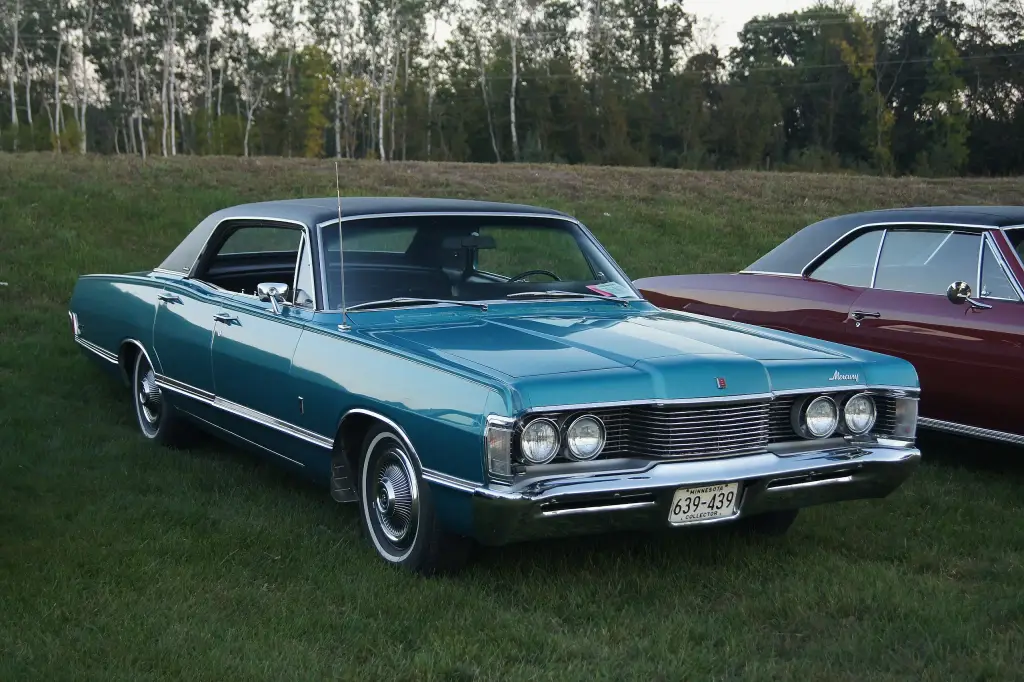
For 1964 the Park Lane returned as Mercury expanded its range for the division’s 25th anniversary, again topping the line above the Monterey and the reintroduced Montclair. Unlike the first generation it used the same wheelbase as the other Mercurys and differed mainly in trim. The four-door hardtop listed at US$3,413 and 6,060 were sold. Many Park Lanes were ordered with a retractable “Breezeway” rear window, first used on the Turnpike Cruiser and the 1958–1960 Continental, installed in hardtop sedans with the reverse-slant configuration. The fastback roofline was available as part of the Marauder option package, and the Colony Park wagon was now aligned with the Park Lane line. For 1965 the full-size Ford and Mercury chassis was redesigned and the Mercury line took on a much more slab-sided look influenced by the 1965 Lincoln Continental; the retractable rear window survived only on sedan bodies across the range. In 1969 the Marquis became a full model line and replaced the Park Lane in the Mercury range.
Design and features
- Super Mercury: a flagship aimed at the Buick Limited and Chrysler 300D.
- 430 MEL V8: 360 hp in 1958 and up to 400 hp with the Super Marauder option.
- Long wheelbases: 125 inches in 1958, 128 in 1959 and 126 in 1960.
- Breezeway window: the retractable rear window that later reached the Continental Mark.
- Two lives: flagship in 1958–1960 and top model again in 1964–1968.
Mercury Park Lane versions
- Park Lane (1958–1960): the first generation, with the 430 V8 and long wheelbases.
- Park Lane Super Marauder (1958): the 400 hp engine option.
- Park Lane (1964–1968): the second generation above the Monterey and Montclair.
- Park Lane Brougham: the top trim of the second generation.
The Park Lane topped the range above the Monterey and Montclair, and was replaced by the Marquis line. More cars are in the Mercury collection.
Sources
- Mercury Park Lane, English Wikipedia: both generations, chassis, engine, prices and equipment