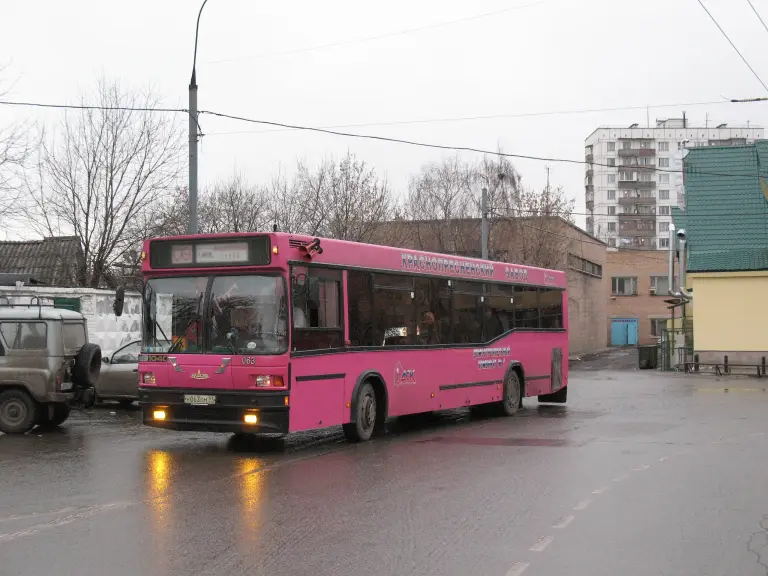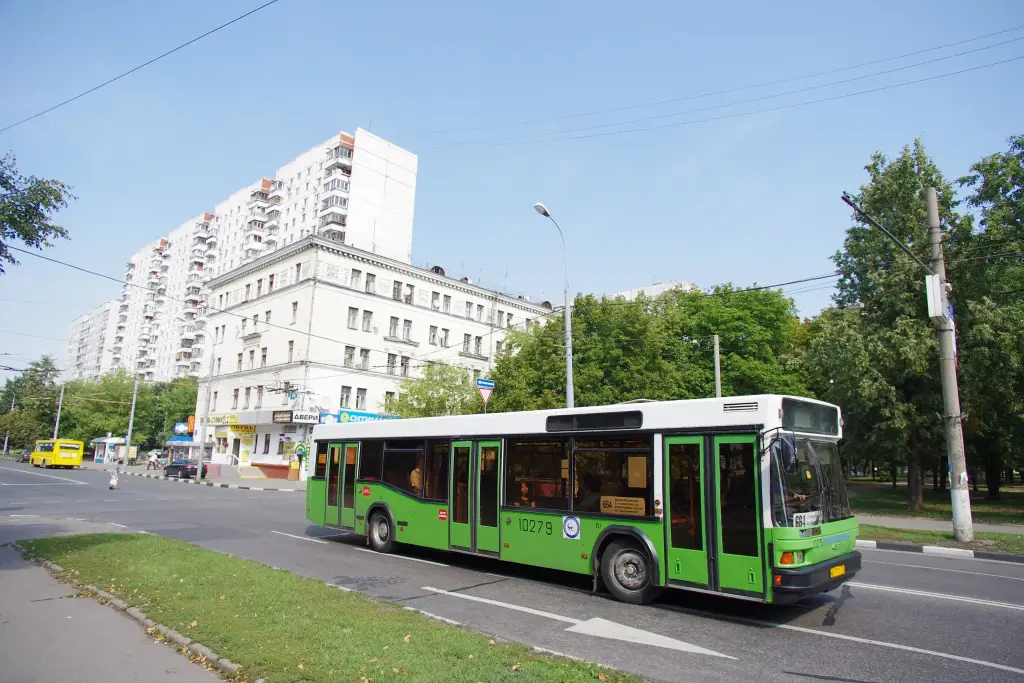
The MAZ-103 is a semi-low-floor city bus built by the Minsk Automobile Plant from 1996 to 2022. It grew out of the licensed MAZ-101 and became the base of a whole family of Belarusian buses, sold in dozens of cities from Belarus and Russia to Poland and Serbia.
MAZ-103 at a glance
| Maker | Minsk Automobile Plant (MAZ), Belarus |
|---|---|
| Production | 1996–2022 |
| Class | large city bus, semi-low-floor |
| Floor | level except a step at the rear door |
| Derived from | MAZ-101, built under a 1992 Neoplan licence |
| Modifications | about 50, city and suburban, diesel and gas |
| Suburban version | MAZ-103S, no rear door, 40 seats, nominal capacity 90 |
| Gas version | MAZ-103.965 on compressed natural gas, from 2017 |
| Facelifts | new body design from 2008, new interior in 2011 |
| Assembly outside Minsk | Nizhny Novgorod 2006–2007, Kragujevac 2011 |
| Successor | MAZ-303, introduced in 2021 |
The MAZ-103 is covered only by the Russian Wikipedia article; this page is based on one source.
History of the MAZ-103
From the MAZ-101 licence
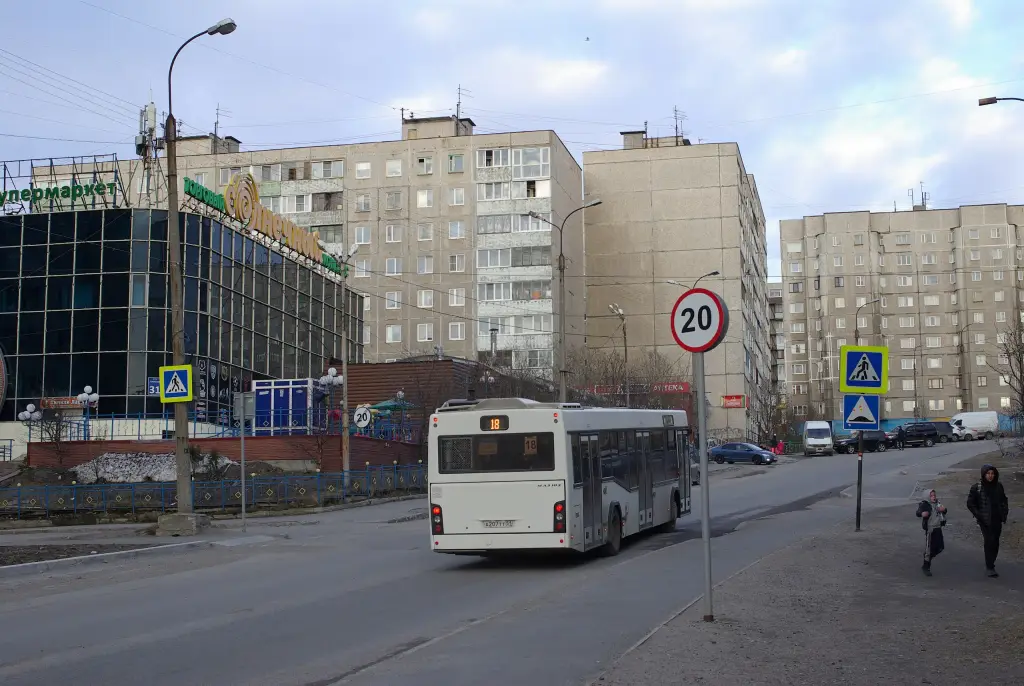
In 1992 the Minsk Automobile Plant signed a licence agreement with the German firm Neoplan. The result was the MAZ-101, but its price and its poor reliability on bad roads made it uncompetitive in the CIS, and only five buses of the licensed design were built. The plant decided to use domestic components and to adapt the construction to local conditions. The MAZ-103 that followed used a rear axle of MAZ’s own design instead of the portal axle of the MAZ-101; that produced a step in the rear doorway, while the other two doors stayed step-free, but it made the bus cheaper, more reliable and easier to repair.
City and suburban versions
In 1996 the plant added the suburban MAZ-103S, which had no rear door and up to 40 seats in the saloon, with a nominal capacity of 90 passengers. Over the life of the model about 50 modifications were created, city and suburban, with door layouts such as 2-2-0 and four rows of seats, and with either diesel or gas engines; the gas modifications carried the numbers 946, 965 and 966.
Restyling and the end of the line
From 2008 the MAZ-103 was made in a restyled body with a more modern finish, and in 2011 the interior was changed as well. From 2017 a version running on compressed natural gas, the MAZ-103.965, was added, and from the same year the interior was updated again. In January 2021, with the third-generation MAZ-303 going into series production, an order was signed to take the MAZ-103 out of production, although the bus continued to be built until 2022.
Assembly away from Minsk
Between 2006 and 2007 MAZ-103 buses were also assembled in Nizhny Novgorod by Samotlor-NN; those buses have a different front mask with smaller round headlights and a different interior finish, and a school version was made there too. In 2011 at least two examples were assembled in the Serbian city of Kragujevac by BIK. Special bodies on the MAZ-103 base included the MAZ-163 sanitary bus, the Samotlor-NN 5275 and the SAMCO City M76 BMXE, a narrowed version for Vietnam built in 2017.
Design and features
- Step only at the rear door: the change from the licensed portal axle to a MAZ rear axle kept the price down and made the bus easier to repair.
- One base, many bodies: some 50 modifications covered city, suburban, diesel and gas versions.
- Local assembly: the Nizhny Novgorod buses were recognisable by a front mask with smaller round headlights.
- Long service: the model stayed in production for 26 years and was sold in dozens of cities in Belarus, Russia, Ukraine, Kazakhstan, Romania, Serbia, Hungary and Poland.
MAZ-103 versions
- MAZ-103 (1996–2022): the standard city bus.
- MAZ-103S (1996): suburban version without the rear door, 40 seats.
- MAZ-103.965 (from 2017): compressed natural gas.
- 2008 restyling: a more modern body finish, followed by a new interior in 2011.
- MAZ-163: a sanitary bus on the MAZ-103.002 base, built in male and female versions for the St Petersburg water utility in 2003.
- SAMCO City M76 BMXE: a version for Vietnam, narrowed to local road standards, built in 2017.
The high-floor MAZ-104 was its cheaper stablemate, and the fully low-floor MAZ-203 replaced it as the main city bus; the smaller MAZ-206 covered medium routes. More are in the MAZ collection.
Sources
- MAZ-103, Russian Wikipedia: licence history, modifications, assembly, end of production