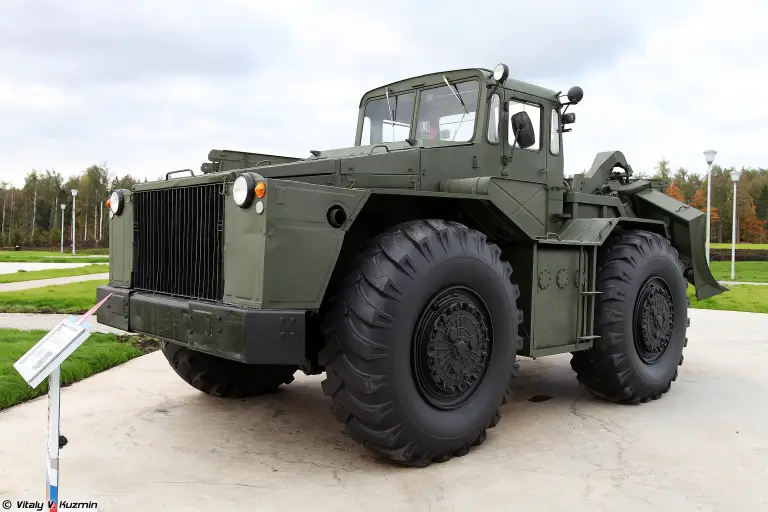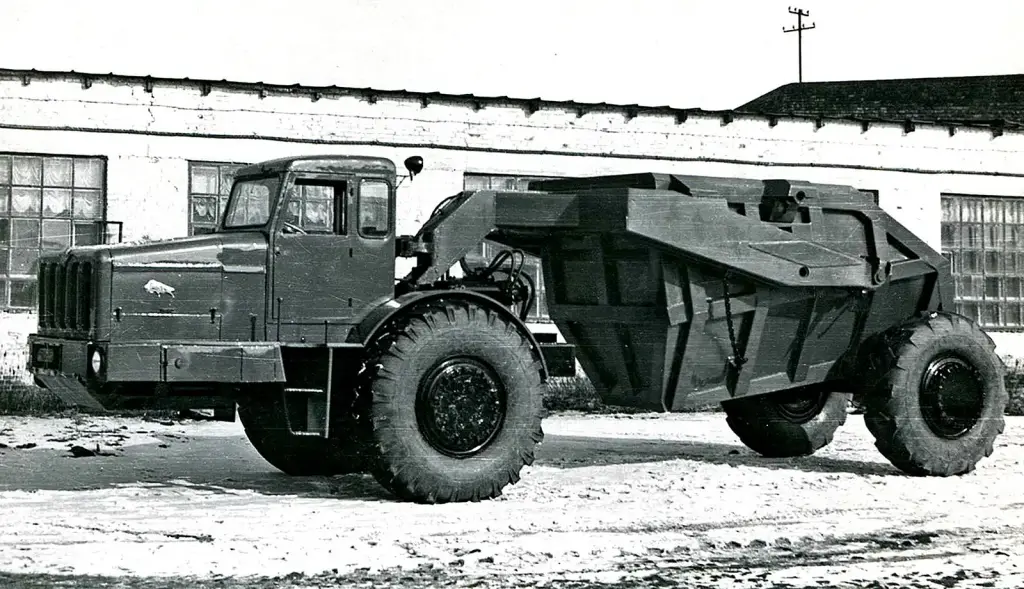
The MAZ-529 was the first Soviet single-axle tractor able to work with a wide range of trailers and attachments, for military and civil use alike. It was built at the Minsk Automobile Plant from 1959 to 1961 and then at the Mogilev plant until 1973.
MAZ-529 at a glance
| Maker | Minsk Automobile Plant 1959–1961, Mogilev plant from 1961 |
|---|---|
| Production | 1959–1973, as the MoAZ-529 after 1961 |
| Layout | single axle, articulated with the trailer |
| First prototype | 1956, with a single-seat cab |
| Engine | YaAZ-206 six-cylinder two-stroke diesel |
| Power | 165 hp, raised to 180 hp for production |
| Gearbox | five-speed manual |
| Tyres | 21.00-28, 1,790 mm in diameter |
| Top speed | 40 km/h |
| Train weight | 34 tonnes with the D-357 scraper |
| Suspension | none; the tyres alone absorb the shocks |
History of the MAZ-529
An idea from America
In the 1950s the United States began building special machines with an articulated frame made of two parts, a single-axle tractor and an attachment. Such machines were very mobile, had a small turning circle and still coped well with rough ground, and they could serve both industry and the army. The Soviet Union started work on similar machines and gave the task to the SKB-1 design office of the Minsk Automobile Plant. The first customer was the Ministry of Defence, which needed mobile missile installers, refuelling vehicles for those missiles and construction machines.
Prototype and production
The first prototype was built in 1956 with a single-seat cab and the YaAZ-M206 diesel of 165 hp. Trials called for changes, and the revised MAZ-529 was shown in 1958 with a boosted engine of 180 hp and a two-seat cab; it was recommended for production. In 1961 production moved to Mogilev, to the Kirov plant of lifting and transport equipment, the future MoAZ. The tractors were built in Mogilev while the scrapers and rollers for them were made in Mozyr.
With missiles and on building sites
In the army the tractors worked with the 8U210 installers for the R-12 and R-14 missiles, and special military cranes and rocket-fuel tankers were developed for them. In industry the scrapers and rollers that worked with the MAZ-529 became indispensable in road and industrial construction. A variant for tropical climates was offered with a cab under a soft folding canopy. In the late 1960s the Meliormash design office in Minsk developed the DE-7 snow-clearing machine for airfield runways, which the MoAZ-529 towed from 1972.
The end of the line
In 1965 the tractors were modernised and became the MoAZ-529I. In 1969 the new MoAZ-546P took over from it, but series production of the 529 continued in Mogilev until February 1973. Several tractors survive, most of them in storage; one with a scraper stands as a monument to the builders of KamAZ in Naberezhnye Chelny, unveiled in 1981, and another is shown in the agricultural display of the Victory Park in Saratov.
Design and features
- No suspension: the huge tyres of 1,790 mm diameter were the only damping.
- Jockey wheel: a small steered wheel at the front let the tractor move about the yard without a trailer.
- Articulated train: the tractor and its attachment formed one machine, with a 34-tonne train weight with the D-357 scraper.
- Missile work: the tractors served the 8U210 installers of the R-12 and R-14 missiles.
- A first of its kind: the single-axle tractor can formally be called the first Soviet front-wheel-drive vehicle.
MAZ-529 versions
- Prototype (1956): single-seat cab and the YaAZ-M206 of 165 hp.
- MAZ-529 (from 1959): two-seat cab and a boosted engine of 180 hp.
- MoAZ-529 (from 1961): the same tractor built in Mogilev.
- MoAZ-529I (from 1965): modernised version.
- Tropical version: cab with a soft folding canopy.
- DE-7 snow clearer: airfield machine towed by the MoAZ-529 from 1972.
The MAZ-529 was the first of the Minsk single-axle tractors and led to the MoAZ-546P; the MAZ-7310 later took over heavy military transport work at MAZ. More are in the MAZ collection.
Sources
- MAZ-529, English Wikipedia: origins, technical data, MoAZ production
- MAZ-529, Russian Wikipedia: development, military use, modernisation, survivors