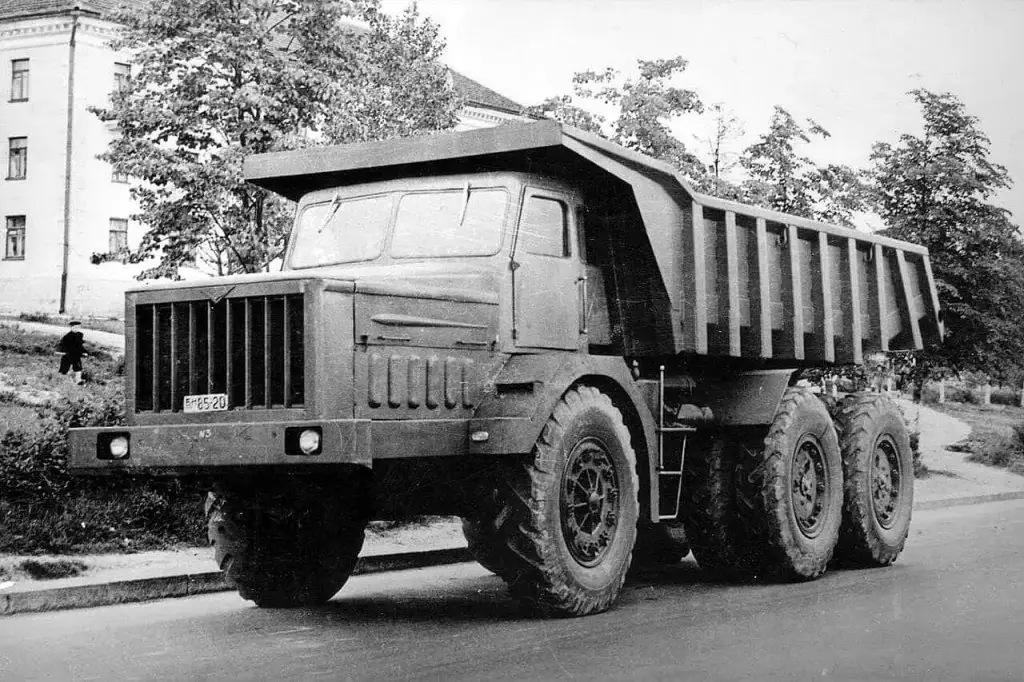
The MAZ-530 was a heavy Soviet quarry tipper with a 6×4 layout, built at the Minsk Automobile Plant from 1957 to 1960 and then at the BelAZ works near Minsk until 1963. It was the first and only large 6×4 quarry tipper of the USSR, yet only about thirty were made and none survives.
MAZ-530 at a glance
| Maker | Minsk Automobile Plant 1957–1960, BelAZ 1960–1963 |
|---|---|
| Layout | 6×4 quarry tipper |
| Engine | D-12-450 V12 diesel, 450 hp |
| Payload | 15 tonnes more than the MAZ-525 |
| Rear axles | two driven axles on equalising suspension |
| Frame | box-section beam |
| Tyres | 18.00-32 oversize |
| First prototype | early March 1957 |
| Award | Grand Prix at the Brussels world exhibition, 1958 |
| Built | about thirty by 1963 |
| Survivors | none |
History of the MAZ-530
A bigger brother for the MAZ-525
In the 1950s the Soviet Union built the two-axle MAZ-525 quarry tipper with a capacity of 25 tonnes, but its output was no longer enough. In the mid-1950s the MAZ plant began work on a more capable quarry tipper. The new MAZ-530 kept almost the same classic layout as the MAZ-525 but became three-axle, which gave it a much larger scoop-shaped dump body and 15 tonnes more payload. Because it was far heavier and more productive, it received a more powerful V12 diesel, the D-12-450 of 450 hp. Its technical features included two driven rear axles on equalising suspension, a box-section frame beam and oversize 18.00-32 tyres.
Prototype and Brussels
The first prototype was ready in early March 1957 and went on a test run; by the summer it was the most notable exhibit in the Mechanical Engineering pavilion of the All-Soviet Agricultural Exhibition in Moscow. In 1958 the MAZ-530 was shown at the World Industrial Exhibition in Brussels, where it was awarded the Grand Prix.
Hand-built, then moved to BelAZ
The MAZ-530, like its smaller brother the MAZ-525, was assembled by hand, and the plant could not build large quarry tippers in greater numbers. The specialisation of Soviet car plants also directed MAZ towards heavy road lorries of a new generation and military wheeled chassis. In 1960 production moved to the new BelAZ works in Zhodino near Minsk. Contrary to what some sources say, the tippers kept the MAZ name at the new plant, and because they were still hand-built, two identical machines were rare. By 1963 about thirty MAZ-530s had been built at MAZ and BelAZ.
Why it ended
In 1963 the MAZ-530 was taken out of production: tests found it not the best machine for quarry work, because of its very large turning circle and the difficulty of manoeuvring it. Comparable tippers were built only in the United States. The MAZ-530 had good prospects but arrived too late, when its classic layout was already outdated and the BelAZ design office was starting on fundamentally new quarry tippers of its own. Thirty machines were a tiny number for a country the size of the USSR, and for that reason none was exported. Most were replaced by newer tippers in the late 1960s and early 1970s, and no example remains.
Design and features
- 450 hp V12: the D-12-450 diesel was needed for a machine far heavier than the MAZ-525.
- Three axles: the 6×4 layout carried a much larger dump body and 15 tonnes more payload.
- Oversize tyres: 18.00-32 tyres and two driven rear axles on equalising suspension.
- Grand Prix: the tipper won the top award at the Brussels world exhibition in 1958.
- Hand-built: assembly was manual, so almost no two machines were identical.
MAZ-530 versions
- MAZ-530 (1957–1960): built at the Minsk Automobile Plant.
- MAZ-530 at BelAZ (1960–1963): the same machine built at Zhodino, still under the MAZ name.
The MAZ-530 grew out of the 25-tonne MAZ-525 and was followed at BelAZ by a new generation of quarry tippers; the MAZ-503 covered the smaller tipper class at Minsk. More are in the MAZ collection.
Sources
- MAZ-530, English Wikipedia: production years, engine, Brussels award, total built
- MAZ-530, Russian Wikipedia: development, hand assembly, reasons for withdrawal