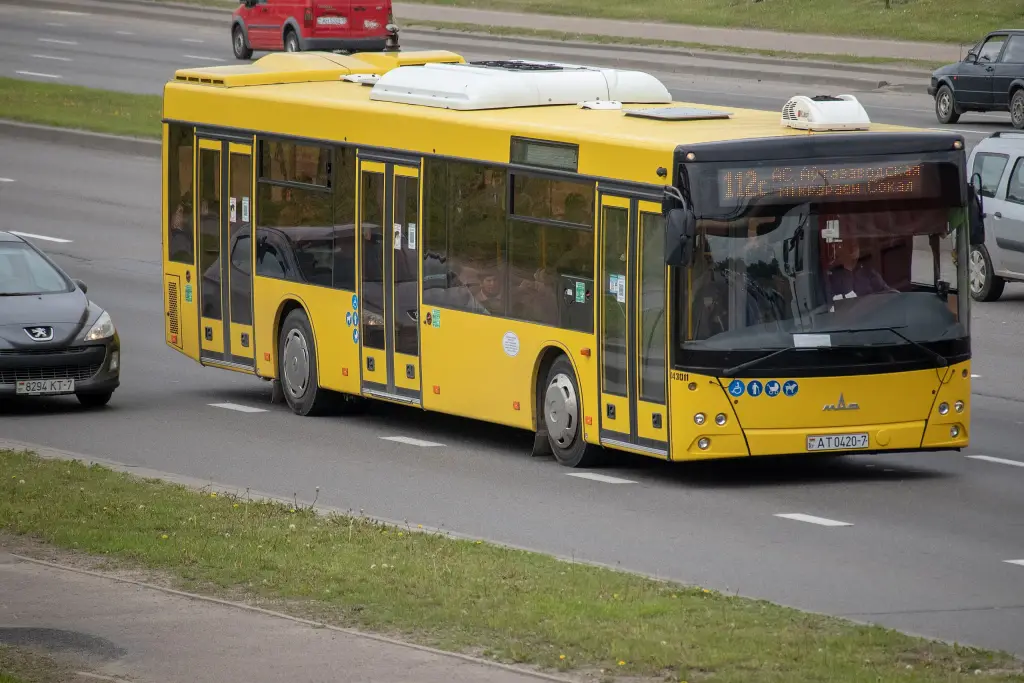
The MAZ-203 is a fully low-floor single-decker city bus of the Minsk Automobile Plant and the second generation of MAZ city buses. It succeeded the MAZ-103 in 2006, has been sold in Poland, Ukraine, Russia, Romania and Serbia, and by the summer of 2023 more than 4,000 had been built.
MAZ-203 at a glance
| Maker | Minsk Automobile Plant (MAZ), Belarus |
|---|---|
| Production | since 2006, planned to end with the third generation |
| Class | large city bus, fully low-floor |
| Floor height | 330 mm above the road over the whole floor |
| Predecessor | MAZ-103 |
| Body | galvanised steel frame with glued fibreglass panels and glass |
| Engines | MAN, Mercedes-Benz and Minsk Motor Plant; MAZ-Weichai only from 2022 |
| Brakes | disc brakes with air actuation, ABS and ASR |
| Gas versions | compressed or liquefied natural gas, from 2017 |
| Trolleybus | MAZ-203T from 2008; MAZ-ETON T203 |
| Built | more than 4,000 by the summer of 2023 |
History of the MAZ-203
A second-generation city bus
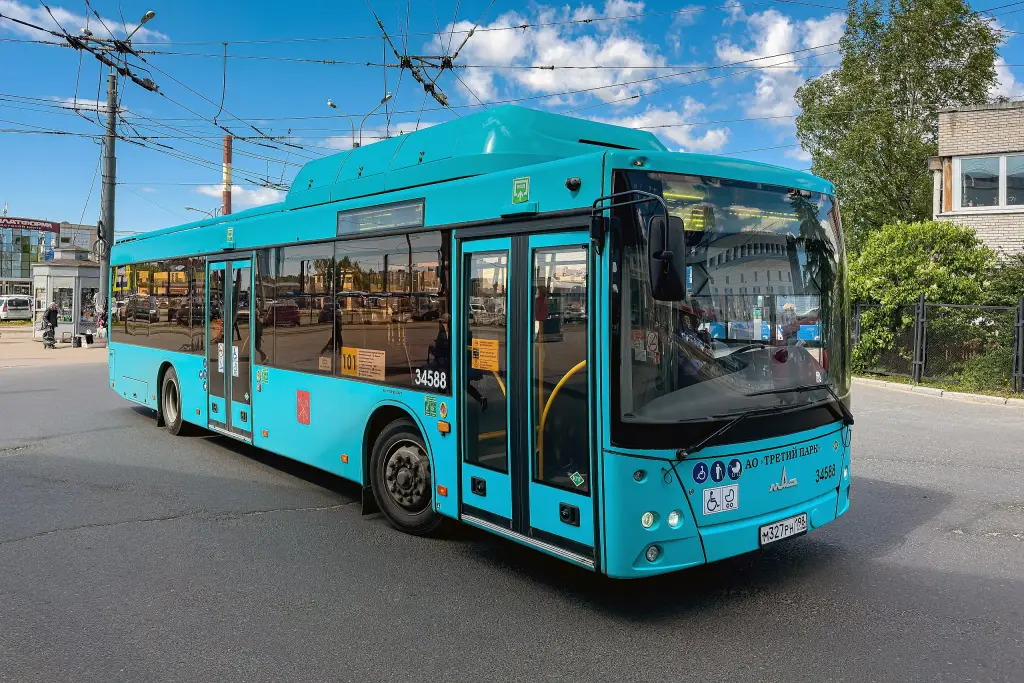
The MAZ-203 followed the MAZ-103 as the second generation of MAZ city buses. Its floor is 330 mm above the road over its whole length, unlike the MAZ-103, whose floor rose at the rear platform. The body follows the construction used by all second-generation MAZ buses, the MAZ-256, MAZ-206, MAZ-251 and MAZ-171: a frame of galvanised rectangular tubes into which fibreglass panels and glass are glued, without cover profiles over the joints. The bus has a panoramic windscreen and, in the basic version, a front door as wide as the others. Later a version with a partition in the front door was developed for Minsk, and the plant went on to offer narrow, wide and no-partition variants; operators in Kazakhstan, Serbia and western Europe chose the version without a partition. A suburban version has no rear door and can be fitted with soft seats.
Production and deliveries
Small-series production began in the second quarter of 2006. The first large batch of fifty buses was ordered by Kazan and built in the first half of 2007, and in Belarus the first city to receive the MAZ-203 was Gomel. Mosgortrans tested the bus in 2008. Rostov-on-Don took a batch of 75 ahead of the 2018 World Cup, and in 2022 St Petersburg operators received 889 MAZ-203 and MAZ-206 buses running on compressed and liquefied gas; those buses introduced a new front mask, first seen on the MAZ-206 delivered to Moscow in 2021. From September 2022 buses with the new mask reached Grodno and Gomel.
Engines and running gear
For a long time the MAZ-203 was fitted either with imported MAN or Mercedes-Benz engines meeting Euro 4, Euro 5 and Euro 6 with an automatic gearbox, or with engines from the Minsk Motor Plant. From 2022, after sanctions imposed on Belarus by the European Union and the United States, only Belarusian-Chinese MAZ-Weichai engines were used. The bus has a portal rear axle and portal front axle, disc brakes on all wheels with air actuation, and ABS and ASR. From 2017 versions running on compressed natural gas, with the cylinders in a compartment on the roof, and on liquefied natural gas, with the tank in the rear overhang and no rear window or rear seats, have been offered. The MAZ-203 meets UNECE Regulations 85 and 107, which allows it to be sold in the European Union, and bus operators in Poland and Germany have bought it. It won a special prize of the professional jury at the Motor Show 2005 in Moscow and was named best large city bus at the SIA-2006 show in Kyiv.
Trolleybuses and the third generation
A trolleybus, the MAZ-203T, has been built on the same body since 2008. The MAZ-ETON T203, with electrical equipment from the Belarusian firm Eton, followed the same year. In Serbia MAZ worked with Bus Industries Kragujevac on the BIK-203, built on the MAZ-203 platform. With the third generation of MAZ buses going into full production, the second generation, including the MAZ-203, is to be phased out.
Design and features
- 330 mm floor: the whole floor is level from front to back, which the MAZ-103 could not offer.
- Glued body: fibreglass panels and glass are bonded into a galvanised steel frame, without joint covers.
- Choice of front door: wide, with a narrow partition or without one, to the operator’s order.
- European approval: the bus meets UNECE Regulations 85 and 107 and has been sold in Poland and Germany.
- Gas versions: compressed gas cylinders on the roof or a liquefied gas tank in the rear overhang.
MAZ-203 versions
- MAZ-203: the standard city bus.
- Suburban version: no rear door, optional soft seats.
- MAZ-203T (from 2008): trolleybus on the same body.
- MAZ-ETON T203: trolleybus with Eton electrical equipment.
- BIK-203: Serbian-built version on the MAZ-203 platform.
- Gas versions (from 2017): compressed natural gas and liquefied natural gas.
The MAZ-203 replaced the MAZ-103 in the MAZ range and was joined by the smaller MAZ-206. More are in the MAZ collection.
Sources
- MAZ-203, English Wikipedia: second generation, export markets, trolleybus and BIK-203
- MAZ-203, Russian Wikipedia: body construction, engines, deliveries, gas versions