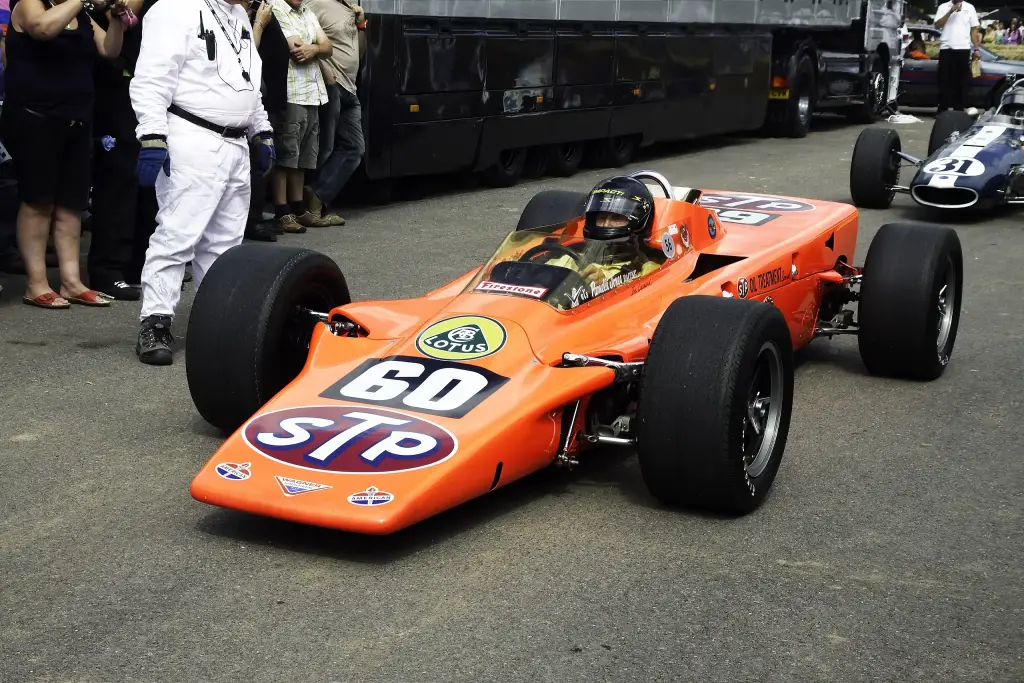
The Lotus 56 was a gas turbine-powered, four-wheel-driven racing car designed by Maurice Philippe as Team Lotus’s STP-backed entry in the 1968 Indianapolis 500. All three cars entered and all three retired, Joe Leonard’s expiring while he led with only eight laps to go.
Lotus 56 at a glance
| Built | 1968, three Indianapolis cars |
|---|---|
| Designer | Maurice Philippe |
| Engine | ST6 gas turbine, developed from the STP-Paxton Turbocar |
| Drive | four-wheel drive |
| Body | wedge shape instead of a cigar |
| 1968 Indy 500 | three cars, all retired |
| Pole | Joe Leonard |
| Drivers | Graham Hill, Joe Leonard, Art Pollard |
| Formula One version | 56B, three races in 1971 |
| Legacy | wedge shape carried into the Lotus 72 |
Based on one source (English Wikipedia).
History of the Lotus 56
The 56 used a modified version of the ST6 gas turbine fitted to the STP-Paxton Turbocar, the “Silent Sam” that had almost won in 1967, but the car itself was a new and more advanced design with a distinctive wedge-shaped body instead of a cigar. USAC had brought in rules aimed at handicapping turbine cars by drastically reducing the air intake size; the 56 answered with sophisticated suspension, four-wheel drive as on Silent Sam but lighter, and advanced aerodynamics.
Development took place at a difficult time for Team Lotus. Jim Clark, who had briefly tested the car, was killed in a Formula Two race in Germany, and his replacement, Mike Spence, was killed at Indianapolis while testing the 56. Three cars were entered for the race, for Graham Hill, Joe Leonard and Art Pollard, with Leonard on pole. Hill’s car lost a wheel, Pollard’s fuel pump drive shaft failed, and Leonard, who was leading, suffered the same failure with a handful of laps left.
The turbine cars were more evenly matched with the top contenders than in 1967, much of which was down to aerodynamics and chassis design rather than the engine. USAC then imposed further restrictions that effectively removed turbine cars from competition and subsequently banned both turbines and four-wheel drive. For the second year running an STP turbine car had led within a few laps of the finish and failed to win. Art Pollard returned in 1969 with an Offenhauser-powered 56, qualified on the fourth row and retired after six laps.
Chapman had developed the 56 with Formula One in mind, hoping for one design to race at Indianapolis and in Grands Prix. The Formula One version, the 56B, had front and rear wings and extra fuel tanks. Emerson Fittipaldi first drove it in the non-championship 1971 Race of Champions at Brands Hatch, where it was far the fastest car in wet practice but lost in the midfield in the dry race. At the International Trophy it lasted three laps before suspension failure, Dave Walker took it from 22nd to 10th in five laps of a wet Dutch Grand Prix before sliding off, and Fittipaldi brought it home eighth in Italy. The 56 never won, but with Jim Hall’s Chaparrals it showed the importance of aerodynamics and set the mould for open-wheel racing cars for the next decade; the Lotus 72 used the same wedge nose and won three world championships.
Design and features
- Gas turbine: an ST6 unit derived from the STP-Paxton Turbocar.
- Four-wheel drive: traction to all four wheels, as on Silent Sam.
- Wedge body: a new shape that replaced the cigar profile.
- Aerodynamic focus: designed to recover the power lost to USAC’s intake restrictions.
- 56B: the Formula One version, with wings and extra tanks.
Lotus 56 versions
- Lotus 56 (1968): three Indianapolis cars with the ST6 turbine.
- Lotus 56B (1971): Formula One version with wings and additional fuel tanks.
The 56’s wedge shape led to the Lotus 72, and its four-wheel-drive idea was tried again in the Lotus 63. The Indianapolis cars followed the Lotus 38. More cars are in the Lotus collection.
Sources
- Lotus 56, English Wikipedia: design, 1968 Indy 500, 56B, legacy