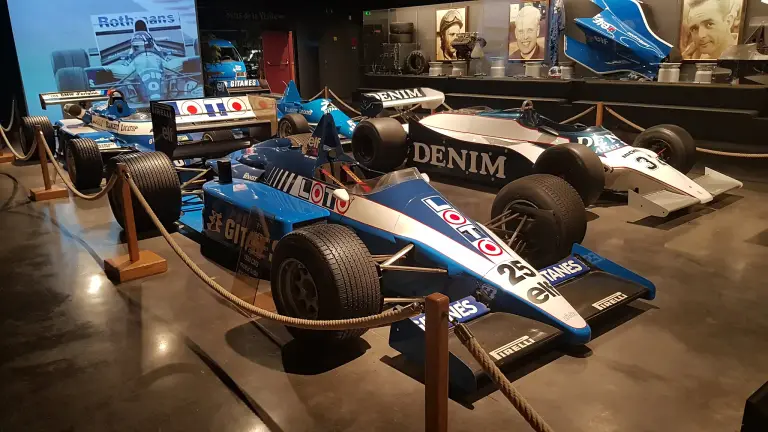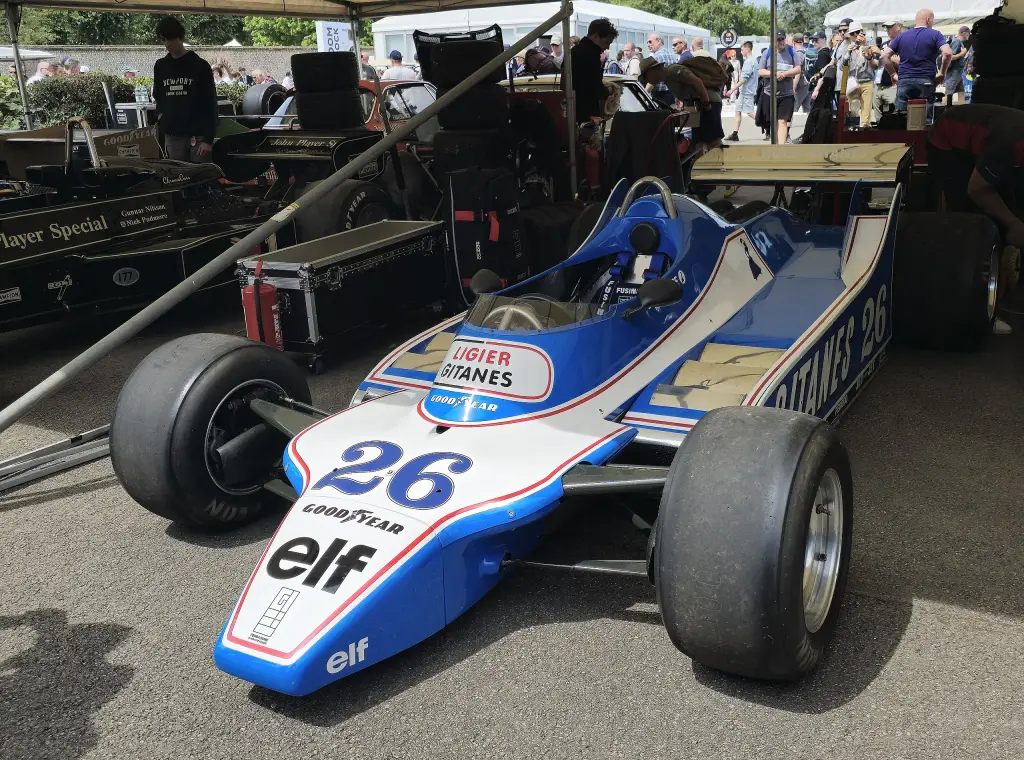
The Ligier JS11 was a ground-effect Formula One car designed by Gérard Ducarouge for the French team Ligier. Powered by a Ford Cosworth DFV mated to a Ligier-built gearbox, it raced in the 1979 and 1980 World Championships and was immediately competitive.
Ligier JS11 at a glance
| Designer | Gérard Ducarouge |
|---|---|
| Engine | Ford Cosworth DFV |
| Gearbox | Ligier in-house |
| Seasons | 1979, 1980 |
| Wins | five |
| Pole positions | seven |
| Points scored | 127 |
| 1979 result | third in the Constructors’ Championship |
| 1980 result | second in the Constructors’ Championship |
| Main drivers | Jacques Laffite, Patrick Depailler, Jacky Ickx, Didier Pironi |
| 1981 successor | Ligier JS17 |
This page is based on English Wikipedia only, so the figures could not be cross-checked against a second source.
History of the Ligier JS11
The 1979 car
Driven by Jacques Laffite, the JS11 won the first two races of the 1979 season and kept scoring consistently. Patrick Depailler added a further win in Spain, and the team finished third in the Constructors’ Championship behind Ferrari and Williams. Depailler was injured halfway through the season in a hang-gliding accident and was replaced by Jacky Ickx, who struggled to match the car and his teammate and left at the end of the year with only a handful of points.
The chassis problem
The car’s troubles began at the fourth race of 1979 at Long Beach. It produced so much downforce that the aluminium chassis could not cope: the chassis began to flex, the skirts lifted off the ground and the ground-effect suction was lost. The problem hampered the team all season and could not be solved in time for Laffite to challenge the Ferraris of Jody Scheckter and Gilles Villeneuve, and later the dominant Williams of Alan Jones.
The JS11/15 of 1980
For 1980 the car was updated as the JS11/15 with improved aerodynamics and better ground effects. Didier Pironi replaced Depailler. The car was again fast, but the Brabham BT49 and Williams FW07 proved the cars to beat, with Alan Jones taking the title. Ligier still scored two wins, and the flexing had been cured, but the ground effect now loaded the suspension and wheel hubs so heavily that stress fractures appeared, costing the team chances under hard braking. Ligier finished second in the Constructors’ Championship ahead of Brabham, and the design evolved into the JS17 for 1981. The JS11 was also used as a primary test car for Michelin’s tyre experiments.
The “clapet”
To control the excessive downforce, Ducarouge devised a system of flaps inside the venturi tunnels, called the “clapet”, which opened at a certain pressure. Because it was a movable aerodynamic device, the team kept it secret until the technical illustrator Giorgio Piola photographed it at the final race of 1980 at Watkins Glen, after one of the cars had been repaired following a shunt.
Design and features
- Ground effect: full-length venturi tunnels generated the downforce that made the car fast and eventually overstressed its chassis.
- Cosworth DFV: the standard customer V8 of the era, paired with a gearbox built in-house at Ligier.
- Race-winning start: victories in the first two rounds of 1979 established Ligier as a front-running team.
- Development potential: updated into the JS11/15 for 1980 and then into the JS17 for 1981.
- Pop-culture fame: the JS11 appeared in the first Transformers toy line as the alternate mode of the Autobot Mirage, with the Gitanes logo respelled “Citanes”.
Ligier JS11 versions
- JS11 (1979): the original car with the aluminium chassis that flexed under load.
- JS11/15 (1980): revised aerodynamics, improved ground effect and a stronger structure.
- JS17 (1981): the further development that followed the JS11.
- Michelin test car: a JS11 was used by Michelin to develop its tyres.
The JS11 followed Ligier’s first Formula One car, the JS5, and was replaced on track by the JS27 later in the decade. The marque’s road cars are in the Ligier collection.
Video: Didier Pironi Monaco On Board Lap 1980
Video on YouTube.
Sources
- Ligier JS11, English Wikipedia: design, races, results, clapet, popular culture