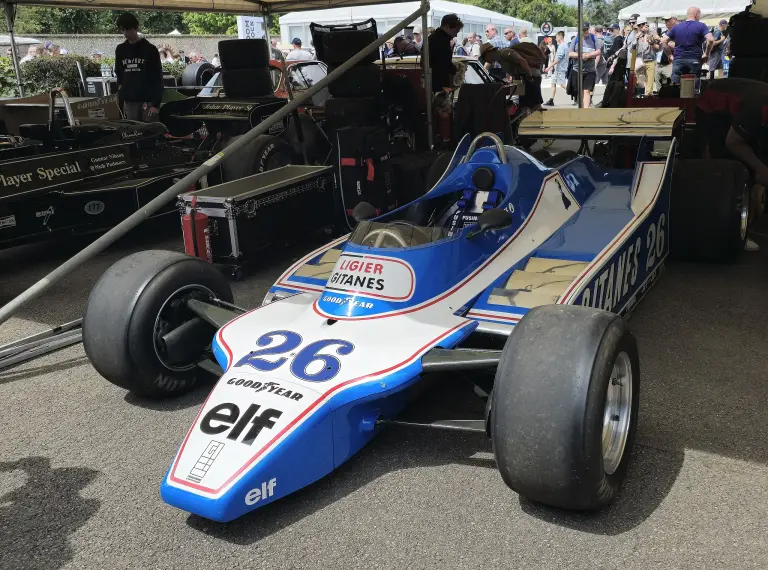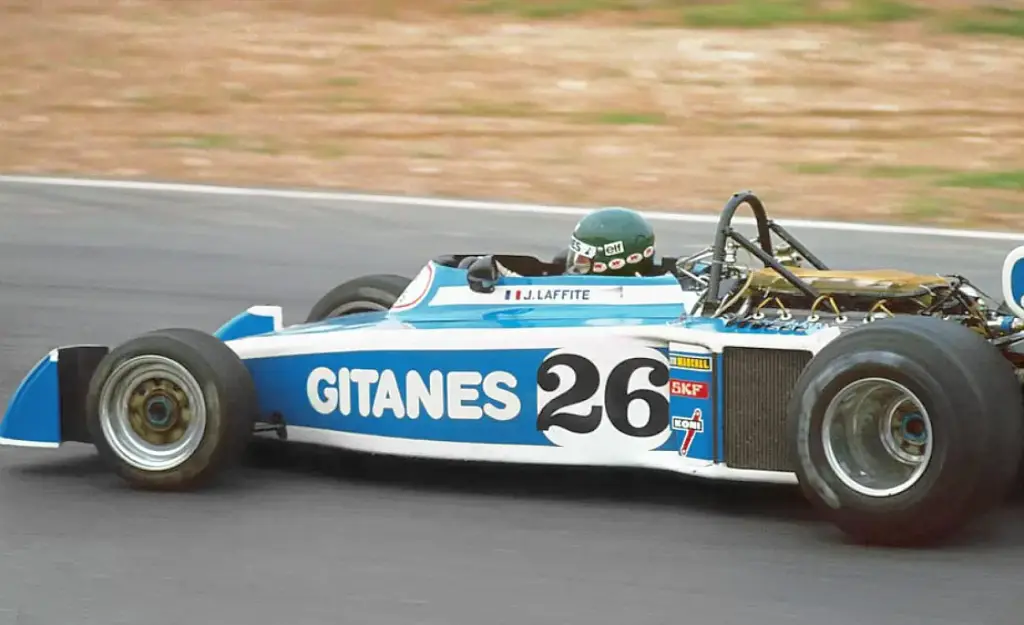
The Ligier JS5 was the first Formula One car built by Ligier. Designed by Gérard Ducarouge, it competed in the 1976 season, scored 20 points and finished sixth in the Constructors’ Championship, and it gave Jacques Laffite and the team their first pole position at Monza.
Ligier JS5 at a glance
| Designer | Gérard Ducarouge, with Michel Beaujon |
|---|---|
| Engine | Matra MS73 V12 |
| Chassis | conventional monocoque, long wheelbase |
| Season | 1976 |
| Points | 20 |
| Constructors’ position | sixth |
| Driver | Jacques Laffite |
| First race | Brazilian Grand Prix, 1976 |
| Best result | second in Austria |
| First pole | Italian Grand Prix, Monza |
| Nickname | “Teapot” |
This page is based on English Wikipedia only, so the figures could not be cross-checked against a second source.
History of the Ligier JS5
Background
Guy Ligier had become wealthy through his construction company and had briefly raced in Formula One as a driver in the 1960s. He founded a race car company in 1969 that built sportscars, including the JS2, which was raced at Le Mans in 1972. In late 1974, with backing from the French tobacco company SEITA, he recruited Gérard Ducarouge from Matra and began preparing a Formula One entry.
The car
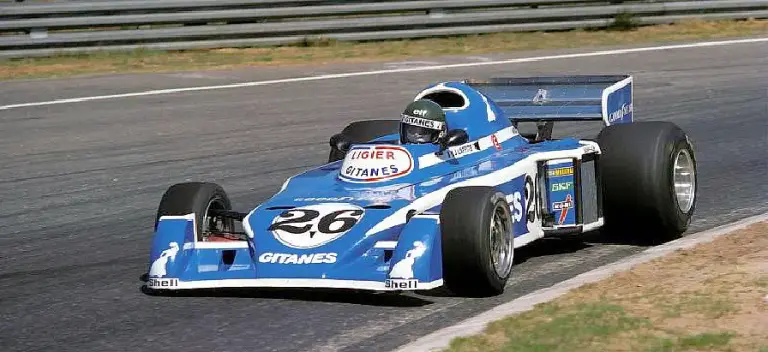
Ducarouge, assisted by Michel Beaujon, drew up a conventional monocoque with a long wheelbase, designated the JS5 and powered by the Matra MS73 V12 that had been used in sportscar racing for several seasons. It was completed in October 1975 and exhibited at SEITA’s main offices in Paris; the following month testing began at the Circuit Paul Ricard. Ligier signed Jacques Laffite to drive, after briefly considering the experienced Jean-Pierre Beltoise.
The Teapot
The early races of 1976 were run with a large airbox that earned the car the nickname “Teapot”. Changes to the regulations after the 1976 Spanish Grand Prix forced it to be drastically reduced in size, and the rear wing was moved forward. Aerodynamics were improved again when the second JS5 chassis was built, with a substantially less curved body than the first.
Racing history
The JS5 made its debut at the opening race of 1976 in Brazil, where Laffite qualified 11th and retired, as he did in South Africa. At Long Beach, from 12th on the grid, he drove it to fourth place and Ligier’s first points. He took his first podium in Belgium, third from sixth on the grid, and followed it with another fourth in Sweden. A new chassis was completed by the Austrian race, where Laffite finished second from fifth; in Italy he was third after qualifying on pole. Ligier ended the season sixth with 20 points, and Laffite was seventh in the Drivers’ Championship.
Design and features
- Matra V12: a proven sportscar engine that gave the small team a competitive power unit.
- Long wheelbase: a conventional monocoque layout aimed at stability rather than experiment.
- The Teapot airbox: a huge intake that was cut down after the 1976 Spanish Grand Prix.
- First pole: Laffite put the JS5 on pole at Monza, the team’s first in Formula One.
Ligier JS5 versions
- Chassis 1: the original car with the large Teapot airbox and the more curved bodywork.
- Chassis 2: built during 1976 with revised, less curved aerodynamics.
- Later specification: smaller airbox and a forward-mounted rear wing after the Spanish Grand Prix.
The JS5 was followed in Formula One by the ground-effect JS11, and its engine supplier’s road cars came from the same company that built the JS2 sportscar. More Ligier cars are in the Ligier collection.
Video: [F1C] Ligier Gitanes-Matra JS5 “Teapot” @Zandvoort
Video on YouTube.
Sources
- Ligier JS5, English Wikipedia: design, background, races, results