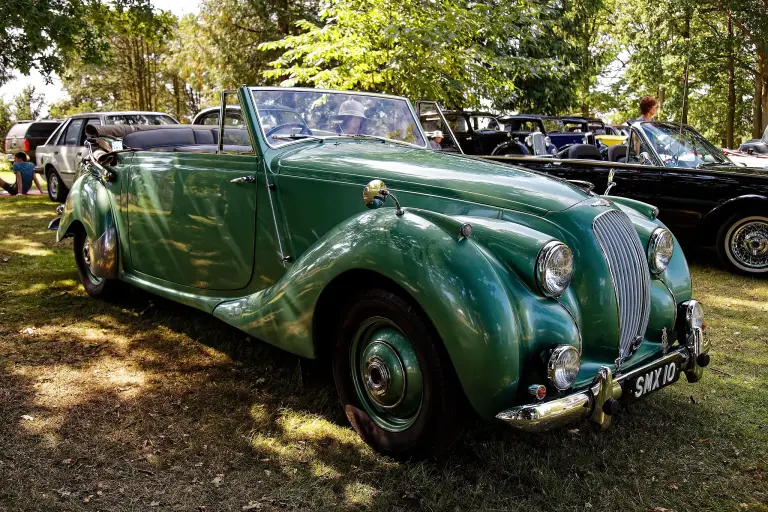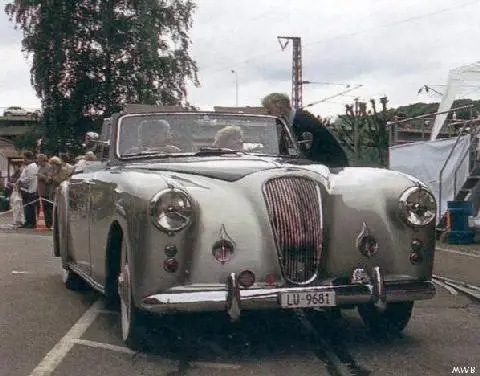
The Lagonda 3-Litre was produced by Aston Martin Lagonda from 1953 to 1958. It was the second Lagonda of the David Brown era, after the 2.6-Litre, and used a larger 2.9-litre version of the Bentley-designed twin-cam straight-six. The car came as a two-door coupé or drophead coupé by Tickford and, from 1954, as a four-door saloon.
Lagonda 3-Litre at a glance
| Maker | Aston Martin Lagonda, Newport Pagnell |
|---|---|
| Production | 1953–1958 |
| Engine | 2,922 cc straight-six, twin overhead camshafts |
| Power | 140 bhp (142 PS) |
| Carburettors | two SU |
| Gearbox | four-speed manual by David Brown; floor lever from the 1955 Mark II |
| Body styles | two-door coupé and drophead coupé by Tickford; four-door saloon from 1954 |
| Chassis | separate cruciform-braced steel chassis |
| Suspension | independent all round: coil springs at the front, torsion bars and a swing axle at the rear |
| Brakes | Lockheed drum, servo assisted, 12 in front and 11 in rear |
| Performance | 104 mph and 0–60 mph in 12.9 seconds (1956 road test) |
| Built | 270 of all three body styles |
History of the Lagonda 3-Litre
Background
Lagonda was founded in 1906 by Wilbur Gunn and named after Lagonda Creek in Ohio. By the 1920s it had moved into the luxury class, competing with Rolls-Royce, Bentley and Daimler. After a collapse in 1935 the company changed hands and W. O. Bentley, recently departed from Rolls-Royce, joined as chief engineer. Bentley designed a powerful twin-cam straight-six, but the war kept it out of production. In 1947 David Brown bought Lagonda and merged it with Aston Martin, largely to obtain that engine for his sports cars. The first David Brown Lagonda, the 2.6-Litre, appeared in 1948.
Engineering
The 3-Litre was technically very close to the 2.6-Litre. The straight-six grew to 2,922 cc, output rose from 107 to 142 PS, and two larger SU carburettors were fitted. The engine kept two overhead camshafts and two valves per cylinder and drove through a four-speed David Brown gearbox. The chassis was the same X-shaped steel frame Bentley had designed before the war, with a steel floor pan carrying the body. All four wheels were independently suspended, unusual at the time, with coil springs at the front and torsion bars at the rear. The Lockheed drum brakes had inboard rear drums, and a Jackall hydraulic jacking system was fitted.
Body and production
The body was new and drawn by Frank Feeley, who had styled the 2.6-Litre. It was a ponton design with the front wings integrated into the body, 20 cm longer than its predecessor and about the length of a Jaguar Mark VII. The front doors were rear-hinged, among the last new cars to use that arrangement. Tickford of Newport Pagnell, bought by David Brown in 1955, built all bodies by hand; there were no special bodies from independent coachbuilders. The new shape had first appeared in autumn 1953 on 16 special 2.6-litre chassis sold by the London dealer Brooklands of Bond Street, ten cabriolets and six coupés. A four-door saloon joined the range in 1954, the two-door coupé was dropped in 1956 and the convertible ended in 1957 after about 55 cars, the saloon following in 1958. Only 270 cars of the three body styles were sold, partly because the 3-Litre was more expensive than its rivals. The interior was luxurious, with polished walnut, leather seats, a heater, a radio and built-in hydraulic jacks as standard. A 1956 test by The Motor recorded 104 mph, 0–60 mph in 12.9 seconds and 19.9 miles per imperial gallon, the car costing £2,993 including £998 in taxes.
Design and features
- Bentley six: the 2,922 cc twin-cam engine with two SU carburettors, giving 142 PS.
- Independent suspension all round: coil springs at the front, torsion bars at the rear, plus the Jackall jacking system.
- Tickford bodies: every body was hand-built by Tickford of Newport Pagnell.
- Luxury interior: walnut veneer, leather seats, heater, radio and built-in jacks as standard.
- Rarity: only 270 cars of all three body styles were sold.
Lagonda 3-Litre versions
- Two-door coupé: the original body, built until 1956.
- Drophead coupé: about 55 cars, production ending in 1957.
- Four-door saloon: added in 1954 and built until 1958.
- Mark II: the 1955 version with a floor-mounted gear lever.
- Brooklands of Bond Street specials: 16 cars on 2.6-litre chassis with the new 3-Litre body, ten cabriolets and six coupés.
The 3-Litre replaced the Lagonda 2.6-Litre and was the last David Brown Lagonda before the Rapide of 1961. More cars are in the Lagonda collection.
Sources
- Lagonda 3-Litre, English Wikipedia: engines, bodies, performance, production
- Lagonda 3 Litre, German Wikipedia: background, chassis, body design, specials