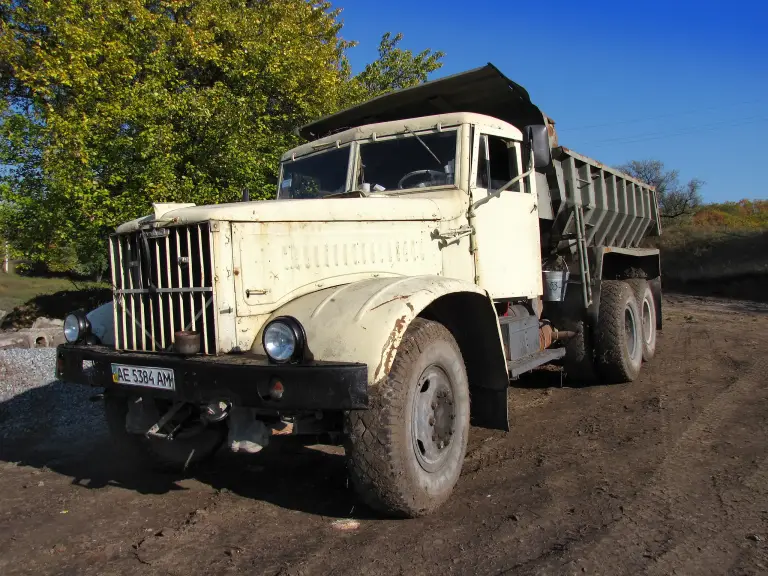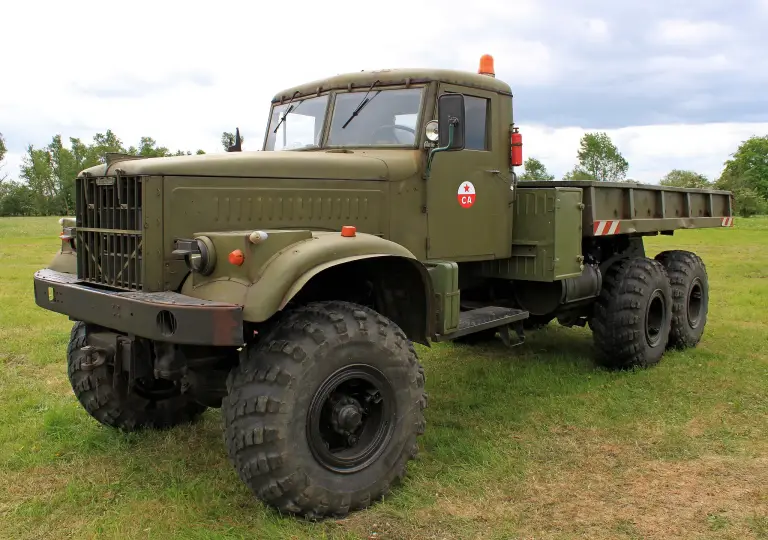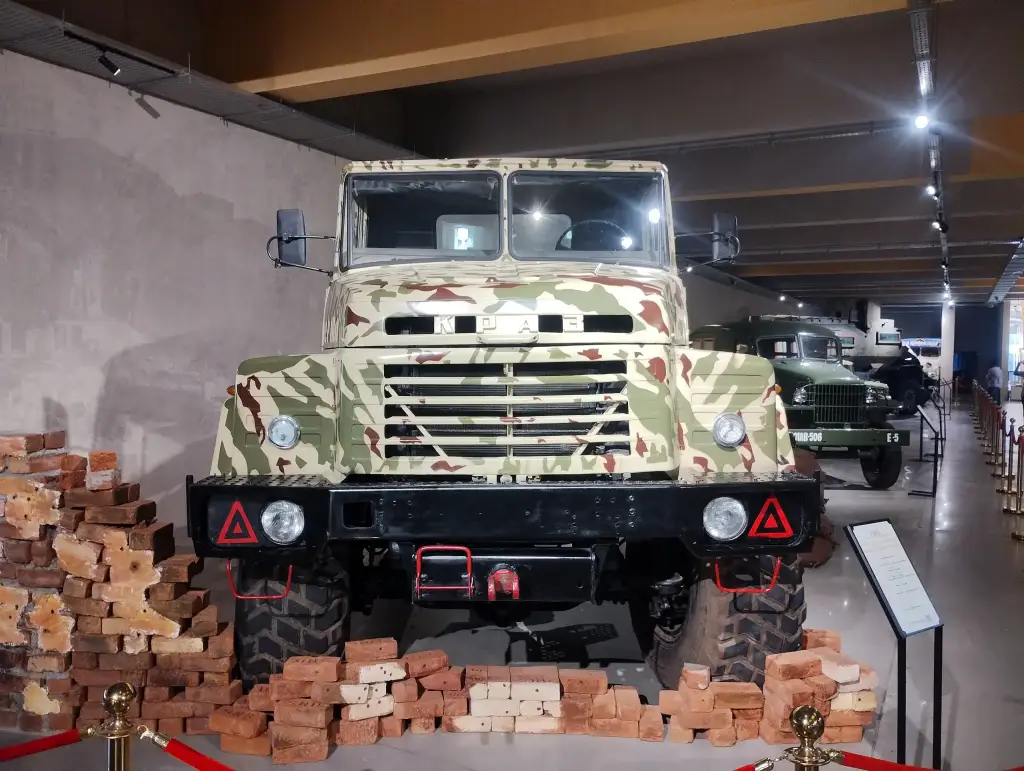
The KrAZ-260 was a three-axle heavy off-road truck designed to carry cargo and troops and to tow trailers over roads of every category and across open country. It was the first model from the Kremenchuk plant with a turbocharged engine, and it was built in series from 1981 to 1994.
KrAZ-260 at a glance
| Maker | KrAZ, Kremenchuk |
|---|---|
| Production | 1981–1994 |
| Layout | 6×6 |
| Engine | YaMZ-238, V8 diesel, 14.86 litres, turbocharged |
| Power | 300 hp at 2100 rpm |
| Torque | 1,079 Nm at 1500 rpm |
| Transmission | eight forward and two reverse gears, two-speed transfer case |
| Top speed | 80 km/h |
| Fuel | 2 × 165 litres plus a 50-litre reserve |
| Range | 1,000 km |
| Payload | 9,000 kg |
| Unladen weight | 12,775 kg |
| Dimensions | 9030 × 2720 × 2985 mm |
| Wading depth | 1.2 m |
| Built | 15,279 |
History of the KrAZ-260
Design work on the KrAZ-260 began in the 1960s in the Kremenchuk design office under chief designer V. V. Tabolin, using the French Berliet GBC 8KT military truck as a starting point. The truck was a joint development of the plant, NAMI and the Bauman technical university in Moscow. The first pilot batch was built in 1979 and the vehicle was tested at the NII-21 proving ground in Bronnitsy; introduction was delayed because the plant lacked the capacity to make all-metal cabs.
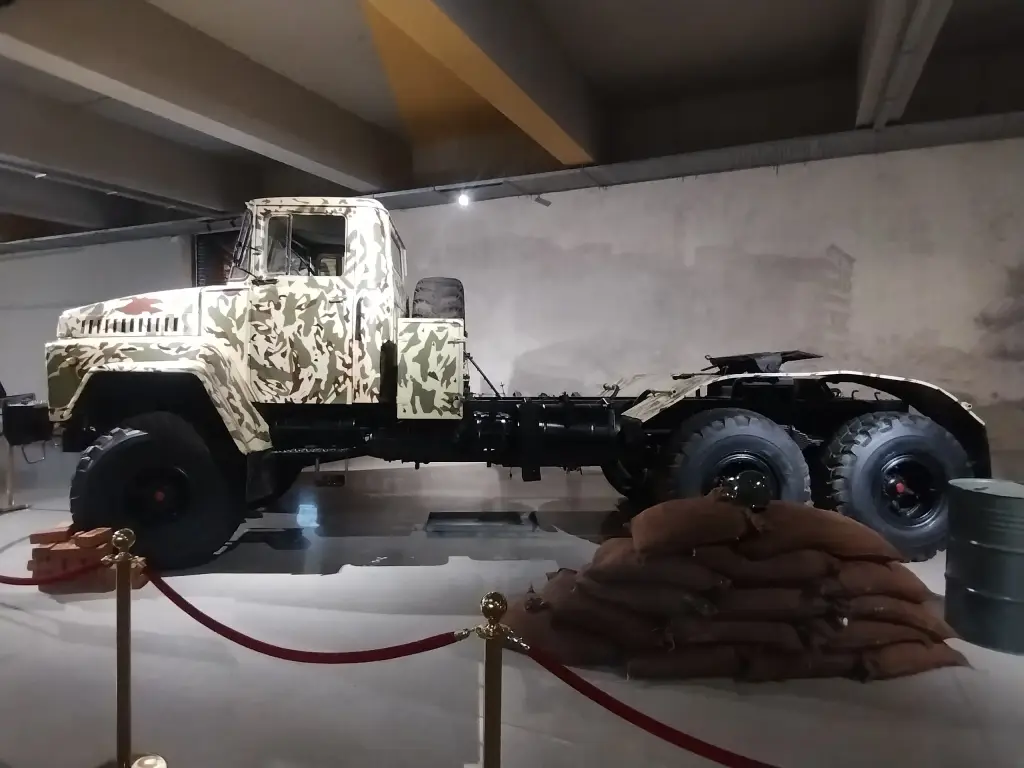
Series production began in 1981, when the KrAZ-260 was intended to replace the KrAZ-255B but was actually built alongside the 255B1. In the same year the Kherson driveshaft plant mastered shafts for the new model, and on 2 December 1983 the plant officially announced the switch to the KrAZ-260. Production continued until 1994 with 15,279 vehicles built, after which the improved KrAZ-6322 took its place on the line.
The KrAZ-260 was the plant’s first model with a turbocharged engine, at first the YaMZ-238L and from 1984 the YaMZ-238B, fitted with a preheater and a Termostart device for cold starting. It used the all-metal cab of the KrAZ-250 with a new ventilation and heating system, and 80.9% of the parts of the two models were unified. The bonnet layout allowed the cab to be moved forward over the engine for a better view, which in turn made the cargo platform longer; two air cleaners under the bonnet gave the intake air two-stage cleaning. The exhaust system had no silencer, since part of the energy of the gases was absorbed by the turbocharger.
Design and features
- Turbocharged YaMZ-238: 300 hp and 1,079 Nm, the first turbo diesel at Kremenchuk, with a preheater and Termostart.
- Permanent all-wheel drive: short front and rear overhangs, single tyres and a central tyre inflation system for cross-country work.
- Self-recovery winch: 12,000 kgf pull and a 55 m cable, mounted under the cargo platform.
- Long range: 1,000 km on two main tanks and a 50-litre reserve, at 34 litres per 100 km at a steady 50 km/h.
- All-metal cab: taken from the KrAZ-250, with adjustable seats, a roof-mounted searchlight and a radio as standard.
KrAZ-260 versions
- KrAZ-260: the base nine-tonne cargo truck.
- KrAZ-260A: with a YaMZ-238N engine and no centrifugal fuel pumps or auxiliary tank.
- KrAZ-260V: tractor unit.
- KrAZ-260G: long-wheelbase chassis.
- KrAZ-260D: experimental tractor for an active road train; 22 were built by 1985.
- KrAZ-260L and 260LS: experimental and production logging trucks.
- KrAZ-6437: a 30-tonne logging truck, in production from 1987.
- Special bodies: the ATs-10-260 tanker, BM-21K rocket launcher, EOV-4422 excavator, TMM-3M1 bridgelayer and the KrAZ-260 Tornado water-cannon vehicle.
The 260 replaced the KrAZ-255 on the line and was itself superseded by the KrAZ-6322; its road-going sister was the KrAZ-250. More trucks are in the KrAZ collection.
Video: Russian truck KRAZ 260 это силища
Video on YouTube.
Sources
- KrAZ-260, English Wikipedia: specifications, variants, operators
- КрАЗ-260, Russian Wikipedia: history, design, production numbers, variants