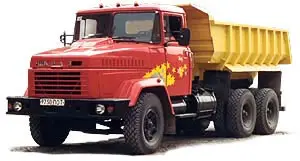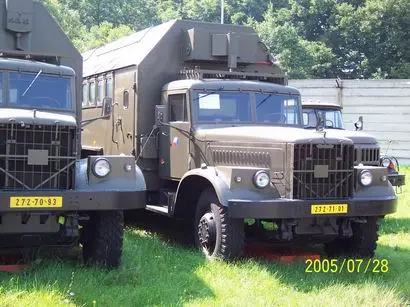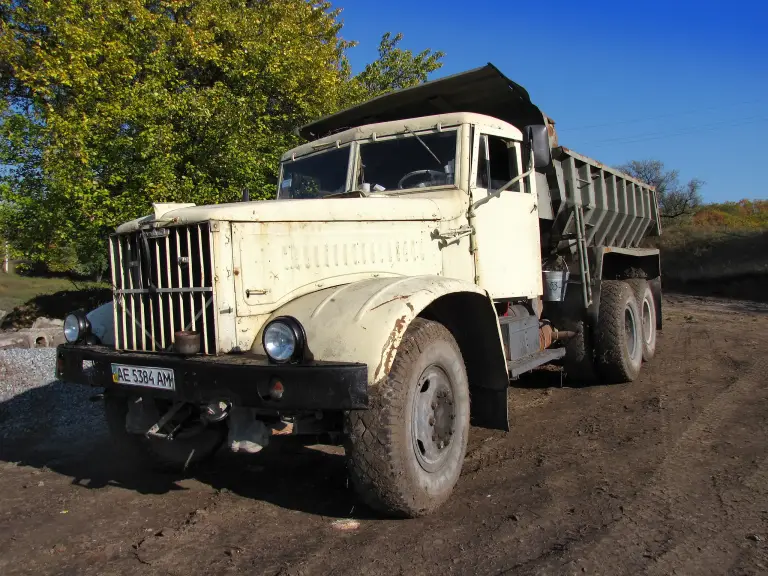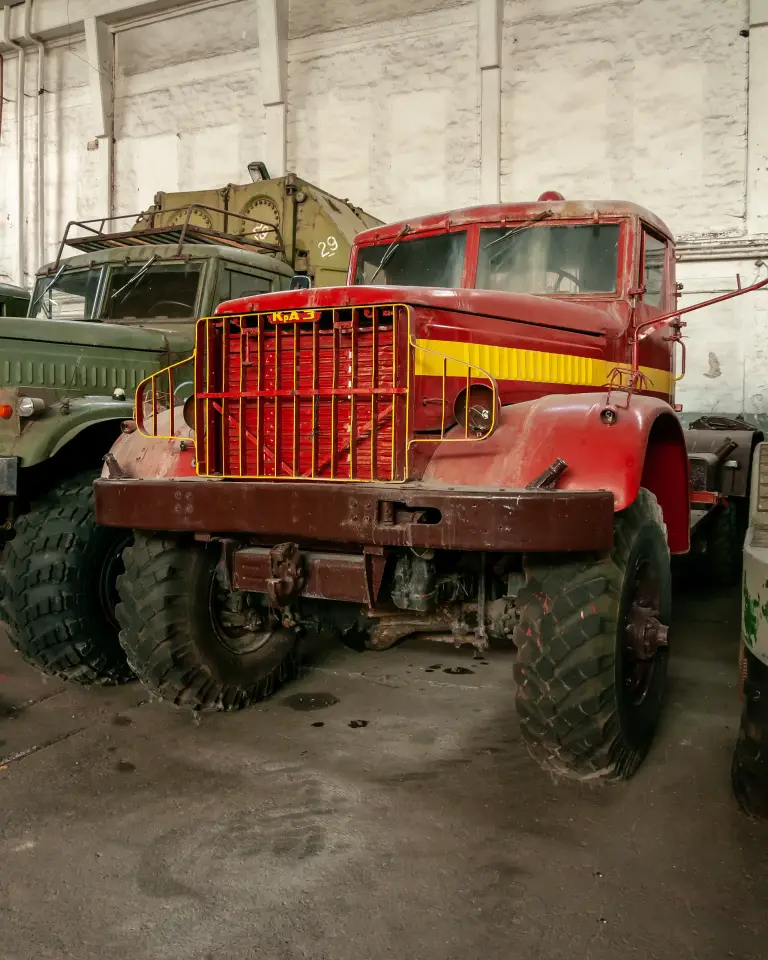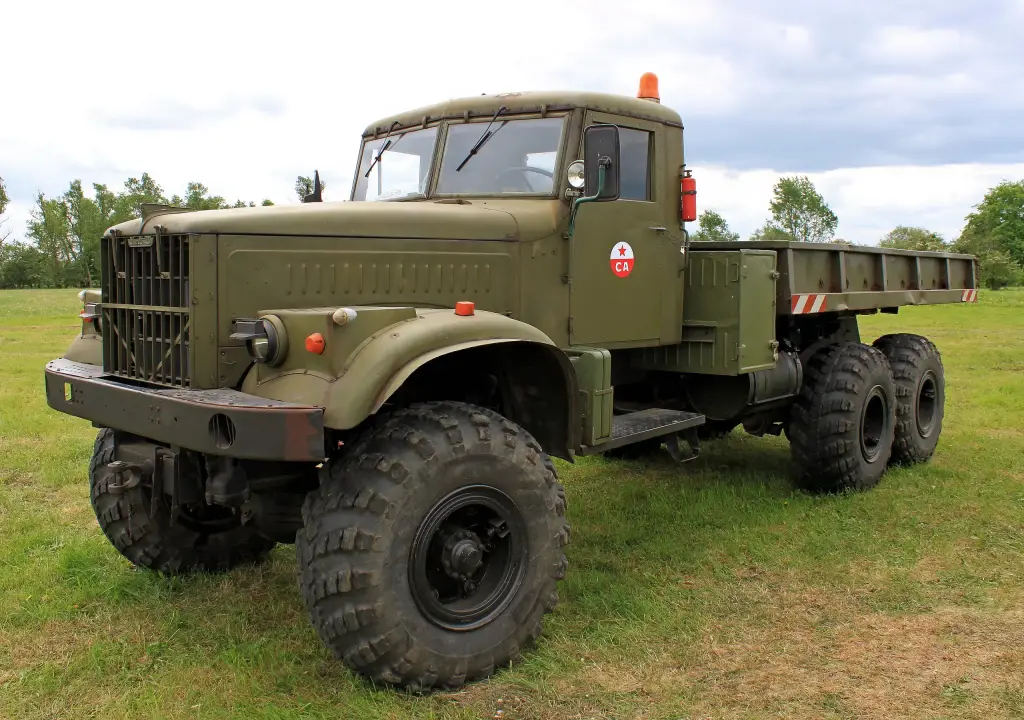
The KrAZ-255 was a Soviet three-axle off-road truck with six-wheel drive, built at Kremenchuk from 1967. It was developed from the KrAZ-214, from which it took its cab and platform, but it received a much more powerful V8 diesel, a new gearbox and very wide tyres that gave it better flotation on soft ground.
KrAZ-255 at a glance
| Maker | KrAZ, Kremenchuk |
|---|---|
| Production | 1967–1994 |
| Layout | 6×6 |
| Engine | YaMZ-238 V8 diesel, 14.86 litres |
| Power | 240 PS at 2100 rpm |
| Torque | 883 Nm at 1500 rpm |
| Top speed | 71 km/h |
| Tyres | 1300 × 530–533 mm |
| Range | 750 km |
| Wading depth | 1 m |
| Maximum gradient | 58% |
| Turning radius | 14.2 m |
| Unladen weight | about 12 tonnes |
History of the KrAZ-255
The KrAZ-255 was created on the basis of the KrAZ-214B, whose general layout it kept. The main differences were the more powerful and more economical YaMZ-238 engine and wide-section tyres with a central inflation system. The 255B entered the Kremenchuk assembly line in July 1967, with mass production from 8 August 1967, and almost 82,000 examples of this version alone were built. Counting chassis and special vehicles, 160,732 machines of the 255B and 255B1 family were made before production ended in 1994.
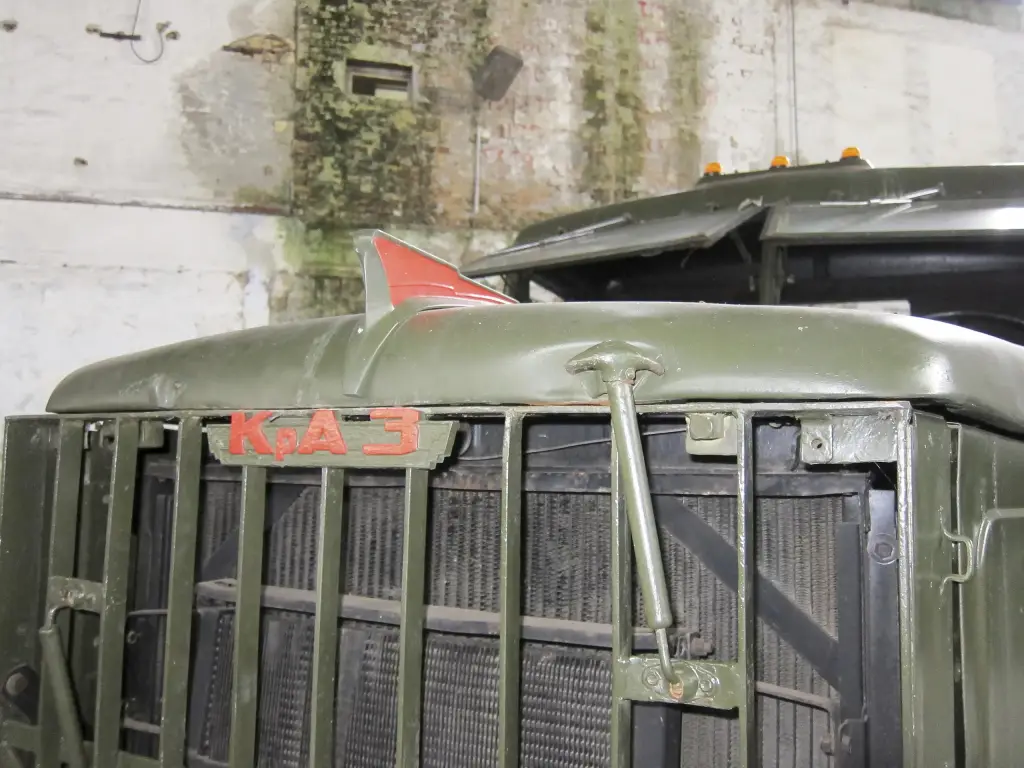
In its basic form the truck served with the Soviet armed forces alongside the Ural, ZiL, KamAZ, GAZ and MAZ lorries, and with many civilian organisations, above all construction trusts. As the heaviest of the Soviet three-axle military cargo trucks, it was most often used to tow heavy artillery such as the D-74, M-46 and 2A65 howitzers and the T-12 anti-tank gun, and in tractor form to move aircraft between hangars and runways. It also carried the cabins and antennas of the PRV-9 and PRV-16 height-finding radars and served as the base of the PMP pontoon park and the TMM-3 bridgelayer.
The truck earned the State Quality Mark of the USSR in 1975 and the nickname «Laptyozhnik» among drivers. Production of the 255B and 255B1 family peaked between 1978 and 1987 at 7,500 to 8,000 vehicles a year. Its service life grew steadily: 80,000 km for trucks built before 1970, 125,000 km for those of 1970–1979 and 140,000 km for those of 1980–1982. From 1979 the modernised 255B1 had a separate brake drive and other small changes; in 1985 the balance-axle design, the platform sections and the steering wheel material were all revised.
Design and features
- Wide tyres with central inflation: 1300 × 530–533 mm tyres with a system to adjust pressure while driving, fitted to the 255B and 255V.
- YaMZ-238 V8: a 14.86-litre diesel with 240 PS, coupled to a five-speed gearbox and a two-speed transfer case with a lockable inter-axle differential.
- Winch: fitted to the 255B and 255L for self-recovery.
- New front lighting: from 1969 the headlights and turn signals sat in rectangular metal boxes on the wings.
KrAZ-255 versions
- KrAZ-255B (1967): the 12-tonne cargo truck and the most numerous version.
- KrAZ-255B1 (1979): modernised truck with a separate brake drive.
- KrAZ-255V: tractor unit for semi-trailers and aircraft.
- KrAZ-255L and 255L1: logging trucks, the L1 in production from 1980.
- Special chassis: the ATZ-8.5 tanker, KS-3572 crane, EOV-4421 excavator, TMM-3 bridgelayer, PMP pontoon park and the PRV-9 and PRV-16 radars.
The 255 replaced the KrAZ-214 and was joined, not replaced, by the KrAZ-260 in 1981. Its dump-truck relative was the KrAZ-256; more trucks are in the KrAZ collection.
Video: KrAZ-255 beim Trecker Treck Kölzin
Video on YouTube.
Sources
- KrAZ-255, English Wikipedia: engine, production, roles, variants
- КрАЗ-255Б, Russian Wikipedia: production numbers, design, service life