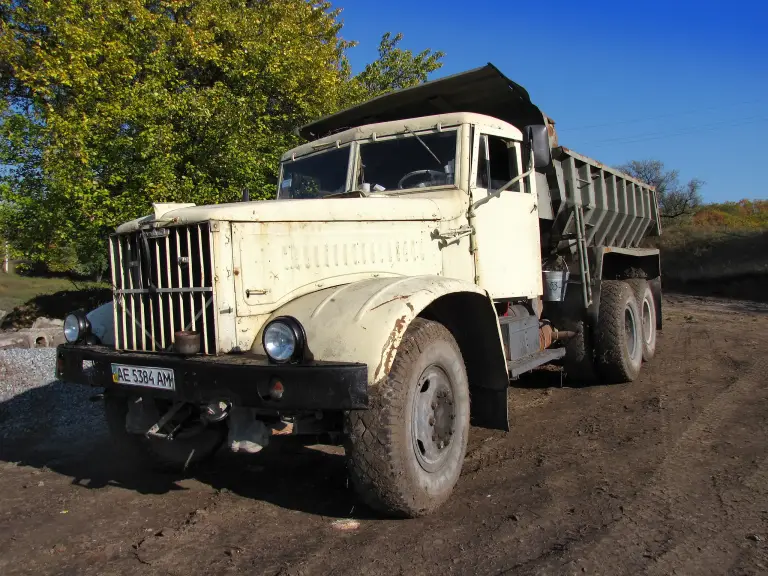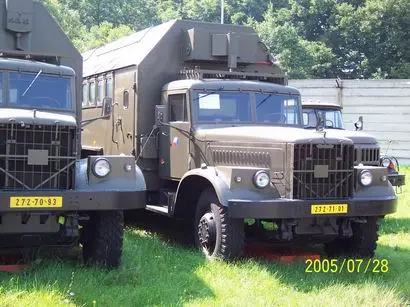
The KrAZ-257 was a heavy flatbed truck of the second generation, produced by the Kremenchuk automobile plant from 1965 to 1995. It was developed to replace the KrAZ-219 and became the parent of a whole line: the 258 tractor unit and the 256 dump truck shared its chassis and main units.
KrAZ-257 at a glance
| Maker | KrAZ, Kremenchuk |
|---|---|
| Production | 1965–1995 |
| Layout | 6×4 |
| Body | flatbed platform, 5770 × 2450 mm, wooden drop sides |
| Gearbox | five-speed manual |
| Cab | three seats, wooden frame with metal skin |
| Tyres | 12.00–20 (320–508) |
| Trailer weight | 16,600 kg in the base 257, 20,000 kg in the 257B1 |
| Top speed | 62 km/h, 68 km/h in the 257B1 |
| Built | more than 750,000 base models and modifications |
| State Quality Mark | 1975 |
The article is based on the Russian Wikipedia page on the KrAZ-257; the English Wikipedia page on the plant supplies the model’s place in the range.
History of the KrAZ-257
Work on the KrAZ-257 began in the early 1960s as a replacement for the KrAZ-219. The new line differed from its predecessors by a more modern diesel engine and a number of design changes. It consisted of three main models: the KrAZ-257 itself as chassis and flatbed truck, the KrAZ-258 tractor unit and the KrAZ-256 dump truck.
The base KrAZ-257 was built from 1965 to 1977. It could tow trailers of up to 16,600 kg and reached 62 km/h; by 1977 the service life of series trucks had been raised to 180,000 km. In 1977 the modernised KrAZ-257B1 arrived with a longer service life, a separate brake drive, the PZhD-448 preheater and other small improvements. Its trailer weight rose to 20,000 kg and its top speed to 68 km/h, and by the end of 1984 the service life of series 257B1 trucks had reached 210,000 km. This version was built until 1994, and the model remained in production in some form until 1995.
The design was revised in 1985: a new balance-axle design, developed with the Dnepropetrovsk metallurgical institute, replaced the solid axle with one made from thick-walled steel tube and raised its life from 1.265 to 1.383 million load cycles. Platform construction moved from 3 mm hot-rolled sheet to 2.5 mm cold-bent profiles, which saved 34 kg on the KrAZ-257 platform, and the steering wheel was changed from cellulose aceto-butyrate to a frost-resistant polypropylene. In January 1988 KrAZ and MAZ were told to unify the 8.5-20 wheel fittings of the KrAZ-257 and the MAZ-64221, and during the first half of 1988 the fuel system and the steels used for gearbox and axle gears were improved as well.
Design and features
- Flatbed platform: 5770 × 2450 mm with wooden drop sides and a towing coupling with a locking catch.
- Five-speed gearbox: a mechanical unit, with a preheater for cold starts as part of the standard equipment.
- Arctic version: the 257S for temperatures down to −60 °C, with electrically heated windscreens, double glazing and an independent diesel heater.
- Rail use: with a set of rail wheels the truck worked as a shunting locomotive, moving trains of up to 1,000 tonnes.
KrAZ-257 versions
- KrAZ-257 (1965–1977): the base flatbed truck and chassis.
- KrAZ-257Sh: a chassis for special equipment.
- KrAZ-257S: the arctic version, first shown at the Avtoprom-77 exhibition.
- KrAZ-257B1 (1977–1994): the modernised truck with a separate brake drive and a longer service life.
- Special bodies: concrete mixers, truck cranes, drilling rigs, fuel, oxygen and nitrogen tankers, and the AKDS-70 oxygen stations.
The 257 was the parent of the KrAZ-256 dump truck and the KrAZ-258 tractor, and it was itself replaced by the KrAZ-250. More trucks are in the KrAZ collection.
Sources
- КрАЗ-257, Russian Wikipedia: history, design, production, variants
- KrAZ, English Wikipedia: place of the model in the plant’s range