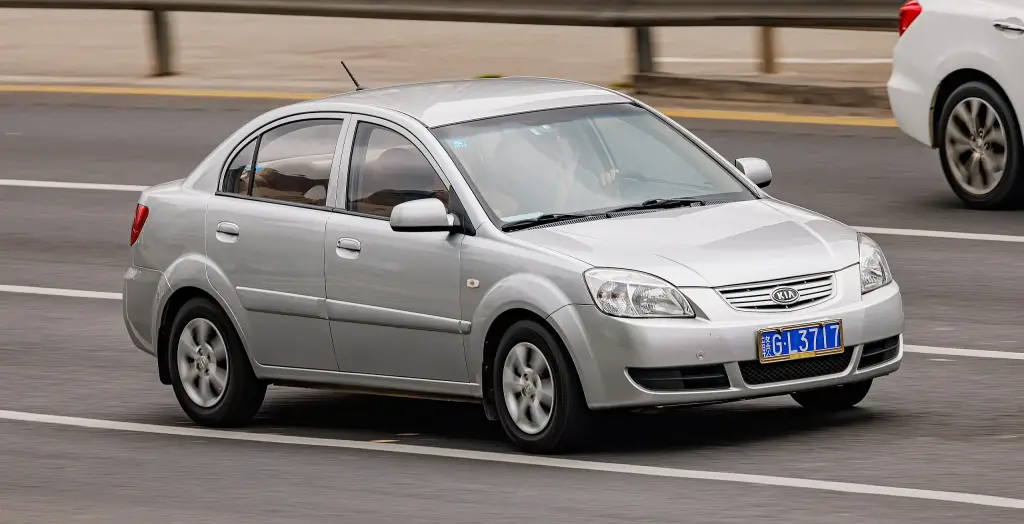
The Kia Rio was a subcompact car that Kia built from 1999 to 2023 in hatchback, sedan and estate bodies. It replaced the first-generation Pride and the Avella, and in its first year on the American market it was the least expensive mass-produced car on sale there.
Kia Rio at a glance
| Maker | Kia |
|---|---|
| Production | 1999–2023 |
| Bodies | three and five-door hatchback, four-door sedan, estate |
| First generation | DC, 1999–2005 |
| Second generation | JB, from 2005 in Europe, 2006 in North America |
| Platform, second generation | shared with the Hyundai Accent |
| US engines, first generation | 1.5 with 96 hp, 1.6 with 104 hp |
| European engine | 1.3 SOHC with 75 hp, 80 hp after the facelift |
| Gearbox | five-speed manual or four-speed automatic |
| Successor | K3, from August 2023 in some markets |
History of the Kia Rio
The first-generation Rio, known internally as DC, came as a four-door sedan and a five-door station wagon. At its launch it was the cheapest mass-produced car sold in the United States. Its styling and price were well received, but reviewers criticised its build quality and the way it drove. The estate was sold as the Rio Cinco in the United States, the Rio RX-V in Canada and the Rio Look in Chile, and in Korea the hatchback was the Rio RX-V. The sedan was not sold in Britain, where only the hatchback carried the Rio name.

Engines and facelift
In the United States each model year had a single engine: a 1.5-litre DOHC four of 96 hp for 2001 and 2002, then a 1.6-litre of 104 hp for 2003 to 2005, with a five-speed manual or a four-speed automatic. Other markets, including Britain and most of continental Europe, could have a 1.3-litre SOHC eight-valve engine of 75 hp. Korea did not get the 1.6 because the tax system penalised cars over 1,500 cc, and claimed outputs there were higher: 84 PS for the 1.3, 95 PS for the SOHC 1.5 and 108 PS for the DOHC 1.5. A 2002 facelift brought engine, suspension and brake changes, new styling inside and out, and the name Rio SF in Korea. In Europe the 1.3 rose to 80 hp. Iranian production by SAIPA began in 2005 and ended in early 2012, and those cars had no ABS or airbags until 2012.
Second generation (2005)
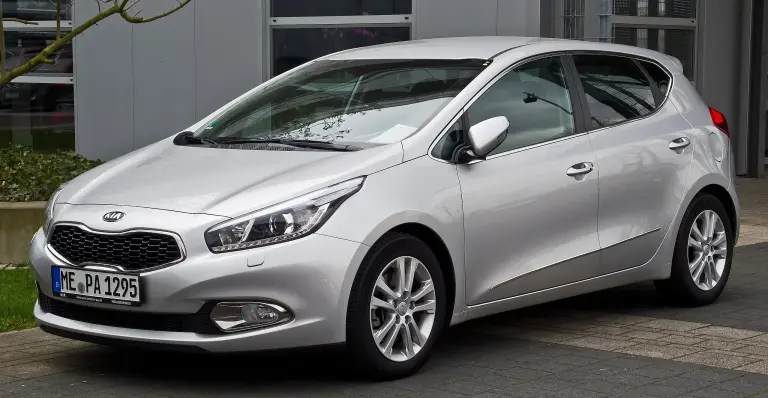
The JB generation arrived in Europe in early 2005 and in North America for 2006, on a new platform shared with the Hyundai Accent. The engine was a 110 hp 1.6-litre Alpha II, also shared with the Accent, and the estate was dropped in favour of a five-door hatchback. In the United States the hatchback was sold as the Rio5 in SX trim, and the sedan came as Rio and Rio LX. Europe could also have a 1.4-litre of 96 hp and a 1.5-litre turbodiesel of 109 hp, while the United States had only the 1.6. In 2007 about 4,000 pre-production Rio hybrids were tested by the Korean government, though the planned production model was never launched. The Rio continued through later generations until 2023, when the K3 took over in markets such as Mexico and the Gulf states.
Design and features
- Cheapest in America: the first Rio undercut every other mass-produced car in the United States.
- Many bodies: sedan, hatchback and estate, the last sold as the Rio Cinco and Rio RX-V.
- Accent platform: from 2005 the Rio shared its underpinnings with the Hyundai Accent.
- Long run: five generations in twenty-four years.
Kia Rio versions
- Rio DC (1999–2005): sedan and estate, 1.3, 1.5 and 1.6 engines.
- Rio SF (2002–2005): the facelifted first generation in Korea.
- Sports-Pac: a first-generation special with a bonnet scoop, rear wing, gold wheels and lowered suspension.
- Rio JB (2005–): sedan and five-door, Rio5 in the United States.
- K3 (2023–): the successor in Mexico and the Gulf states.
The Rio replaced the Kia Pride and the Avella and sits below the Cerato. More Kia models are in the Kia collection.
Sources
- Kia Rio, English Wikipedia: generations, engines, markets, facelift, successors