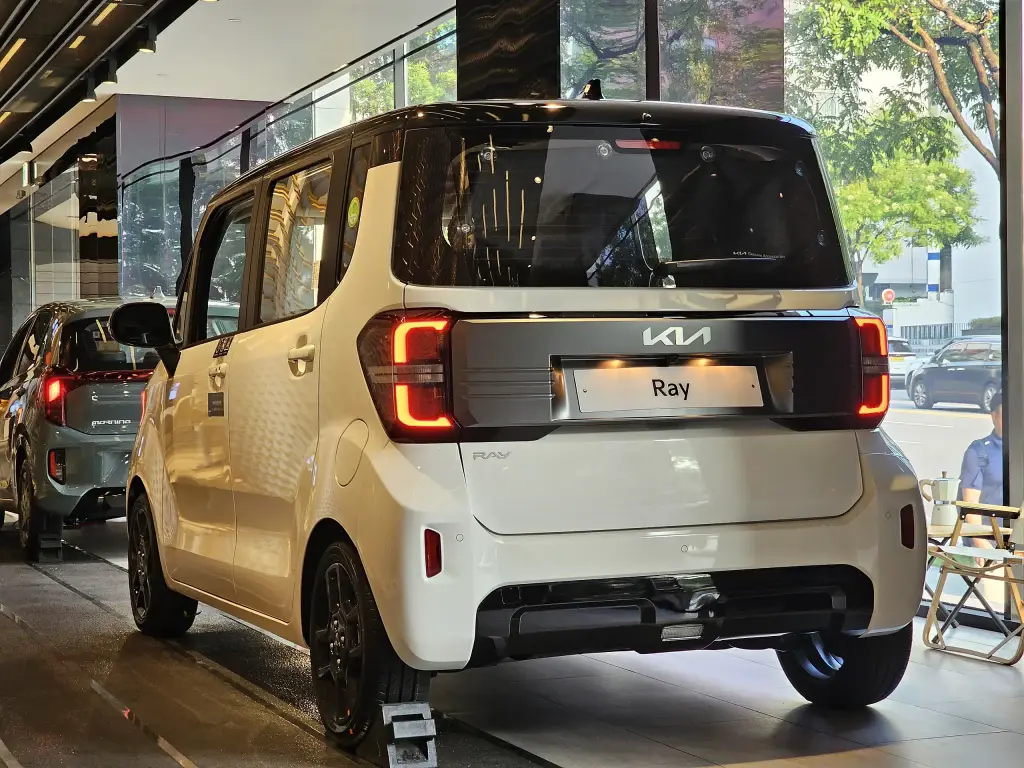
The Kia Ray is a city car that Kia builds only for the South Korean market. It is based on the Picanto and Morning and was designed to fit Korea’s light-car tax class, which favours cars under 3,600 mm long and 1,600 mm wide, and it became the basis of Kia’s first production electric car.
Kia Ray at a glance
| Maker | Kia |
|---|---|
| Production | since 2011, Korea only |
| Based on | Kia Picanto/Morning |
| Engine | 998 cc petrol, 78 PS at 6,400 rpm |
| Doors | sliding door on the passenger side, swing-out door on the driver’s side |
| Seats | four |
| Ray EV (2011) | 50 kW motor, 16.4 kWh battery, 139 km range |
| Ray EV (2023) | 64.3 kW motor, 35.2 kWh LFP battery, 205 km range |
| Facelifts | December 2017 and September 2022 |
History of the Kia Ray
The Ray is a Korean-only model, sold in no other market. Its boxy, kei-car-inspired shape makes the cabin larger than most cars of its size, though it seats only four. The body has an unusual door arrangement: a sliding door for the rear seats on the passenger side and a conventional swing-out door on the driver’s side. The only engine is a 998 cc petrol unit of 78 PS at 6,400 rpm.
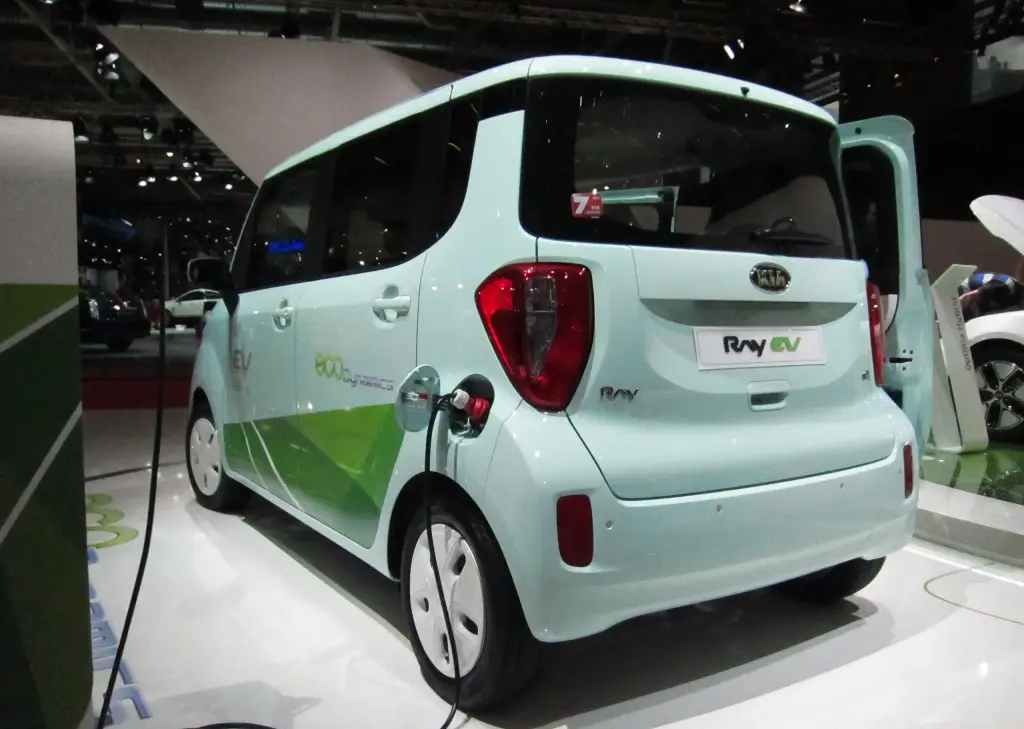
Ray EV (2011)
The Ray EV of 2011 was Kia’s first production battery-electric vehicle. It used a 50 kW electric motor with 167 Nm, a 330 V 16.4 kWh lithium-ion battery and a range of about 139 km depending on conditions. Despite weighing 1,185 kg, 187 kg more than the petrol car, it was claimed to reach 100 km/h in 15.9 seconds and a top speed of 130 km/h. Charging took six hours from a 220 V household supply or 25 minutes at a DC fast charger, with the AC port in the front grille and the DC port where the fuel filler sits on the petrol model. The first run of 2,500 cars went to South Korean government fleets for 2012. In May 2013, 184 Ray EVs joined a Seoul car-sharing service at US$5 per hour, which had 15,000 registered customers by that month. Production of that version ended in 2018.
Facelifts
The New Ray of 13 December 2017 raised the central grille to the height of the headlamps and painted it in body colour, added honeycomb patterns to the tailgate garnish, made a sudden-braking alarm standard and added rollover detection to the six airbags. A single-seat Ray Van with Prestige and Prestige Special trims followed on 8 February 2022. The second facelift was unveiled on 10 August 2022 and released on 1 September with Starmap lighting, a flat angular bumper, a skid plate, 15-inch alloy wheels, a 4.2-inch LCD cluster, a light grey interior and driver aids including rear cross-traffic collision avoidance. On 17 November 2022 a tougher-looking Gravity version was added.
Ray EV (2023)
The updated Ray EV launched on 21 September 2023, again for Korea only. Its price fell from 45 million won to 27.4 million, about 20 million after national and local incentives. It uses the 2022 styling, a 64.3 kW motor with 147 Nm, a 265 V 35.2 kWh lithium iron phosphate battery and a range of 205 km, with 80 per cent charge in 40 minutes from a 100 kW DC source or six hours on household AC. Ray sales have risen every year since 2017, and in the first quarter of 2024 the Ray EV was the best-selling electric vehicle built in Korea, with 2,442 sold.
Design and features
- Korean light-car class: sized to earn tax benefits at home.
- Sliding passenger door: a practical layout for tight city parking.
- Boxy cabin: more interior space than most cars of its length.
- Electric history: Kia’s first production EV in 2011 and a much-improved version in 2023.
Kia Ray versions
- Ray (2011–): 998 cc petrol city car.
- Ray EV (2011–2018): 50 kW, 16.4 kWh battery.
- Ray Van (2022–): single-seat commercial version.
- Ray Gravity (2022–): design version with dark trim and black wheels.
- Ray EV (2023–): 64.3 kW and a 35.2 kWh LFP battery.
The Ray shares its platform with the Picanto and is sold only in Korea, where it sits below the Rio. More Kia models are in the Kia collection.
Sources
- Kia Ray, English Wikipedia: layout, engine, EV versions, facelifts, sales