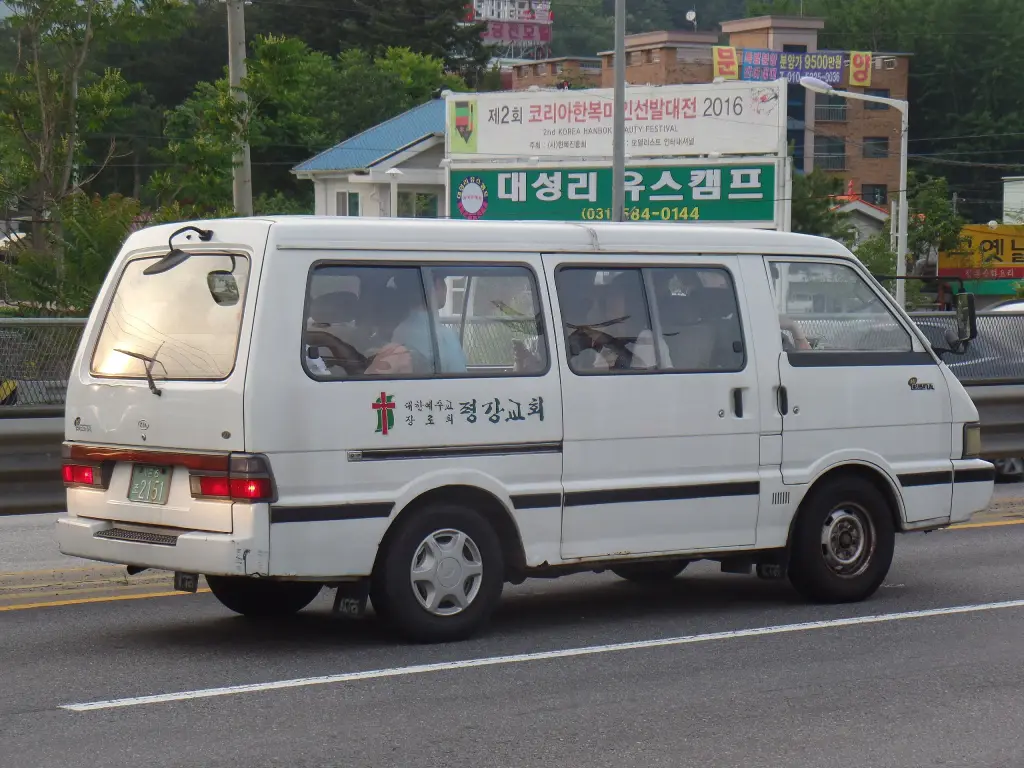
The Kia Besta was the coach, or passenger, version of the second-generation Bongo van. It was sold from 1990 and also carried the Hi-Besta name, and in Brazil it became the best-selling minivan almost as soon as it arrived.
Kia Besta at a glance
| Maker | Kia Motors |
|---|---|
| Also called | Hi-Besta, Kia Bongo coach |
| Production | from 1990; Besta 2.7 until at least summer 1997 |
| Based on | second-generation Kia Bongo |
| Engine at launch | 2.2-litre Mazda R2 diesel, 62 PS |
| Engine from late 1994 | 2.7-litre J2 diesel, 80 PS |
| Top speed | 128 km/h with the 2.7 |
| Layout | cab-over, rear-wheel drive |
| Replaced by | Kia Pregio, from November 1995 |
The Besta is described in the English Wikipedia article on the Kia Bongo; the article here is based on that section alone.
History of the Kia Besta
The Besta appeared with the second-generation Bongo in January 1990. That Bongo was largely a rebadged Mazda Bongo Brawny of the SR series, so the Besta was a Mazda design built under licence in Korea. Its name means “beast” in a number of Romance languages, Portuguese among them.
Engines
The first Bestas used Mazda’s 2.2-litre R2 diesel with 62 PS (46 kW). At the end of 1994 the 2.7-litre J2 unit of 80 PS (59 kW) was installed as well, and that version could reach 128 km/h (80 mph). The same J2 engine was behind the facelifted Bongo J2 name, which Kia used in 1995 for the re-engined and lightly restyled second-generation trucks.
Markets
The Besta name was used for the passenger coach and, in many countries, also for cargo vans. In Brazil it immediately became the best-selling minivan in the market, helped by a low price and a simple cab-over layout with a diesel engine. Where the second-generation Bongo was exported as a truck it usually carried the K2400 or K2700 labels instead.
The Bongo J2 also formed the basis of the Kia Pregio, introduced in November 1995, which replaced the Besta as the coach model. The Besta 2.7 stayed in production alongside the Pregio until at least the summer of 1997 in markets where the cheaper model still sold, so the two overlapped for almost two years.
Design and features
- Cab-over layout: a short nose and a flat floor, which made the Besta roomy for its size.
- Diesel economy: the 2.2 R2 and later the 2.7 J2, both simple and easy to service.
- Passenger and cargo bodies: the coach for families and shuttle work, cargo vans for business.
- Low price: the main reason for its success in Brazil and other emerging markets.
Kia Besta versions
- Besta 2.2 (1990–1994): Mazda R2 diesel with 62 PS.
- Besta 2.7 (1994–1997): J2 diesel with 80 PS and a 128 km/h top speed.
- Hi-Besta: the alternative name used for the same coach model.
- Cargo van: the Besta badge on commercial vans in many markets.
The Besta was the passenger version of the Kia Bongo and was replaced by the Kia Pregio. The tougher Kia Ceres was the agricultural version of the same family. More Kia models are in the Kia collection.
Sources
- Kia Bongo, English Wikipedia: Besta and Hi-Besta names, engines, Brazil, Pregio replacement