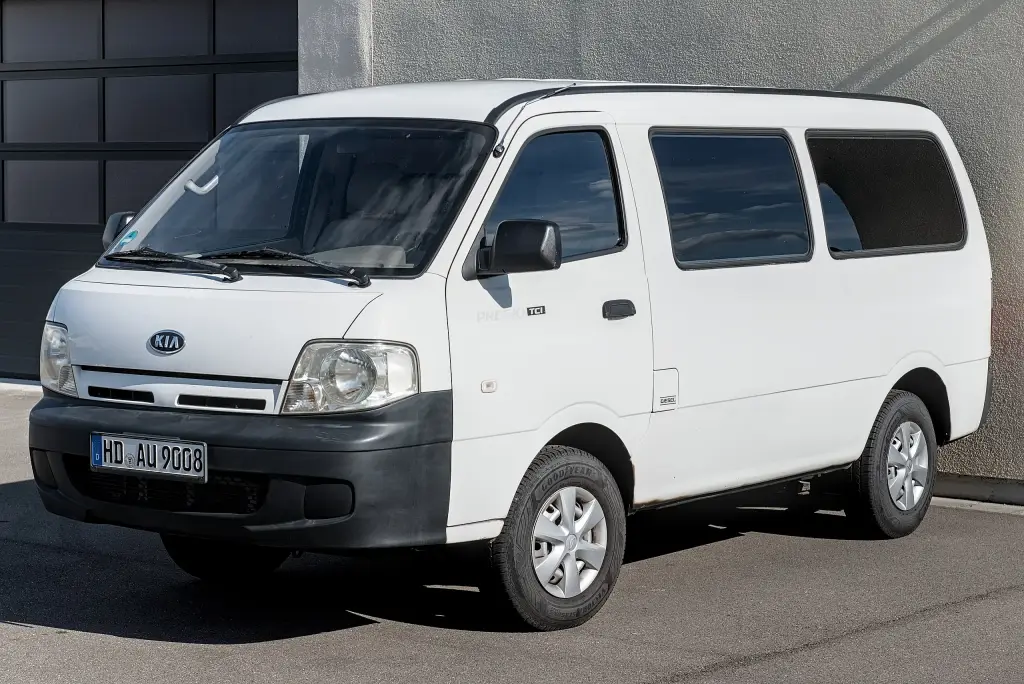
The Kia Pregio was a rear-wheel-drive cab-over van and minibus that Kia built from November 1995 to 2006. It replaced the Bongo-based Besta, and its long-wheelbase version, the Pregio Grand, became one of the best-selling vans in Colombia and Ecuador.
Kia Pregio at a glance
| Maker | Kia Motors |
|---|---|
| Production | November 1995–2006 |
| Based on | Kia Bongo |
| Body | panel van and minibus |
| Engine at launch | 2.7-litre (2,665 cc) diesel from the Bongo J2 |
| Engine from 1997 | 3.0-litre OHV diesel, 90 PS |
| Engine, late cars | 2.5-litre (2,476 cc) TCi intercooled turbodiesel, 94 PS |
| Gearbox | five-speed manual; four-speed automatic from 2001 |
| Suspension | independent double wishbones front, live axle with leaf springs rear |
| Long version | Pregio Grand, 16 to 19 passengers |
History of the Kia Pregio
The Besta had gathered many complaints about its engine, so when Kia developed a new van using the more modern Bongo J2, it gave the model a new name. The Pregio appeared in 1995 with the 2,665 cc diesel of the Bongo J2, and it was updated in 1998, 2000 and 2002. A 3.0-litre OHV diesel of 90 PS joined the range in 1997, and a four-speed automatic was added in 2001.
Chassis
The Pregio was a rear-wheel-drive cab-over design like the Bongo it came from. The front suspension was independent, with coil springs and double wishbones, while the rear used a live axle on elliptic leaf springs to save space and carry heavy loads. Disc brakes at the front and drums at the rear were standard in Europe at least. For export markets, right-hand-drive Pregios were built only as panel vans.
Engines and the Hyundai effect
Late in its life the Pregio gained a 2,476 cc intercooled turbodiesel of Mitsubishi origin called TCi. This 94 PS unit met the Euro III emission standard for commercial vehicles, and the van version could reach 160 km/h. Mitsubishi parts reached Kia because of Hyundai’s 1998 takeover, after years in which Kia had relied on Mazda engineering. By late 2003 the Pregio had been thoroughly facelifted, with a different look that could pass stricter European safety demands.
Markets
In Brazil the Besta had built a strong reputation, so the new van was sold there from August 1997 as the Kia Besta GS; it made the Besta name Brazil’s best-selling imported vehicle of any kind from 1997 to 2001. In Korea the Pregio was made as the Bongo III Coach, and in Indonesia a local coach version of the Bongo III called the Kia Travello replaced it. The long-wheelbase Pregio Grand carried 16 to 19 passengers and sold well in Colombia and Ecuador.
The Pregio was discontinued after the 2006 model year as demand fell, making room for the shorter, front-wheel-drive Carnival, which had until then been sold only in long-wheelbase form.
Design and features
- Rear-wheel drive: a load-carrying layout shared with the Bongo.
- Two sizes: the standard van and the long Pregio Grand minibus.
- Simple diesels: 2.7 and 3.0-litre engines, then a 2.5 Mitsubishi-derived TCi.
- Latin American favourite: the Grand dominated its class in Colombia and Ecuador.
Kia Pregio versions
- Pregio van (1995–2006): panel van and minibus.
- Pregio Grand: long-wheelbase minibus for 16 to 19 passengers.
- Besta GS (Brazil, 1997–): the Pregio sold under the old Besta name.
- 2003 facelift: new front and interior for European safety rules.
The Pregio replaced the Kia Besta and was built on Bongo mechanicals, and it sat below the Carnival in Kia’s range. More Kia models are in the Kia collection.
Sources
- Kia Pregio, English Wikipedia: dates, engines, chassis, markets, facelift