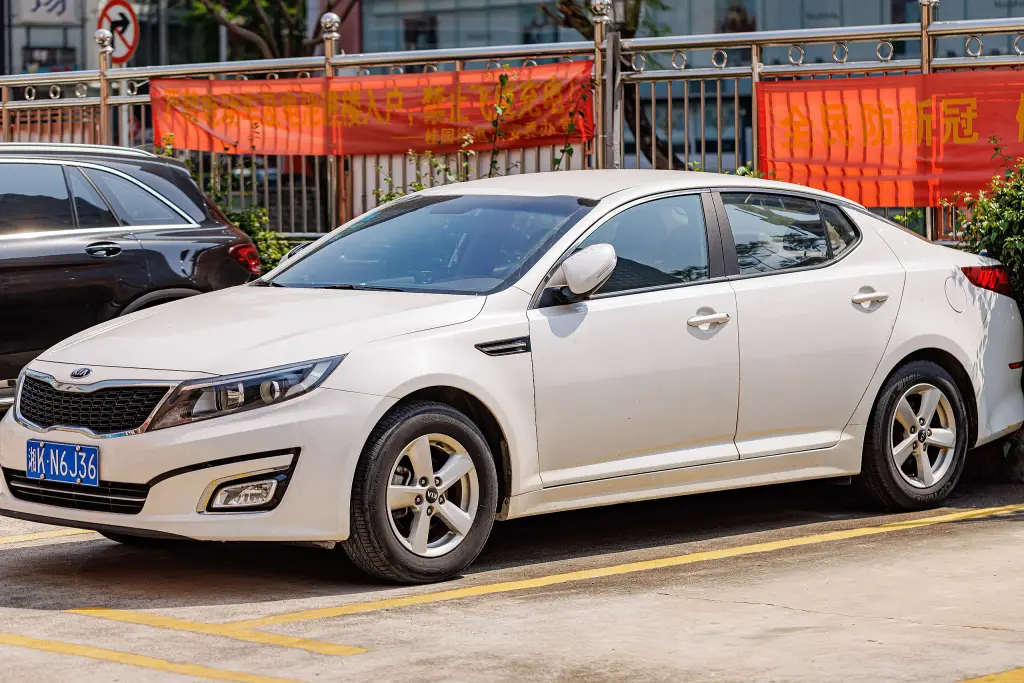
The Kia Optima is a mid-size saloon that Kia has built since 2000 and now sells as the K5. Over five generations it has carried four names — Optima, Magentis, Lotze and K5 — depending on the market.
Kia Optima at a glance
| Maker | Kia |
|---|---|
| Production | since 2000 |
| Names | Optima, Magentis, Lotze, K5 |
| First generation | MS, 2000–2005, a rebadged Hyundai Sonata |
| Second generation | MG, from November 2005 |
| Third generation | TF, from 2010, K5 in Korea and China |
| Fifth generation | K5 in all markets, from 2019 |
| Engines, second generation | 1.8 and 2.0 fours, 2.4 four, 2.7 V6, 2.0 turbodiesel, 2.4 LPG |
| Gearbox | five-speed manual or automatic |
History of the Kia Optima
The first Optima, from 2000 to 2005, was a rebadged variant of the Hyundai Sonata, differing only in minor exterior styling and equipment. It was shown in Korea in July 2000 and was the first product of the plan to share platforms between Kia and Hyundai. In Australia it arrived in May 2001 with a 2.5-litre V6 and a choice of manual or automatic, and a later update brought a 2.7-litre engine and a four-speed automatic; Australian sales reached 41,289 in 2005. A luxurious Korean version, the Optima Regal, used the 2.0 four or the 2.5 V6.

Second generation (2005)
The MG generation was launched in Korea in November 2005 as the Lotze, sold elsewhere as the Magentis except in the United States and Malaysia, where it stayed the Optima. Unlike the first car it used a global platform of Kia’s own, though it still shared its 2.4-litre four and five-speed gearboxes with the Sonata. Worldwide engines included 1.8 and 2.0-litre fours, a 2.4 four, a 2.7 V6 and a 2.0 turbodiesel, plus a 2.4 LPG version in Korea. The 2008 update, sold as a 2009 model, brought new front styling, new tail lamps, a body about 70 mm longer and the Theta II 2.4 with dual variable valve timing and 176 hp; the 2.0 four made 164 hp, and the 2.7 V6 193 hp.
Later generations
The third generation of 2010 was completely redesigned on the same platform as the Hyundai i40 and made its debut at the New York show; it took the K5 name in Korea and China, with Peter Schreyer’s new design language. The K5 name spread to all markets with the fifth generation in 2019, and the Optima name was used in the United States, Canada, Malaysia and the Middle East until the 2021 model year.
Design and features
- Hyundai roots: the first generation was a Sonata with different trim.
- Many names: Optima, Magentis, Lotze and K5 for the same car.
- Wide engine range: petrol fours and V6, a turbodiesel and an LPG unit in Korea.
- Design shift: the 2010 car introduced Peter Schreyer’s styling to the class.
Kia Optima versions
- Optima MS (2000–2005): Sonata-based, 2.5 then 2.7 V6 in Australia.
- Optima Regal: the luxury Korean version of the first generation.
- Lotze/Magentis/Optima MG (2005–2010): Kia’s own global platform.
- K5 TF (2010): the third generation, K5 in Korea and China.
- K5 (2019–): one name for all markets.
The Optima replaced the Kia Credos and sits below the Kia K8; its people-carrier relative is the Carens. More Kia models are in the Kia collection.
Sources
- Kia K5, English Wikipedia: names by market, generations, engines, updates