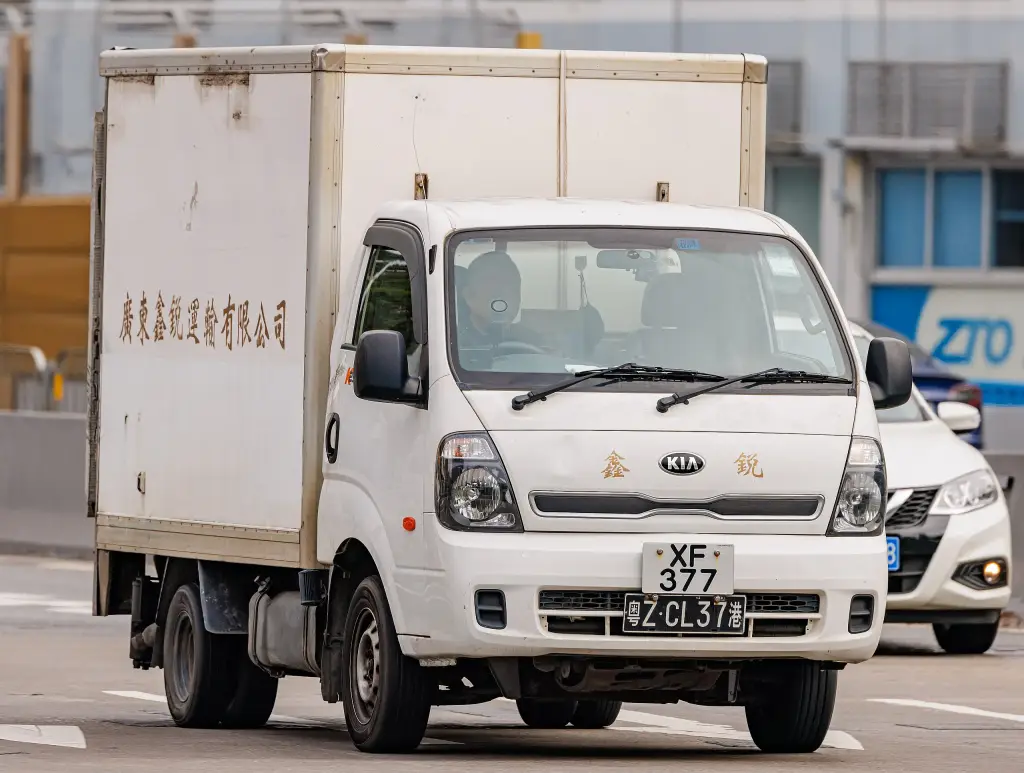
The Kia Bongo is a cab-over pickup truck and van that Kia has built since 1980, and it is still made today as the Bongo III. In Europe, Australia and South America it has been sold as the Kia K-Series, with the K2400 and K2700 labels, and in some markets as the Kia Frontier.
Kia Bongo at a glance
| Maker | Kia Motors |
|---|---|
| Production | since 1980, still in production as Bongo III |
| Also called | K-Series, K2400, K2700, Frontier, Besta (van), Kaon (Taiwan) |
| First engine | 2.2-litre S2 diesel of Perkins origin, 70 PS |
| Petrol option | 1.4-litre UC from 1985 |
| Power Bongo engine | 2.4-litre SF diesel, 80 PS |
| Second generation | 1990–1997, based on the Mazda Bongo Brawny |
| Third generation | Bongo Frontier, April 1997–2004 |
| Fourth generation | Bongo III, from 2005 |
| Layout | cab-over, rear-wheel drive |
History of the Kia Bongo
Truck production started in 1980 and van production in 1981. Early Bongos had round headlights, replaced by square units in 1981, and the first cars wore “Kiamaster” logos rather than the Kia name, which was changed in February 1986. The original engine was a 2.2-litre S2 diesel of Perkins origin producing 70 PS (51 kW); a 1.4-litre UC petrol engine became an option in 1985.

Wide Bongo and Power Bongo
Wide Bongo production began in 1987. Between 1987 and 1990 the truck was sold as the Power Bongo, a name that reflected the move to the 80 PS (59 kW) 2.4-litre SF diesel; the Power Bongo also had wide rectangular headlights instead of the smaller earlier units. The first generation left production in December 1994, although the tougher Ceres version carried on for another seven years.
Second generation (1990–1997)
The second-generation Bongo Wide arrived in January 1990 and was largely a rebadged SR-series Mazda Bongo Brawny. A 2.7-litre engine was added in 1993, and in October 1994 Kia’s new logo replaced the old “chimney” design. A re-engined and lightly facelifted version called the Bongo J2 appeared in 1995. The passenger coach version was sold as the Besta, and that model became the basis for the Pregio van in 1995.
Third generation (1997–2004)
The third generation appeared in April 1997 as the Bongo Frontier. It used the same JS-series 2.7-litre engine of 80 PS, with an optional 3-litre JT unit of 90 PS from the start; the engine gained four horsepower in August 2001. A four-wheel-drive Bongo Frontier All Terrain arrived in December 1999, which finally ended the Ceres trucks. A facelifted Bongo came in 2000, the truck was discontinued in late 2003, and the van and coach models were built until May 2005.
Fourth generation (2005–present)
The Bongo III arrived in 2005 with modernised engines, including a common-rail option. Tighter emission rules ended the 1.2-ton and 1.4-ton variants in November 2006, and all models except the 1-ton and 1.3-ton versions stopped on 31 December 2007 because of low demand. Production paused between October 2011 and January 2012 while a Euro V engine was prepared. In the Philippines the Bongo III was sold only as the K2700, from May 2005 to August 2018.
The Bongo has carried a long list of names abroad. In Europe, Australia and South America it is the K-Series or the Kia Frontier, which includes the K2400 and K2700; in Taiwan it is the Kia Kaon; in Vietnam it is built under licence by THACO as the THACO Kia New Frontier. The Bongo Frontier was one of the first Kia vehicles exported to Europe and South America.
Design and features
- Cab-over layout: a short nose for maximum load length in a small footprint.
- Diesel engines: from the Perkins-derived 2.2 to the 2.7 JS and 3-litre JT units.
- Many bodies: pickup, chassis cab, van, coach and, from 1999, a four-wheel-drive version.
- Long life: four generations since 1980 and continuous production today.
Kia Bongo versions
- First generation (1980–1994): 2.2 S2 diesel, then the 2.4 SF of the Power Bongo.
- Second generation (1990–1997): Bongo Wide on the Mazda Bongo Brawny, with the 2.7 from 1993.
- Bongo Frontier (1997–2004): 2.7 JS and 3-litre JT engines, All Terrain from 1999.
- Bongo III (2005–present): common-rail engines, sold as the K2700 in the Philippines.
- Export names: K-Series, K2400, K2700 and Frontier.
The Bongo family includes the Besta coach, the Pregio van and the agricultural Ceres. More Kia models are in the Kia collection.
Sources
- Kia Bongo, English Wikipedia: all four generations, engines, export names, dates