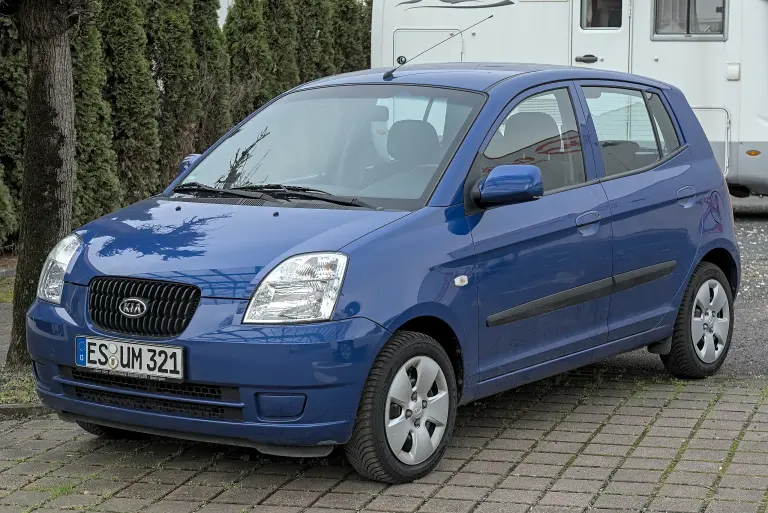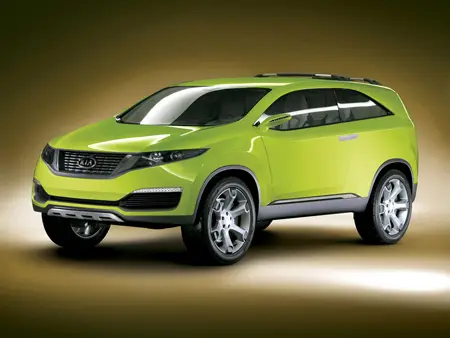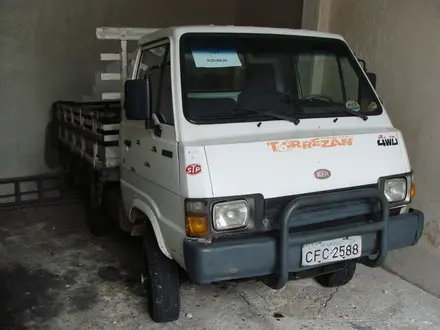
The Kia Ceres was a high-riding one-ton truck developed by Kia Industries in 1983 from the first-generation Bongo. It was one of Korea’s best-known four-wheel-drive trucks, built for farm tracks and orchards rather than public roads.
Kia Ceres at a glance
| Maker | Kia Industries, later Kia Motors |
|---|---|
| Production | 1983–December 1999 |
| Based on | first-generation Kia Bongo |
| Engine, 1983–1995 | 2.2-litre diesel, 60 PS |
| Engine, 1995–1999 | 2.4-litre diesel, 70 PS |
| Gearbox | four-speed column change to 1988, then five-speed floor change |
| Drive | rear-wheel drive; four-wheel drive from 1986, short wheelbase only |
| Body | soft top until 1988, hard top afterwards |
| Top speed | about 100 km/h |
| Name origin | Ceres, the Roman goddess of agriculture |
The detailed account comes from the Korean Wikipedia article; the English article on the Bongo confirms the Ceres as its agricultural version.
History of the Kia Ceres
The Ceres was created in 1983 from the first-generation Bongo truck as a special agricultural model with a raised chassis. Its name comes from Ceres, the Roman goddess of agriculture, the Roman counterpart of the Greek Demeter. Early cars were rear-wheel drive only, and four-wheel drive was added in 1986 for the short-wheelbase version; long-wheelbase trucks stayed rear-driven.
Farm specification
The Ceres was designed to work on rough farm tracks, woodland and slopes, where it was faster and more durable than a walking tractor. Until 1988 the cab had a soft top rather than a hard one, and front suspension used leaf springs, unlike the first-generation Bongo. It could carry a water pump or a pesticide sprayer driven through its power take-off, with a separate rev counter for the PTO at the left corner of the dashboard. For those reasons it sold well on Jeju Island, where there are many orchards, and it is rare in large cities.
Engines and equipment
From 1983 to 1995 the truck used a 2.2-litre diesel of 60 PS; after the 1995 facelift it had a 2.4-litre diesel of 70 PS until production ended in December 1999. The gearbox was a four-speed column change until 1988 and a five-speed floor change afterwards. Because the Ceres was meant for farm work rather than long road journeys it had very little electronic equipment: no power steering and no power windows at any point, air conditioning only on late cars, a radio at first and a cassette radio later. There was no tachometer apart from the PTO gauge.
Badges and facelift
The front badge changed from KIA MASTERS to KIA MOTORS, and with Kia’s new corporate identity in November 1986 it became the kia wordmark with a wave above it in 1988, then the red oval KIΛ in 1994. The 1995 facelift replaced the rectangular headlamps with round ones, rounded the cab and dropped the front kangaroo bar to meet a revised road traffic law. The range included cargo, three-way tipper, mobile fuel and fire versions.
The Ceres was discontinued in December 1999 because it could not meet emission rules, and it was folded into the Bongo Frontier, which then gained a four-wheel-drive version of its own.
Design and features
- High chassis: raised ground clearance for farm tracks and orchards.
- Four-wheel drive: added in 1986 on short-wheelbase trucks.
- Power take-off: ran pumps and sprayers, with its own rev counter.
- Simple equipment: no power steering or windows, so little to go wrong in the field.
Kia Ceres versions
- Ceres rear-wheel drive (1983–1986): the original farm truck with a soft top.
- Ceres four-wheel drive (1986–1999): short wheelbase only.
- Cargo and tipper: flat-bed and three-way tipping bodies.
- Special bodies: mobile fuel truck and fire truck conversions.
The Ceres was the agricultural version of the Kia Bongo family and was replaced by the four-wheel-drive Bongo Frontier; its van relative was the Besta. More Kia models are in the Kia collection.
Sources
- Kia Ceres, Korean Wikipedia: dates, engines, four-wheel drive, equipment, facelift
- Kia Bongo, English Wikipedia: origin as an agricultural Bongo version, export markets