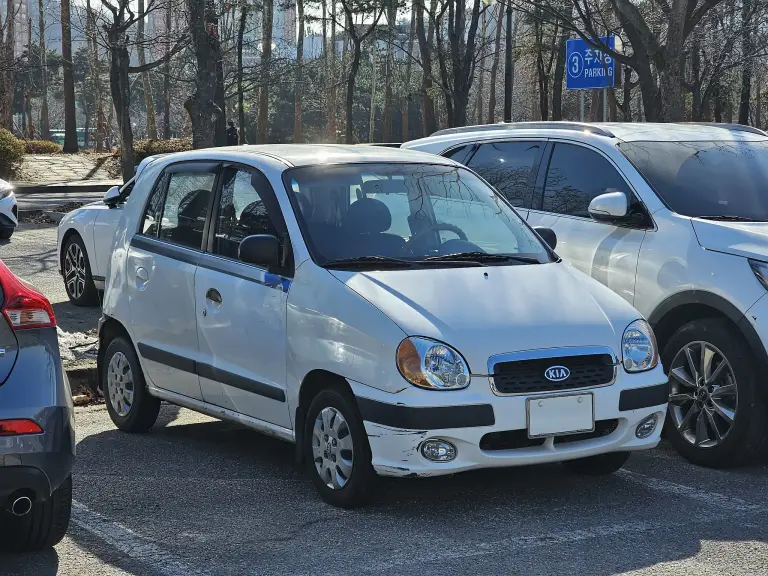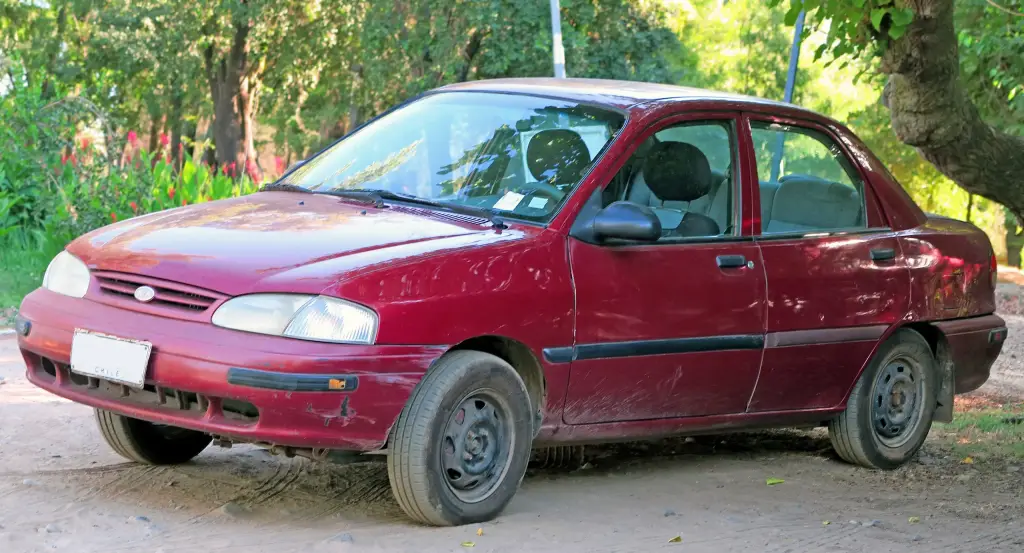
The Kia Avella was a small front-wheel-drive car built in Korea from March 1994 to November 1999. It was the second generation of the Festiva family, developed as a world car with Ford selling and Mazda engineering, and in North America the same car was sold as the Ford Aspire.
Kia Avella at a glance
| Maker | Kia Motors |
|---|---|
| Production | March 1994–November 1999 |
| Project code | WB |
| Also sold as | Ford Aspire (North America), Ford Festiva (other markets) |
| Body styles | three-door and five-door hatchback, four-door sedan from 1995 |
| Drive | front-wheel drive |
| Suspension | MacPherson struts front, torsion beam rear |
| Brakes | ventilated discs front, drums rear |
| Length | 3,880 mm (three-door), 3,975 mm (five-door), 4,165 mm (sedan) |
| Wheelbase | 2,310 mm (three-door), 2,390 mm (sedan and five-door) |
| Seats | five |
| Replaced by | Kia Rio, November 1999 |
The English article covers the Avella as part of the Ford Festiva family; dates and dimensions come from the Korean article.
History of the Kia Avella
The Avella began as the planned replacement for the Kia Pride, the first Festiva generation that Kia had built under Mazda licence since 1986. Because the Pride kept selling well, Kia did not retire it; instead the new car was launched as a more expensive small model and placed between the Pride and the larger Sephia, and the two were built side by side. Like the Pride, the Avella was a world car: Kia built it in Korea, Ford sold it, and Mazda designed it.
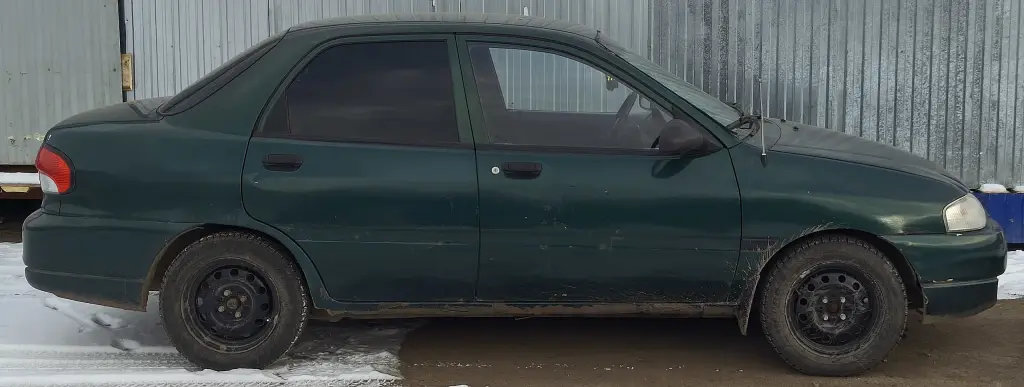
The name comes from the Latin Abella, and also from the Italian town of the same name. Where the Pride had straight lines, the Avella followed the rounded style that Hyundai had used on the Accent. It went on sale on 29 March 1994 with three-door and five-door hatchback bodies only.
Delta sedan
On 21 September 1995 Kia added a four-door sedan for the Korean market, which preferred saloons, and gave it the sub-name Delta. Earlier that year, on 21 February, the range had gained a power antenna, moved from the driver’s A-pillar to the front of the passenger-side fender, and a one-piece front bumper and grille. The hatchbacks were facelifted on 1 September 1996.
The three-door was dropped on 1 October 1997. At the same time the Delta sedan was facelifted, renamed from Avella Delta to plain Delta, and made the base model of the range; the five-door hatchback was facelifted during 1998 and also took the Delta sub-name. The Avella was discontinued on 8 November 1999, when its successor, the Kia Rio, was launched.
In North America the same car was sold as the Ford Aspire for the 1993–2000 model years, and the Festiva name continued in other markets. The Festiva family it belonged to used Mazda’s DA platform and B-series four-cylinder engines in its first generation, and the first generation was sold as the Kia Pride in Korea, as the Mazda 121 in Australia and Europe, and as the Ford Festiva in the United States.
Design and features
- World car: designed by Mazda, built by Kia, sold by Ford in North America.
- Rounded body: a deliberate move away from the boxy Pride towards the shape of the Hyundai Accent.
- Delta sedan: a four-door added in 1995 for the Korean market and later the main body style.
- Front-wheel drive: MacPherson struts and a torsion beam, with disc brakes at the front.
Kia Avella versions
- Three-door hatchback (1994–1997): the entry model, 3,880 mm long.
- Five-door hatchback (1994–1999): 3,975 mm long, facelifted in 1996 and 1998.
- Avella Delta sedan (1995–1997): four-door with a 2,390 mm wheelbase.
- Delta (1997–1999): the sedan after the 1997 facelift, when it became the base model.
The Avella sat between the Kia Pride and the Kia Sephia, and it was replaced by the Kia Rio. More Kia models are in the Kia collection.
Sources
- Ford Festiva, English Wikipedia: world-car arrangement with Ford and Mazda, Aspire and Avella names, model years
- Kia Avella, Korean Wikipedia: launch and facelift dates, Delta sedan, dimensions