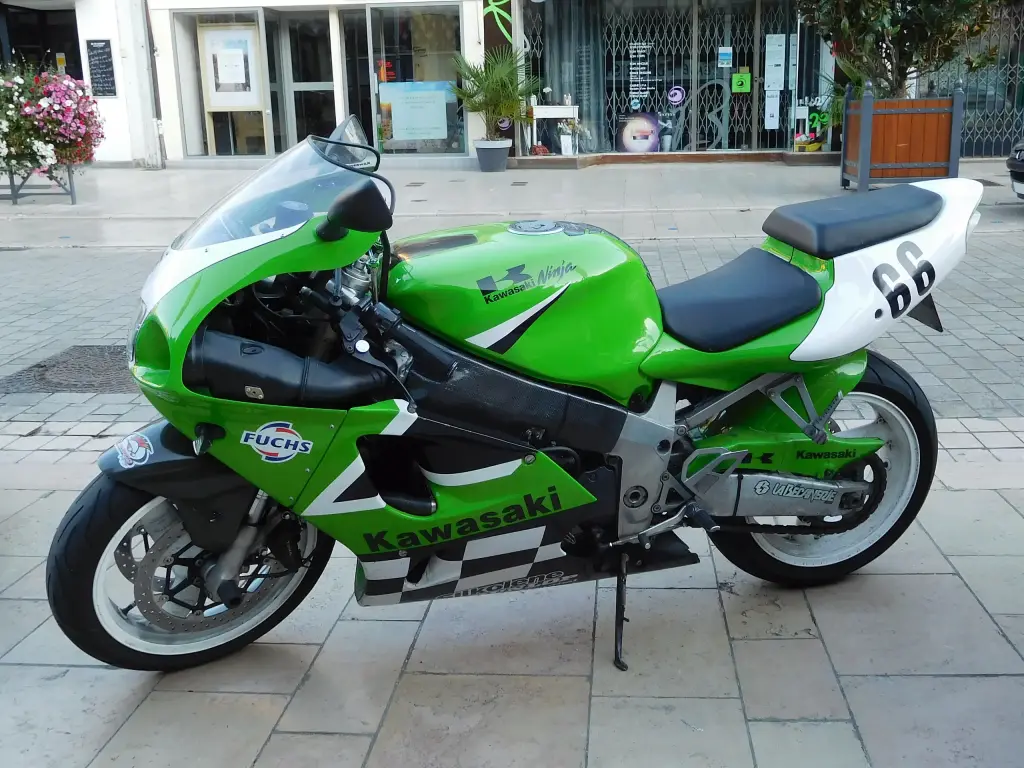
The Kawasaki Ninja ZX-7R was a 750 cc motorcycle in the Ninja sport bike series, produced from 1989 until 2003. From 1989 to 1995 it was sold as the ZX-7 in the United States and as the ZXR-750 in Europe and Asia.
Kawasaki Ninja ZX-7R at a glance
| Maker | Kawasaki |
|---|---|
| Produced | 1989–2003 |
| Class | 750 cc superbike |
| Engine | 749 cc liquid-cooled inline four, DOHC, 4 valves |
| Frame | aluminium twin-spar |
| Rear suspension | Uni-Trak rocker arm |
| 1991 homologation | ZX-7R in the USA, ZXR-750R elsewhere |
| 1996 names | ZX-7R and ZX-7RR |
| First model, 1989 | 107 hp at 10,500 rpm |
| 1989 bore × stroke | 68 × 51.5 mm |
| 1989 compression | 10.8:1 |
| 1989 front brakes | twin 310 mm discs, four-piston calipers |
| 1989 dry weight | 451.9 lb |
Based on one source, the English Wikipedia article on the ZX-7R.
History of the Kawasaki Ninja ZX-7R
Kawasaki developed the ZX-7 because rivals were building more and more racing-oriented 750 cc sport bikes in the late 1980s. Superbike racing was growing worldwide, with the Superbike World Championship starting in 1988, and homologation rules pushed manufacturers to sell road bikes suited to racing. In 1988 Kawasaki’s only 750 cc sport bike was the GPX 750R, which could not match the Honda RC30, Suzuki GSX-R750 and Yamaha FZR-750. Developed from the ZXR7 endurance racer, the ZX-7 arrived for the 1989 model year and was updated continuously through the 1990s; racing versions went on to win four AMA Superbike Championships and one Superbike World Championship.
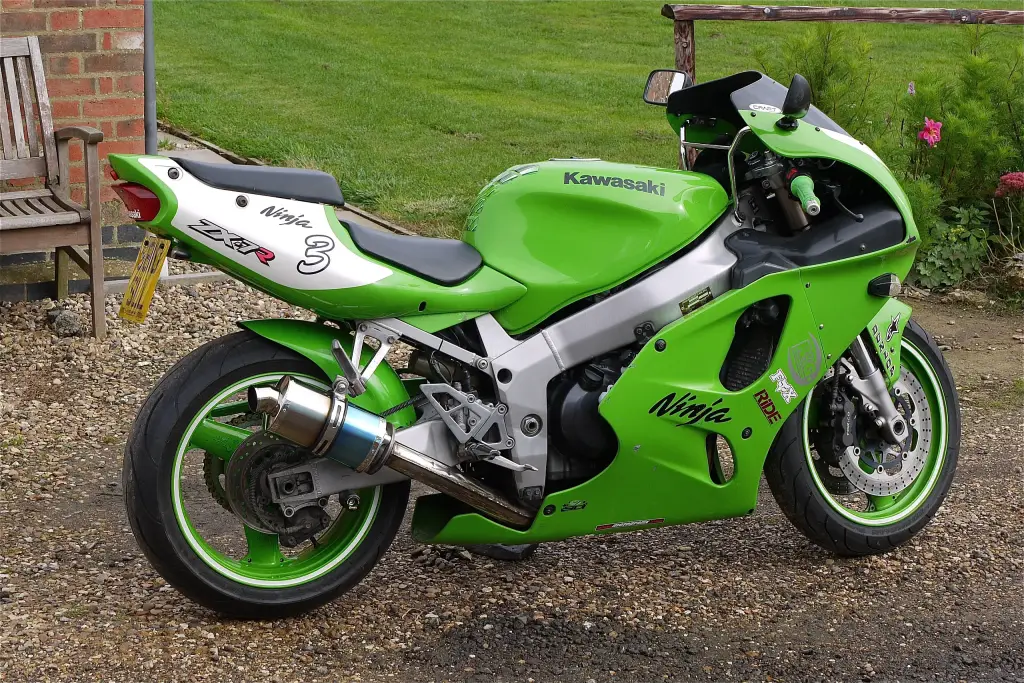
ZX-7 H1, 1989
The first year received mixed reviews. Some journalists criticised its weight, 30 lb more than that year’s Suzuki GSX-R750 and 70 lb more than the Honda RC30, while its handling was praised as approachable, if with a noticeably stiff rear suspension. The H1 produced 107 crankshaft horsepower at 10,500 rpm from an engine based on the GPX750R with a completely new cylinder head, a 68 mm bore, 51.5 mm stroke and 10.8:1 compression. Valves were actuated directly by bucket tappets, the cam chain ran between cylinders two and three, and fuelling came from four 36 mm Keihin CVKD carburettors. The twin-spar frame had bolt-on down tubes cradling the engine, suspension was 43 mm adjustable forks and a Uni-Trak monoshock, front brakes were twin 310 mm rotors with four-piston calipers and the rear a 230 mm rotor with a two-piston caliper. The wheelbase was 1,410 mm and dry weight 451.9 lb.
H2 and J models
The 1990 H2 inherited much of the previous year’s race kit: a cylinder head with larger ports and valves, 38 mm carburettors, lighter pistons and con-rods, compression raised to 11.3:1, an internal paper oil filter, a four-into-one exhaust, a curved radiator and a new oil cooler. The swingarm became a single cast and welded piece, the frame gained 1 mm thicker sections, wheels and axles were lighter, the wheelbase grew to 1,455 mm and dry weight fell to 441 lb. For 1991 the J1 used an entirely new shorter-stroke engine of 71 × 47.3 mm, with the cam chain moved to the side of the engine and a crankshaft 22.6 mm shorter, a roller chain, single valve springs, larger 29 mm inlet and 25 mm exhaust valves, rocker-arm followers, a 20-degree included valve angle and compression of 10.8:1. An oil-to-coolant heat exchanger replaced the oil cooler, and the engine used two oil pumps, one for the engine and transmission.
Naming
From 1991 Kawasaki offered a superbike homologation version called the ZX-7R in the United States and the ZXR-750R worldwide. In 1996 the ZXR name was dropped: the former ZX-7 and ZXR-750 became the ZX-7R, and the homologation model became the ZX-7RR.
Design and features
- Aluminium twin-spar frame: welded from pressed and cast sections, with a square-tube aluminium rear subframe.
- Uni-Trak rear suspension: a rocker arm giving progressively stiffer damping and spring rate under compression.
- Slipper clutch: a multi-plate wet unit feeding a six-speed gearbox.
- Homologation special: the ZX-7R and later ZX-7RR were built to qualify racing versions.
- Racing record: four AMA Superbike titles and one Superbike World Championship.
Kawasaki Ninja ZX-7R versions
- ZX-7 H1 (1989): the original, 107 hp.
- ZX-7 H2 (1990): race-kit engine parts, 38 mm carburettors, lighter chassis.
- ZX-7 J1/J2 (1991–1992): new short-stroke engine with side cam chain.
- ZX-7R / ZXR-750R (from 1991): the homologation version.
- ZX-7R and ZX-7RR (from 1996): the final naming of road and homologation models.
The ZX-7R was developed alongside the smaller ZX-6R and the larger ZX-9R. More models are in the Kawasaki collection.
Video: Kawasaki ZX-7R RUN 2
Video by jellekamma on YouTube.
Sources
- Kawasaki Ninja ZX-7R, English Wikipedia: background, specifications, model years, naming, racing