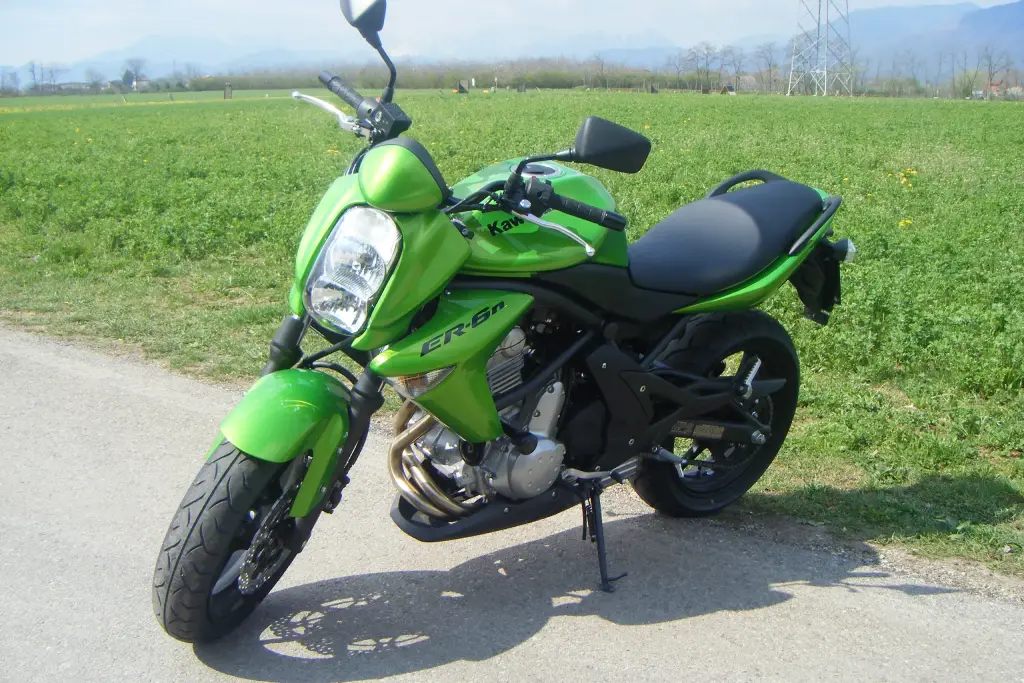
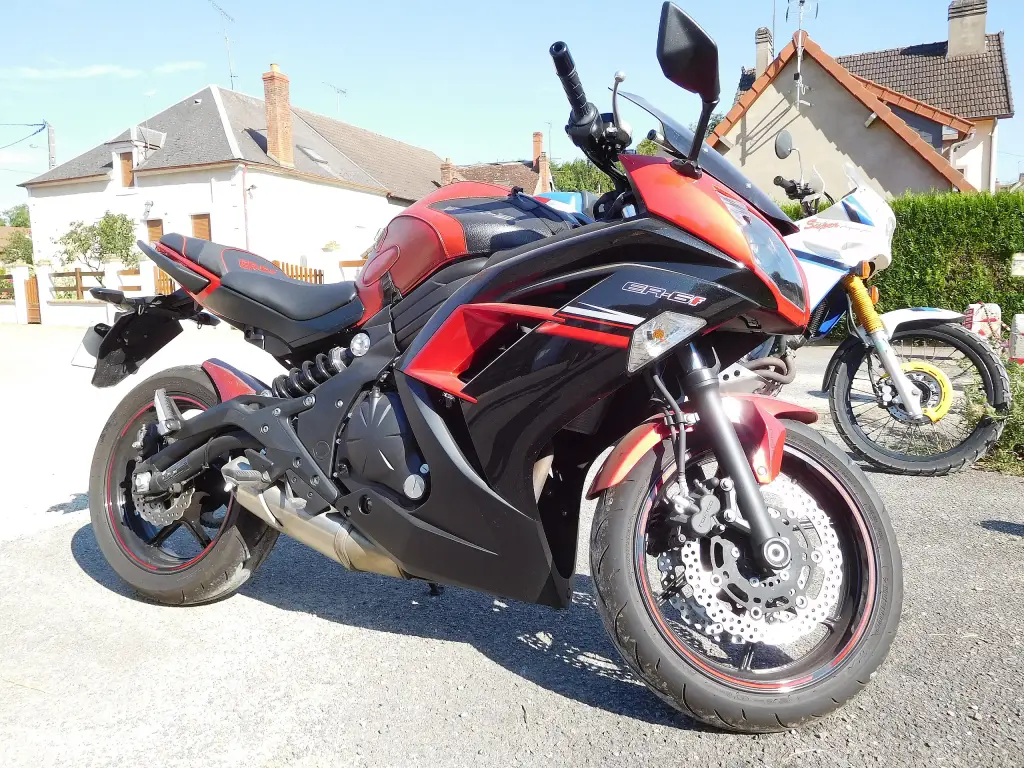
The Kawasaki ER-6 is a 649 cc parallel-twin motorcycle sold from 2005 in two forms: the naked ER-6n and the faired ER-6f, which in North America and some other markets was called the Ninja 650R. Both were replaced by the Z650 and Ninja 650 in 2017.
Kawasaki ER-6 at a glance
| Maker | Kawasaki |
|---|---|
| Sold | 2005–2016 (ER-6); Ninja 650 since 2006 |
| Also called | ER-6n (naked), ER-6f / Ninja 650R (faired) |
| Engine | 649 cc four-stroke parallel twin, 180° crankshaft |
| Power | 72 hp (53 kW) |
| Transmission | six-speed |
| Frame | steel diamond frame; trellis from 2017 |
| Front brakes | twin petal discs |
| Top speed | about 205 km/h |
| Acceleration | 0–100 km/h in 4.1 seconds |
| Replaced by | Z650 and Ninja 650 (2017) |
The English article is written around the Ninja 650R; the Italian article covers the European ER-6n and ER-6f versions.
History of the Kawasaki ER-6
Kawasaki launched the ER-6 in 2005 with a newly designed 649 cc parallel twin derived from the ER-5 engine, in a naked “n” version and a faired “f” version. The 180° crankshaft gives an uneven firing interval of 180° and 540°, which shapes the engine’s character and sound. In North America the faired model was sold as the Ninja 650R from 2006, and the naked ER-6n only arrived there for 2009.
Design
The first ER-6 used a diamond frame of welded chrome-molybdenum tubes, a good compromise between strength and cost. It had modern details taken from Kawasaki’s sports bikes, including twin petal front discs and a cassette gearbox derived from the ZX-10R experience, and the catalytic converter sat under the engine to lower the centre of gravity and keep exhaust heat away from the passenger.
Updates
For 2009 Kawasaki revised the two most basic components, the instruments and the tail, and lightly changed the headlight and mirrors. The 2012 model brought a new perimeter frame of twin steel beams, a new on-board computer for fuel consumption, a two-piece seat, 20 mm wider handlebars and a tachometer above an LCD dash. For 2017 the Ninja 650 moved to a trellis frame, lost the distinctive side-mounted rear shock and gained a slipper clutch.
On the road
Tests found the ER-6 docile but willing, with a modern, agile chassis. It suited beginners, returning riders and anyone wanting a machine that was not too demanding but still fun. The rear shock was mounted high in the frame so the cantilever swing arm could be long — about 40 percent of the bike’s length — while the wheelbase stayed short and stable. The bike was low, the narrow seat met a narrow tank, and the passenger got grab handles and well-placed footpegs.
Design and features
- 649 cc parallel twin: a 180° crankshaft gives the uneven firing interval that defines the ER-6’s feel.
- Low, narrow package: a low seat height and slim tank made the bike approachable for shorter riders.
- Under-engine exhaust: the catalyst sits below the engine to lower the centre of gravity and keep heat off the passenger.
- Petal front discs: sports-bike braking hardware on a middleweight roadster.
- Long cantilever swing arm: about 40 percent of the bike’s length, for stability with a short wheelbase.
Kawasaki ER-6 versions
- ER-6n: the naked version, not sold in North America until 2009.
- ER-6f / Ninja 650R: the faired version, with passenger grab handles as standard.
- 2009 update: new instruments, tail, headlight and mirrors.
- 2012: perimeter frame, new bodywork, on-board computer.
- 2017 Ninja 650: trellis frame, conventional rear shock, slipper clutch.
The ER-6 replaced the ER-5, and its engine and chassis also produced the Versys. More Kawasaki models are in the Kawasaki collection.
Video: Ride 2013 – Kawasaki ER-6N
Video by swobber1 on YouTube.
Sources
- Kawasaki Ninja 650R, English Wikipedia: models, markets, updates, specifications
- Kawasaki ER-6, Italian Wikipedia: frame, brakes, power, road behaviour