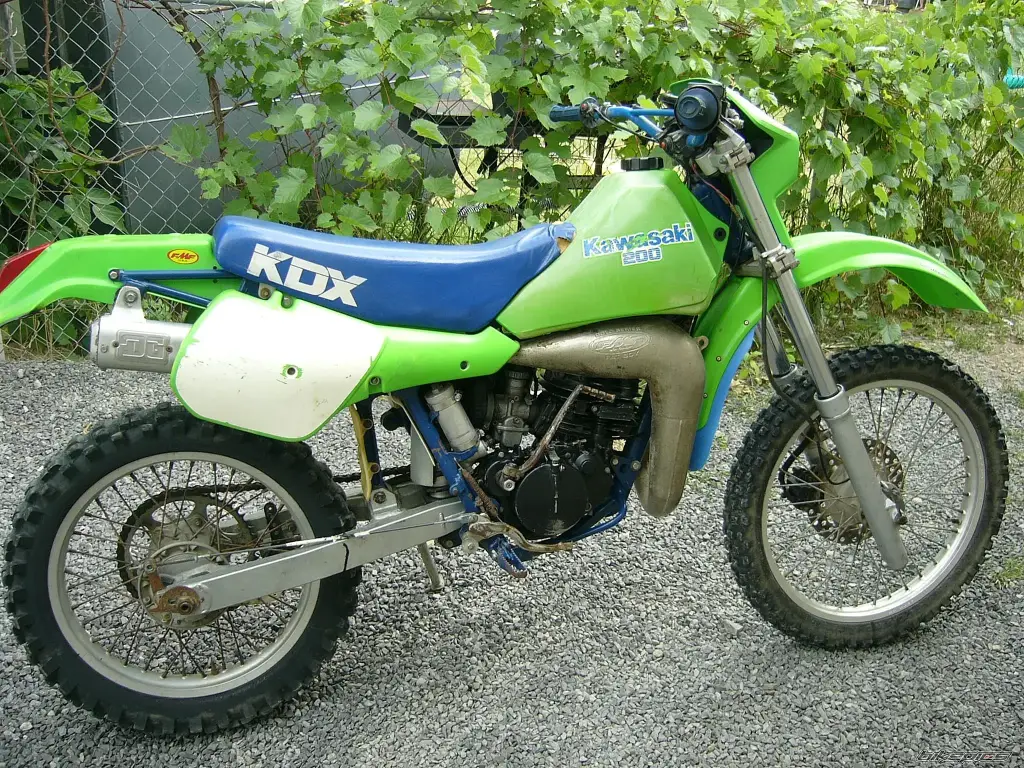
The Kawasaki KDX200 is an intermediate enduro motorcycle intended mainly for off-road use. Introduced in 1983 as a development of the KDX175, it stayed in Kawasaki’s range, with several revisions, until production ended in 2006.
Kawasaki KDX200 at a glance
| Maker | Kawasaki |
|---|---|
| Produced | 1983–2006 |
| Class | intermediate enduro |
| Engine | 198 cc two-stroke single |
| Gearbox | six-speed |
| Power valve | KIPS, Kawasaki Integrated Powervalve System |
| A (1983–1985) | 38 mm Kayaba forks, steel frame based on the 1983 KX125 |
| C (1986–1988) | KIPS, 43 mm forks, front disc brake |
| E (1989–1994) | liquid cooling, dual disc brakes, 12 litre tank |
| H (1995–2006) | perimeter frame, 43 mm cartridge forks |
Based on one source, the English Wikipedia article on the KDX200.
History of the Kawasaki KDX200
The KDX200 arrived in 1983 after revisions to the preceding KDX175. Its engine grew from 173 to 198 cc by lengthening the stroke, with the bore unchanged from the 175, and it used a six-speed gearbox with one more clutch plate than before — seven instead of six. The chassis was based on the 1983 KX125, with steel tubing, a box-section aluminium swingarm, an adjustable aluminium shock and 38 mm Kayaba forks, plus an electronic odometer. For 1984 the A2 was available in green or with a black frame and red plastic, and 1985 brought a new 34 mm Mikuni R slide carburettor.
C generation, 1986–1988
The C model introduced the KIPS power valve system, 43 mm conventional forks, a new rear shock and a front disc brake.
E generation, 1989–1994
1989 was a big year: liquid cooling, a modified power valve system with a larger expansion bottle and valves, a heavier crank, dual disc brakes, heavier clutch springs and more plates, a new frame with a modern-style linkage, a KX125-based shock with 16 compression and 16 rebound adjustments, quick-release rear wheel access, a large airbox and a 12.0 litre fuel tank. Upside-down 41 mm forks became standard on the 1993 and 1994 models.
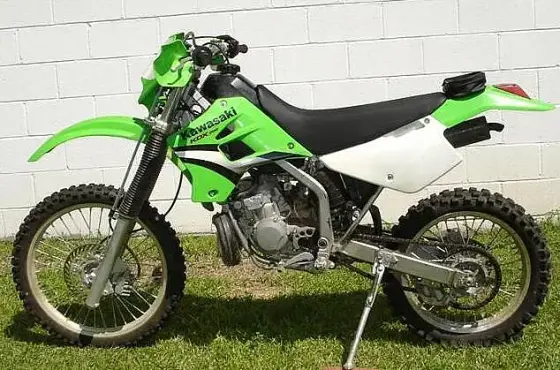
H generation, 1995–2006
1995 brought a modern new look and a redesigned KIPS system with larger valves and a central power valve in the exhaust manifold, along with the first perimeter frame, 43 mm Kayaba cartridge forks, higher compression, larger radiators, a larger clutch and a taller seat. The KDX200 had its last production run in 2006, and leftover machines were sold through 2007 and into mid-2008 in some markets.
Design and features
- KIPS power valve: Kawasaki’s system to broaden the two-stroke powerband, especially the mid-range and top end.
- Six-speed gearbox: close ratios for enduro use, with seven clutch plates from the first model.
- Liquid cooling from 1989: a major upgrade over the earlier air-cooled engines.
- Trail-friendly: less demanding than a motocross bike, the KDX200 became a long-running favourite for off-road riders.
Kawasaki KDX200 versions
- KDX200 A (1983–1985): the original, based on the KX125 chassis.
- KDX200 C (1986–1988): KIPS, 43 mm forks, front disc.
- KDX200 E (1989–1994): liquid cooling, dual discs, upside-down forks from 1993.
- KDX200 H (1995–2006): perimeter frame, new bodywork, taller seat.
The KDX was Kawasaki’s enduro line alongside the motocross KX; the road-going KMX took similar ideas to 125 cc. More models are in the Kawasaki collection.
Sources
- Kawasaki KDX200, English Wikipedia: generations, specifications, changes