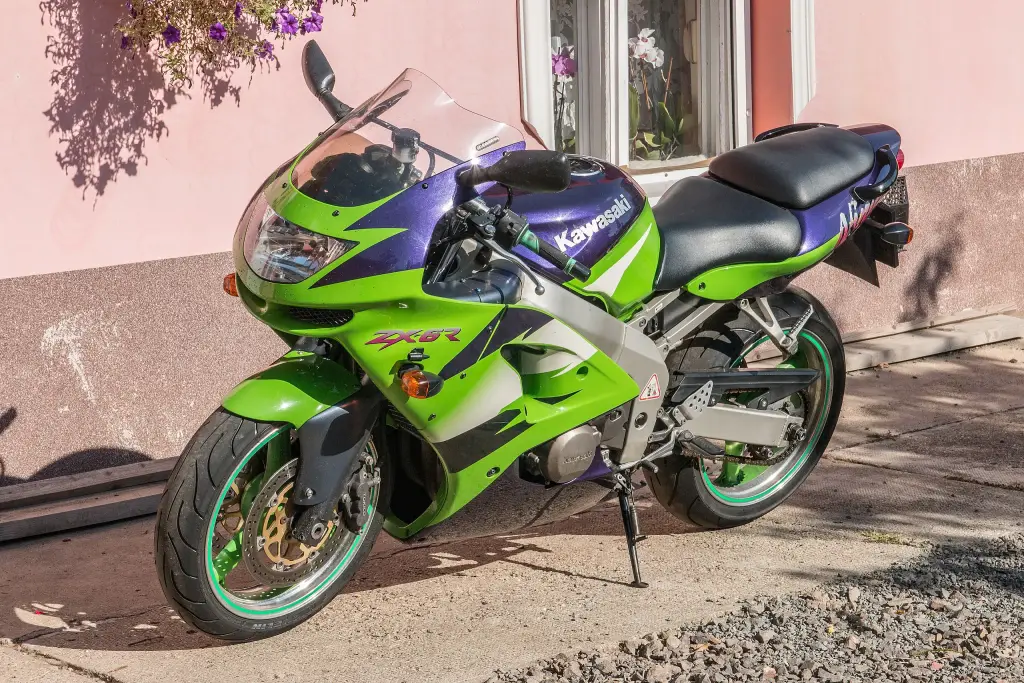
The Kawasaki Ninja ZX-6R is a 600 cc class motorcycle in the Ninja sport bike series. It was introduced in 1995 and has been updated continually in response to new models from Honda, Suzuki and Yamaha.
Kawasaki Ninja ZX-6R at a glance
| Maker | Kawasaki |
|---|---|
| Introduced | 1995 |
| Class | 600 cc sport bike |
| First model dry weight | 182.0 kg |
| First model wet weight | 206 kg |
| 0–60 mph, first model | 3.6 seconds |
| G series (1998) | 108 bhp from a new airbox |
| J series (2000) | 112 bhp, 12.8:1 compression, 180 rear tyre |
| 636 cc (2002) | ZX-6R A1P, plus the 599 cc ZX-6RR for racing |
| 2003 | fuel injection, radial four-piston brakes, inverted forks |
| 2005 | 131 hp at 12,250 rpm, undertail exhaust |
| 2007 | new 599 cc engine with stacked gear arrangement |
| 2009 | Showa Big Piston Fork, low exhaust |
| 2013 | 636 cc engine reintroduced |
Based on one source, the English Wikipedia article on the ZX-6R.
History of the Kawasaki Ninja ZX-6R
Kawasaki introduced the ZX-6R in 1995 with looks and features very similar to the ZX-9R of 1994, including the ram-air intake Kawasaki had developed since the 1990 ZX-11 (ZZ-R1100). The first ZX-6R had a dry weight of 182.0 kg and a wet weight of 206 kg, and accelerated from 0 to 60 mph in 3.6 seconds.
G and J series
The 1998 G series was a major revamp: displacement stayed the same but power rose from 100 to 108 bhp thanks to a new airbox, and the fairing was reworked while keeping a similar headlight, air intakes and screen. In 2000 the J series replaced the G, lifting power to 112 bhp by raising compression from 11.8:1 to 12.8:1. It brought a 180-section rear tyre, a second headlight, an uprated generator and stick coils in place of conventional coils with HT leads.
636 cc
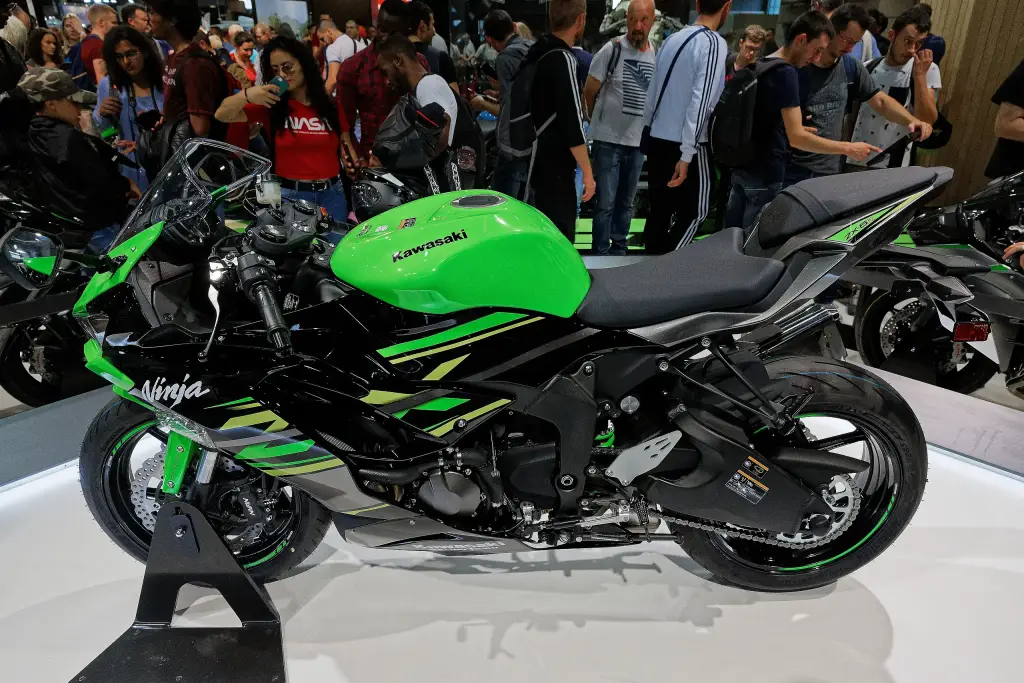
Facing strong competition from the Honda CBR600F4i, Suzuki GSX-R600 and Yamaha YZF-R6, Kawasaki took the unusual step of raising capacity to 636 cc with the 2002 ZX-6R A1P, which used J-series bodywork distinguished by “636” stickers. For riders who needed a machine for displacement-restricted racing, Kawasaki also offered a limited-production 599 cc ZX-6RR, but the 636 cc ZX-6R remained the mass-production middleweight. The 2003 model, known as the ZX636, gained fuel injection, raised engine speed by about 500 rpm, radial four-piston brakes in place of six-piston units, inverted forks, higher chassis rigidity, less weight, an all-digital instrument panel and a larger ram-air intake moved to the centre over the headlight. The 2005 model raised engine speed by another 1,000 rpm for 131 hp at 12,250 rpm, updated the frame and swingarm, and moved the exhaust under the seat.
Back to 599 cc
For 2007 Kawasaki offered a single ZX-6R of 599 cc, with an engine redesigned from the crankcase up, using a stacked gear arrangement that placed crankshaft, primary drive and countershaft in a triangle for a shorter, more compact powerplant about 40 mm smaller in length and width. Frame, swingarm, suspension, brakes and body were redesigned and few parts carried over. For 2009 the styling became more angular to match the ZX-10R, the bike was about 10 kg lighter, the exhaust moved low and the Showa Big Piston Fork was introduced. The 2010 model added an improved engine and a slipper clutch, more exhaust pre-chamber volume and double-bore intake funnels with two heights. For 2013 Kawasaki reintroduced the 636 cc ZX-6R alongside the 599 cc model, with two selectable fuel maps.
Design and features
- Ram-air intake: developed from the ZZ-R1100 and carried through every generation.
- 636 cc option: extra capacity for the road, with a 599 cc ZX-6RR for racing classes.
- Constant development: fuel injection, inverted forks, radial brakes, slipper clutch and big-piston fork arrived in turn.
- Compact 2007 engine: a stacked gear arrangement made the powerplant shorter and narrower.
Kawasaki Ninja ZX-6R versions
- ZX-6R (1995–1997): the first model, 182 kg dry.
- G series (1998–1999): 108 bhp, new airbox.
- J series (2000–2001): 112 bhp, higher compression.
- 636 cc ZX-6R and 599 cc ZX-6RR (2002): the split between road and racing models.
- 2003–2006: fuel injection, radial brakes, inverted forks, 131 hp from 2005.
- 2007–2012: new 599 cc engine, Showa Big Piston Fork from 2009.
- 2013 onwards: the 636 cc engine returns.
The ZX-6R sits below the ZX-9R and above the ZZR600 in Kawasaki’s Ninja range. More models are in the Kawasaki collection.
Video: Kawasaki Ninja ZX-6R 636 | Supersport Vergleich 2013
Video by 1000PS – die starke Motorradseite im Internet on YouTube.
Sources
- Kawasaki Ninja ZX-6R, English Wikipedia: model history, generations, technical changes