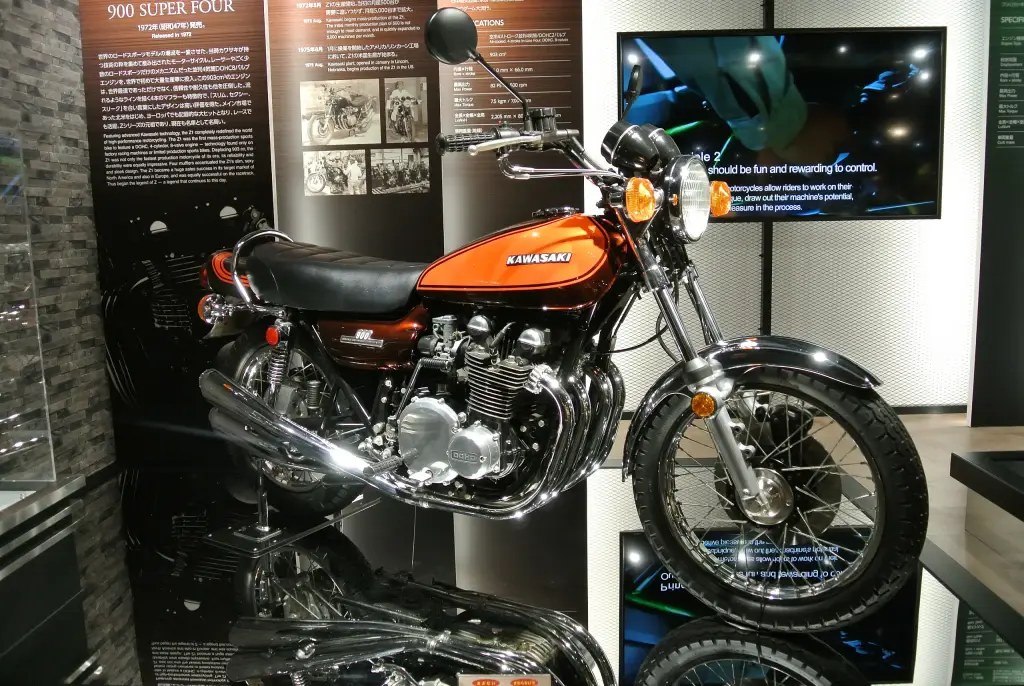
The Kawasaki Z1 is a four-cylinder, air-cooled, double-overhead-camshaft, carburetted, chain-drive motorcycle introduced by Kawasaki in 1972. Following Honda’s CB750 of 1968, the Z1 helped popularise the in-line, across-the-frame four that became known as the Universal Japanese Motorcycle.
Kawasaki Z1 at a glance
| Maker | Kawasaki |
|---|---|
| Introduced | 1972 |
| Engine | 903 cc air-cooled DOHC inline four |
| Claimed output | 82 bhp |
| Top speed | 130–132 mph (about 210 km/h) |
| Induction | carburettors |
| Final drive | chain |
| Project name | New York Steak |
| Also marketed as | Z1-900, 900 Z1, 900 S4 Super Four |
| Endurance record | 2,631 miles in 24 hours at 109.64 mph, Daytona 1972 |
| Update | Z1-B in 1975 |
| Replaced by | KZ900 / Z900 in 1976 |
Based on one source, the English Wikipedia article on the Z1. The old record was of the Z1-R version, which is described here as a variant.
History of the Kawasaki Z1
The Z1 was developed under the project name New York Steak. In the late 1960s Kawasaki, already established as a maker of two-strokes, began prototyping a 750 cc four-cylinder four-stroke sports bike and worked with McFarlane Design in 1969 on its appearance. When Honda brought out the CB750 first, Kawasaki postponed the launch until the displacement could be raised to 903 cc so that the bike could be marketed in the 1000 cc class. Production began in 1972, and the Z1 was the most powerful Japanese four-cylinder four-stroke yet sold.
Why it mattered
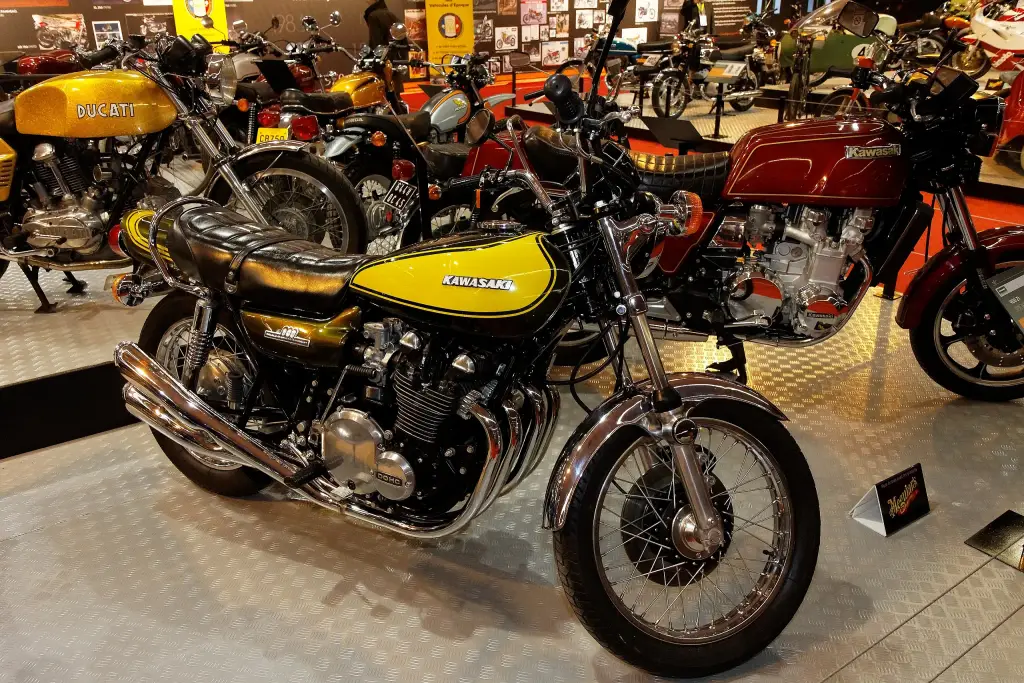
The Z1 was the first large-capacity Japanese four-cylinder production motorcycle with a double overhead camshaft. When it appeared, only the MV Agusta 750 S used that layout, and that was an expensive limited-production machine costing more than twice as much. The Z1 had full instrumentation, electric start and a kickstart, produced 82 bhp and reached 130 to 132 mph. The press praised its smoothness, its damping of vibration, easy starting, straight-line stability and linear acceleration; testers found the steering accurate and the handling good, though the rear tyre, chain and rear shocks wore out quickly.
Records and awards
In 1972 a Z1 set the FIM and AMA 24-hour endurance record on the banked Daytona circuit, covering 2,631 miles at an average of 109.64 mph. At the same time a one-off Z1 ridden by Yvon Duhamel and tuned by Yoshimura set a one-lap record of 160.288 mph with a 100 bhp engine. The Z1 was awarded Machine of the Year by the British weekly Motorcycle News every year from 1973 to 1976, and the Society of Automotive Engineers of Japan lists the 1972 Z1 among its 240 Landmarks of Japanese Automotive Technology.
Changes and successors
The design stayed much the same until 1975, when the 903 cc Z1-B arrived with more power, improved suspension, a stiffer frame, no automatic chain oiler, revised styling and better brakes. In 1976 the Z1 was replaced by the KZ900 in the United States and the Z900 elsewhere, which in turn gave way to the 1977 KZ1000 and the Z1000 Z1-R, and in 1984 to the Z1100R. The Zephyr of 1991 and the Z1000 of 2003 both copied much of the original naked Z1 design, and in 2018 Kawasaki released the Z900RS as a tribute.
Design and features
- First big DOHC Japanese four: a layout that became the Universal Japanese Motorcycle.
- 82 bhp and 130 mph: among the fastest production bikes of the early 1970s.
- Full equipment: instrumentation and both electric and kick starting.
- Endurance record: a 24-hour average of 109.64 mph at Daytona in 1972.
- Design legacy: copied by the Zephyr, the 2003 Z1000 and the 2018 Z900RS.
Kawasaki Z1 versions
- Z1 (1972–1974): the original 903 cc model.
- Z1-B (1975): more power, stiffer frame, improved suspension and brakes.
- Z1000 Z1-R (1978): the faired, black-engined top model that followed the Z1000.
- Z900RS (2018): a modern tribute with water cooling, fuel injection and ABS.
The Z1 was succeeded by the KZ1000 and its style was revived by the Zephyr. More models are in the Kawasaki collection.
Video: Kawasaki Z1000 Z1-R 1978
Video by tore1972 on YouTube.
Sources
- Kawasaki Z1, English Wikipedia: history, records, press reception, successors