The Kawasaki KX is a range of two-stroke motocross motorcycles from Kawasaki Heavy Industries Motorcycle & Engine, presented in 1974 with 125, 250 and 450 models. The line has covered capacities from 60 to 500 cc, and since 2004 it has been joined by the four-stroke KX-F.
Kawasaki KX at a glance
| Maker | Kawasaki Heavy Industries Motorcycle & Engine |
|---|---|
| Presented | 1974, with 125, 250 and 450 models |
| Type | motocross |
| Capacities | 60–65, 80–85, 100, 125, 250 and 450/400/420/500 cc |
| Engine | two-stroke, liquid-cooled from the 1980s |
| Four-stroke line | KX-F, from 2004 |
| Power valve | KIPS, introduced on the 125 in 1985 |
| Rear suspension | Uni-Trak from 1980 |
| Model naming | a letter for the model and a number for its year, as in KX-A1 |
Based on one source, the Italian Wikipedia article on the KX; there is no English article.
History of the Kawasaki KX
Kawasaki presented the KX motocross line in 1974 with 125, 250 and 450 cc machines. Over the following decades the range spread across almost every motocross class, from 60 cc minibikes to 500 cc open-class bikes, and from 2004 it was accompanied by the four-stroke KX-F. Kawasaki names each year’s model with a letter that grows as the model is developed and a number for its year, so a model sold unchanged over several years keeps its letter while the number rises; additional letters mark variants such as KX-F2A.
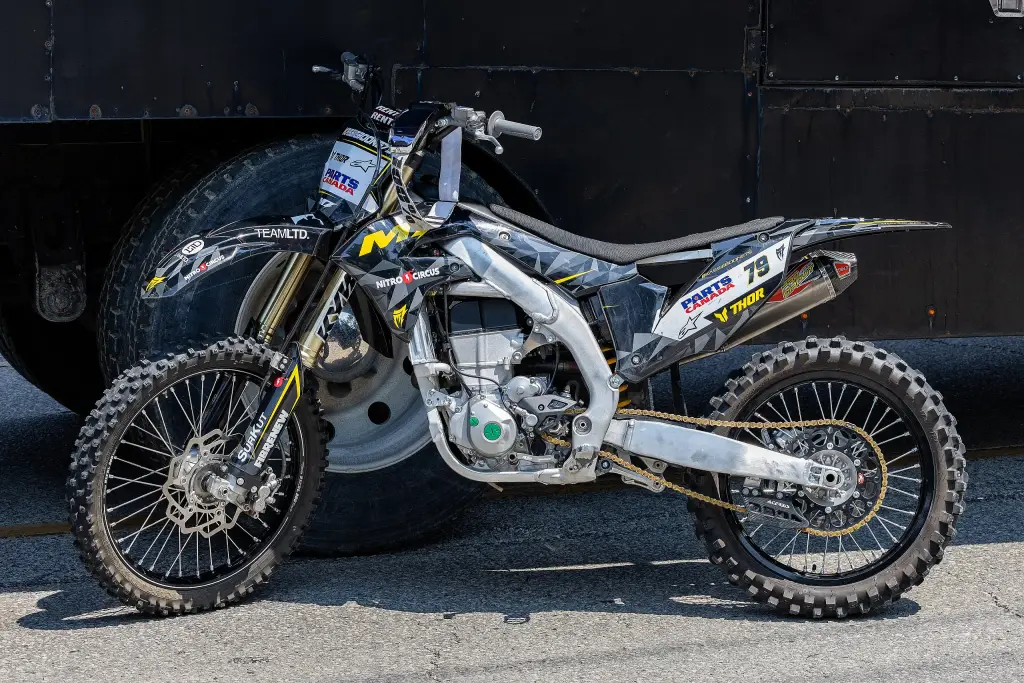
125 and 250
The 125 was a motocross competition bike built from 1974, initially air-cooled. It was not produced in 1977; in 1978 the rotary valve gave way to a reed valve, and in 1980 the rear suspension changed from twin shocks to the Uni-Trak linkage monoshock. In 1982 the brakes moved from drums at both ends to a front disc and rear drum, with discs at both ends following in 1986, and liquid cooling arrived in 1982. KIPS appeared in 1985 with a resonance chamber and two rotary valves; a third rotary valve was added in 1988, the original layout returned in 1990, and from 1992 a two-piece slide valve and two rotary valves were used without the resonance chamber. From 1998 a slide valve was used, updated in 2000 and 2002, and in 2003 Kawasaki returned to a split slide valve. Ignition changed from analogue to digital in 1989, upside-down forks arrived in 1990, and the frame developed from a double-cradle steel design to a twin-spar frame with a split cradle in 1990. The 250 followed the same path from 1974, with reed valves in 1978, Uni-Trak in 1980 and liquid cooling in 1982.
Small capacities
The 60 cc class arrived in 1983, joined by a 65 cc model from 2000 and replaced in 2004; the change came from a bigger bore, from 42.5 × 41.6 to 44 × 41.6 mm. Liquid cooling replaced air cooling in 1985, the 65 gained disc brakes at both ends in 2000, and digital ignition came in 2006. The 80 arrived in 1979 and became an 85 in 2001 through a bigger bore and stroke, from 48 × 44 to 48.5 × 45.8 mm; Monocross with linkage replaced the Doublecross system in 1981 and was revised in 1986, liquid cooling and a front disc arrived in 1983, discs at both ends in 1988, digital ignition in 1991 and KIPS in 1998. The 100, introduced in 1995, was based on the 80 with a larger bore and also gained KIPS in 1998; despite being slightly more powerful it raced in the 85 class.
Design and features
- KIPS power valve: Kawasaki’s exhaust valve system, developed across the range from 1985.
- Uni-Trak suspension: the linkage monoshock that replaced twin shocks on the 125 and 250 in 1980.
- Liquid cooling: adopted through the 1980s as the range moved from air cooling.
- KX-F four-strokes: added in 2004 alongside the two-strokes.
- Clear model naming: a letter for each model and a number for the year, so buyers can identify any machine.
Kawasaki KX versions
- KX 60/65: minibike class, 1983–2004.
- KX 80/85 and KX 100: small-wheel classes, from 1979.
- KX 125 and KX 250: the main motocross classes, from 1974.
- KX 450/400/420/500: open-class two-strokes.
- KX-F: four-stroke models from 2004.
The KX range inspired the miniature KSR110, and Kawasaki’s enduro line is covered by the KDX200. More models are in the Kawasaki collection.
Video: Kawasaki KX 250 FMF Gnarly – Sweet 2-Stroke Sound Compilation
Video by trxmh on YouTube.
Sources
- Kawasaki KX, Italian Wikipedia: range, model history by capacity, technical changes