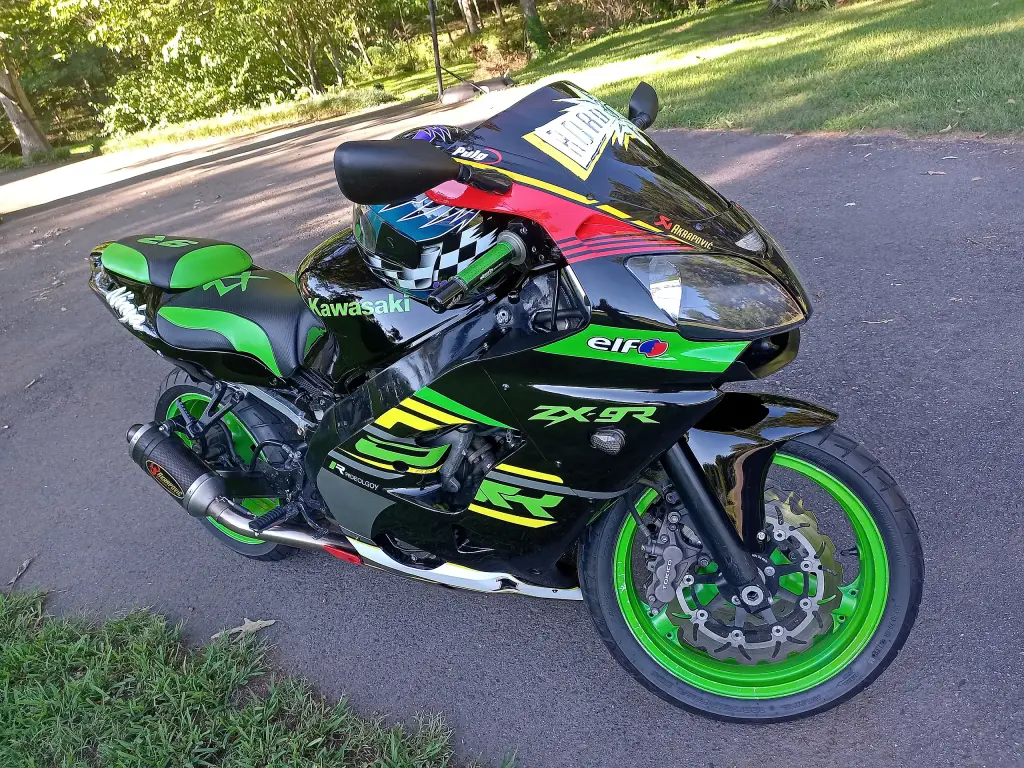
The Kawasaki Ninja ZX-9R is a motorcycle in the Ninja sport bike series, produced from 1994 until 2003. There were five model incarnations across two basic designs.
Kawasaki Ninja ZX-9R at a glance
| Maker | Kawasaki |
|---|---|
| Produced | 1994–2003 |
| Class | 900 cc sport bike |
| Developed from | Kawasaki ZX-7 |
| Launched | 1993 Paris Motor Show, on sale 1994 |
| Engine | 899 cc liquid-cooled inline four, DOHC, 4 valves |
| First engine power | 139 hp at 10,500 rpm |
| 1994 bore × stroke | 73 × 53.7 mm |
| Compression | 11.5:1 |
| Redline | 12,000 rpm |
| Carburettors | four 40 mm Keihin CVKD |
| Front brakes 1994 | twin 310 mm discs, four-piston calipers |
| 1994 dry weight | 477 lb |
| UK 1994–1995 | limited to 125 hp by a manufacturers’ agreement |
| 1998 C model | new engine and chassis, 143 hp |
Based on one source, the English Wikipedia article on the ZX-9R.
History of the Kawasaki Ninja ZX-9R
Kawasaki developed the ZX-9R in response to Honda’s CBR900RR Fireblade of 1992, which put a 900 cc engine into a 750 cc chassis and combined big-bore power with sports-bike handling and meticulous weight saving. The Fireblade not only outpowered the 750s, it was also much lighter, and it revived the 900 cc class. Kawasaki’s only litre-class machine at the time, the ZX-11, weighed 144 lb more than the new Fireblade. Kawasaki began work on a new 900 cc sport bike based on the successful ZX-7, launched it at the 1993 Paris Motor Show and began sales in 1994.
B models, 1994–1997
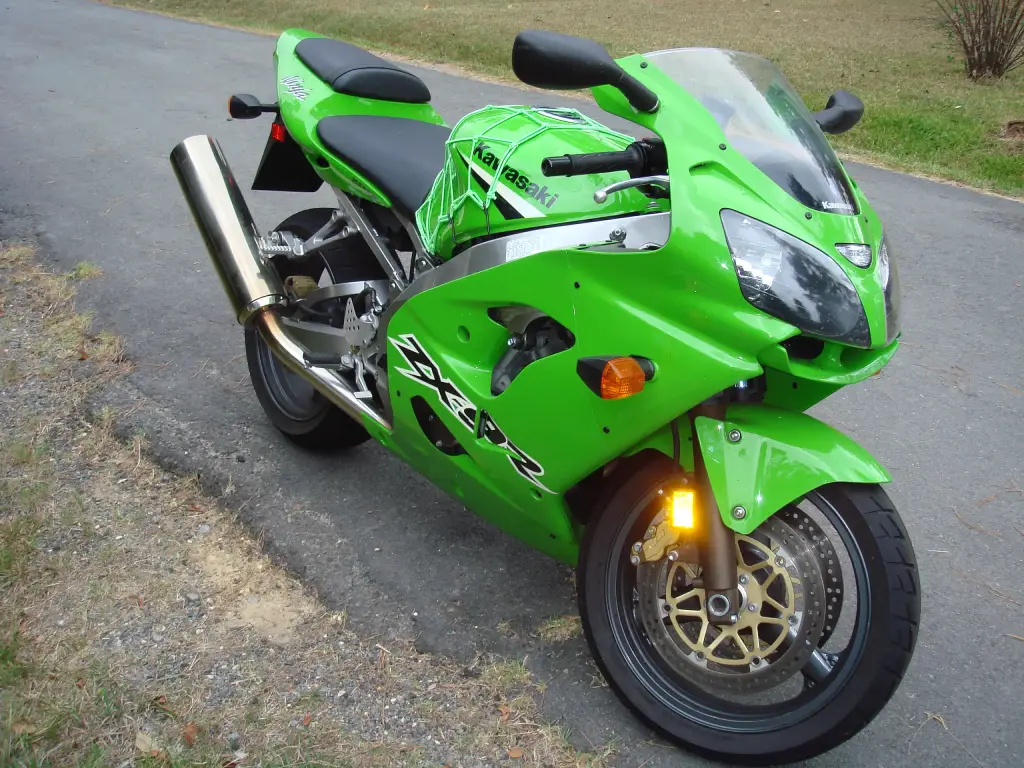
The ZX-9R shares many design features with the ZX-7. To reach 900 cc the bore and stroke grew to 73 × 53.7 mm, and the longer stroke made the cylinder block taller. The crankshaft and crankcases were strengthened for the heavier rotating mass and greater output. Valves were operated by rocker-arm followers, the cam chain sat on the right of the engine, fuelling came from four 40 mm Keihin CVKD carburettors, compression was 11.5:1 and the redline 12,000 rpm. Dual ram-air intakes under the single headlight fed ducts passing over the frame beams near the steering head. The result was 139 hp at 10,500 rpm, 17 more than the 1994 Fireblade. In 1994 and 1995 ZX-9Rs sold in Britain were limited to 125 hp under a manufacturers’ agreement. Suspension was 43 mm upside-down KYB forks adjustable for compression, rebound and preload, with a Uni-Trak linkage and an adjustable KYB damper with remote reservoir at the rear; front brakes were twin 310 mm rotors with four-piston Tokico calipers and the rear a 210 mm rotor with a single-piston caliper. The wheelbase was 57.6 in and dry weight 477 lb. Contemporary reviews called the 1994–1995 ZX-9R a less sharp, more stable and more comfortable alternative to the Fireblade, with higher straight-line speed; Cycle World recorded a 10.65-second quarter mile at 131.38 mph and a 166 mph top speed. The 1996 B3 brought a revised swingarm, linkage and shock to fix a lack of rear grip, new six-piston Tokico front calipers and twin pillion grab rails.
C models, 1998–1999
The 1998 model was heavily redesigned, with an entirely new engine and chassis sharing few parts with the B. The bore grew to 75 mm and the stroke fell to 50.9 mm, allowing larger valves, and direct bucket tappets replaced rocker arms, permitting a narrower valve angle and straighter intake tracts. Compression stayed at 11.5:1 and the redline at 12,000 rpm. The 40 mm Keihin CVKD carburettors gained a throttle position sensor which, with a new camshaft position sensor, let the ignition module vary timing by engine speed and load, and coil-on-plug ignition replaced the remote coils. The crankshaft was lightened and the generator moved to its end to cut rotational inertia, and the gearbox was strengthened with closer ratios. The new engine claimed 143 hp at the crankshaft. The chassis became shorter and lighter, using the engine as a stressed member instead of steel cradles.
Design and features
- Fireblade response: a 900 cc engine in a chassis developed from the ZX-7.
- Ram-air intake: twin intakes under the headlight feeding ducts over the frame beams.
- Strong engine: 139 hp in 1994, 17 more than the contemporary Fireblade.
- 1998 rebuild: new short-stroke engine, direct bucket tappets and a stressed-member chassis.
- British market limit: 125 hp in 1994 and 1995 under a manufacturers’ agreement.
Kawasaki Ninja ZX-9R versions
- ZX-9R B1–B4 (1994–1997): the first generation, 139 hp.
- B3 (1996): revised rear suspension, six-piston front calipers, grab rails.
- ZX-9R C1/C2 (1998–1999): new engine and chassis, 143 hp.
The ZX-9R was developed from the ZX-7R and later provided the engine basis for the first Z1000. More models are in the Kawasaki collection.
Video: Kawasaki ZX-9R Ninja on-board, Top Speed, Acceleration, 300km/h, wheelie
Video by Hopper8256 on YouTube.
Sources
- Kawasaki Ninja ZX-9R, English Wikipedia: background, specifications, B and C models