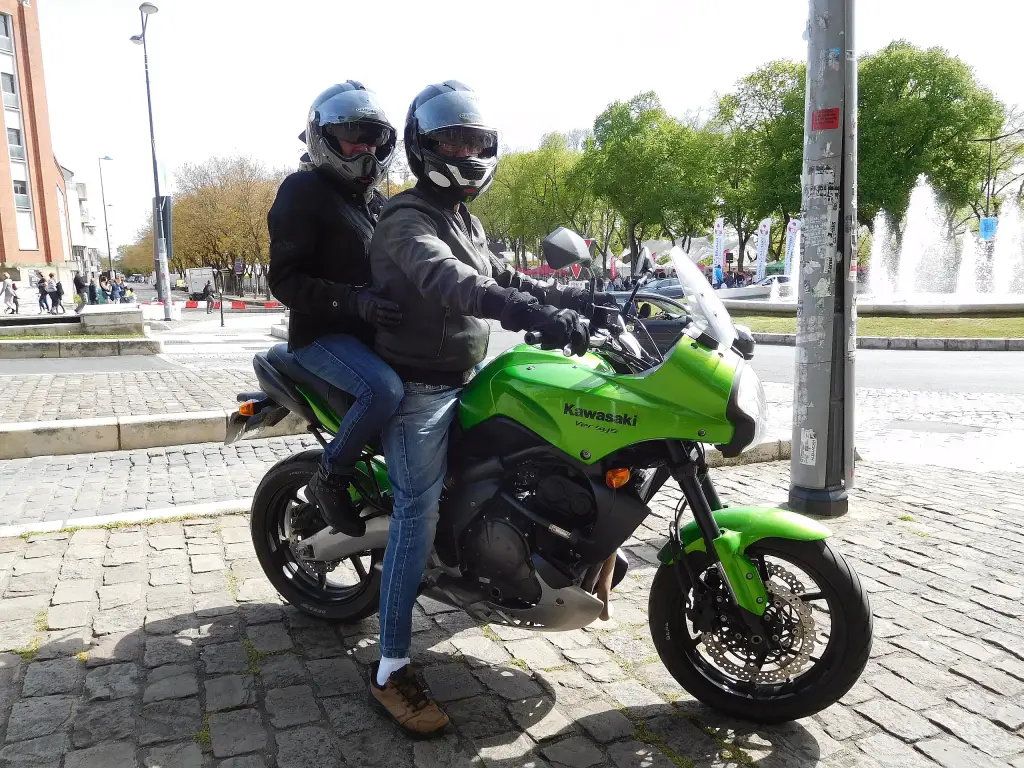
The Kawasaki Versys is a family of adventure touring motorcycles that Kawasaki has built since 2007. Its name comes from the English phrase versatile system, and the range has grown from the 650 to four capacities and more.
Kawasaki Versys at a glance
| Maker | Kawasaki |
|---|---|
| Family since | 2007 |
| Versys-X 250/300 | 2017 onwards, based on the Ninja 250R/300 twin |
| Versys 650 | 2007 onwards, based on the ER-6 twin |
| Versys 1000 | 2012 onwards, based on the Z1000 four |
| Versys 1100 | 2024 onwards, based on the Ninja 1100SX |
| 650 engine | 649 cc liquid-cooled parallel twin |
| 650 power | 51 kW (69 hp) |
| 650 torque | 64 N·m at 7,000 rpm |
| 650 bore × stroke | 83 × 60 mm |
| 650 compression | 10.8:1 |
| 650 top speed | 189 km/h |
| 650 tank | 21 litres from 2015 (19 before) |
| 650 weight | 216 kg from 2015 (209 before) |
The English article lists the family; the German one covers the 650 in detail. The old record carried a dead video, so no video is shown.
History of the Kawasaki Versys
Kawasaki launched the Versys 650 at the end of 2006 for the European market, as a sport tourer whose name was taken from the phrase versatile system. Its design came from Shunji Tanaka, the designer of the Mazda MX-5, and its engineering was based on the ER-6 range, but with longer suspension travel, a 41 mm upside-down fork adjustable for preload and rebound, a half fairing and an engine retuned for better torque at low and middle revs. Since 2007 the family has grown: the Versys-X 250/300 arrived in 2017 on the Ninja 250R/300 twin, the Versys 1000 in 2012 on the Z1000 four, the Versys 1100 in 2024 on the Ninja 1100SX, and a Versys 900 is expected.
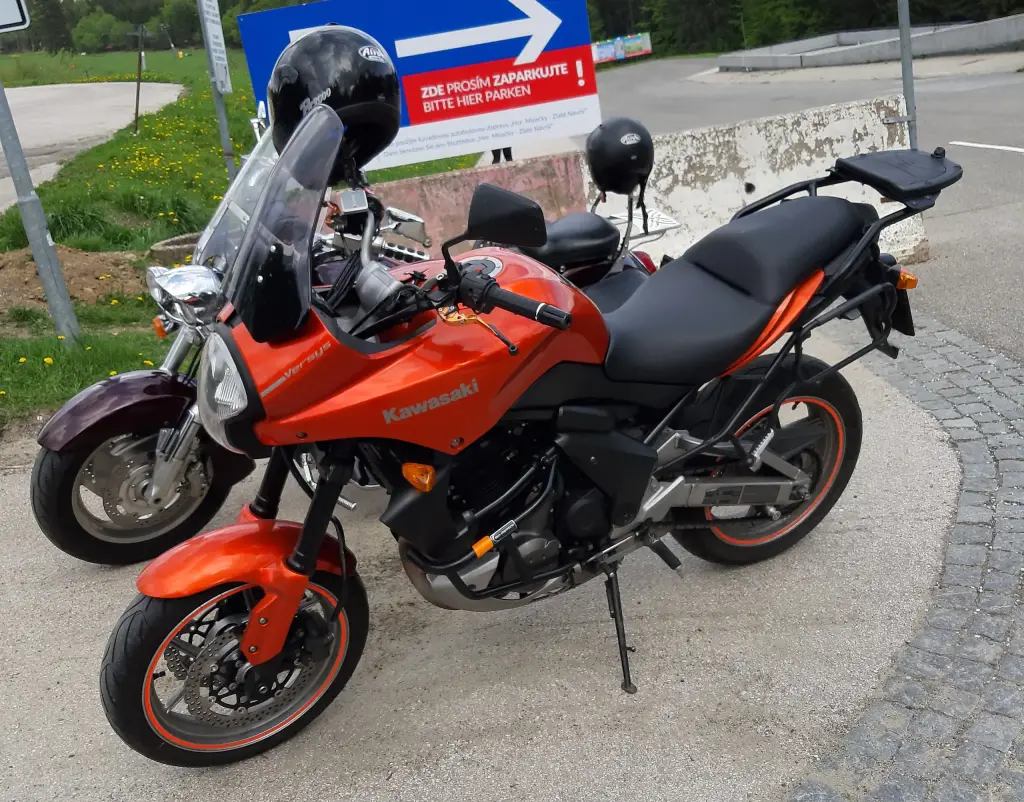
The 650 engine
The liquid-cooled 649 cc parallel twin produces 51 kW (69 hp) and 64 N·m at 7,000 rpm. Its two cylinders have an 83 mm bore and a 60 mm stroke with a compression ratio of 10.8:1, and the engine uses a balancer shaft and two chain-driven overhead camshafts operating two inlet and two exhaust valves per cylinder through bucket tappets. Since 2015 the exhaust is entirely stainless steel, and the engine has met Euro 5 since about 2021. Tests measured 0 to 100 km/h in 4.7 seconds, a top speed of 189 km/h and consumption between 4.0 and 4.8 litres per 100 km.
Model development
From the 2008 model year a sister model called the Travel Edition or Versys Tourer was available with panniers, an improved screen and hand guards. The 2010 update changed the front fairing, mirrors, tail and seat. For 2015 the narrow front fairing with stacked headlights gave way to a wider one with side-by-side lights, the screen grew and became three-way adjustable, the rear shock gained separate preload adjustment, the engine rose from 47 to 51 kW and from 61 to 64 N·m and was rubber-mounted, and the tank grew from 19 to 21 litres while the wet weight rose from 209 to 216 kg. The 2022 model added switchable traction control, a four-way screen, extra bodywork and a colour 4.3-inch TFT display with smartphone integration.
How it was received
Test riders praised the engine character, fuel consumption and handling, and sometimes criticised the front design and the damping of the telescopic fork. In Germany the 650 Versys sold far fewer units than the ER-6 it was derived from, and fewer than the Z 650 that followed; the BMW F 650 GS and F 700 GS and the Suzuki DL 650 V-Strom were its main market rivals.
Design and features
- ER-6-based twin: retuned for low and mid-range torque, with longer suspension travel than the roadster.
- Upside-down fork: 41 mm, adjustable for spring preload and rebound, with a half fairing for wind protection.
- Adventure touring focus: a 21 litre tank since 2015 and a range of accessories, including a Travel Edition with panniers.
- Modern electronics from 2022: switchable traction control and a 4.3-inch colour TFT display.
Kawasaki Versys versions
- Versys 650 (2007 onwards): the original middleweight, updated in 2010, 2015 and 2022.
- Versys-X 250/300 (2017 onwards): the small adventure model on the Ninja 250R/300 twin.
- Versys 1000 (2012 onwards): the four-cylinder version based on the Z1000.
- Versys 1100 (2024 onwards): based on the Ninja 1100SX.
The Versys 650 was developed from the ER-6, and the 1000 uses the engine of the Z1000. More models are in the Kawasaki collection.
Sources
- Kawasaki Versys, English Wikipedia: the family and its models
- Kawasaki KLE 650 Versys, German Wikipedia: design, engine data, model development, market
- Kawasaki Versys, Italian Wikipedia: family overview