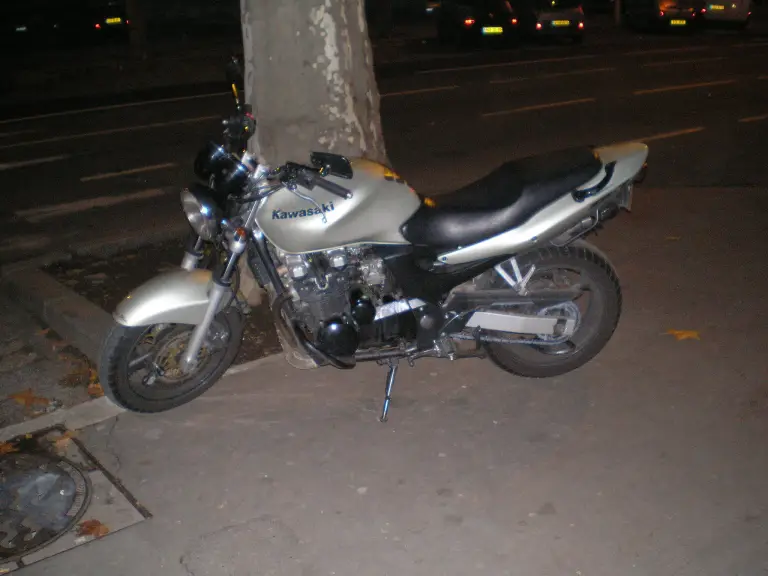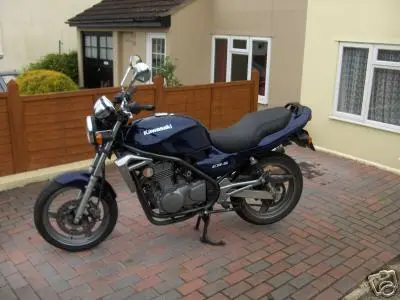
The Kawasaki ER-5 is a naked commuter motorcycle produced in Japan by Kawasaki from 1996 to 2006. Its liquid-cooled four-stroke DOHC 498 cc engine was based on the design used in the GPZ500, and the bike was eventually replaced by the ER-6.
Kawasaki ER-5 at a glance
| Maker | Kawasaki |
|---|---|
| Produced | 1996–2006 |
| Class | naked commuter |
| Engine | 498 cc liquid-cooled DOHC parallel twin |
| Power | 49.6 hp (37 kW) |
| Carburettors | two, one per cylinder |
| Front brake | single disc, twin-piston caliper |
| Rear brake | drum |
| Front fork | 36 mm tubes on A models, 37 mm on C models |
| Rear suspension | twin shocks with adjustable preload |
| Weight | about 180 kg |
| Top speed | about 180 km/h |
| Replaced by | Kawasaki ER-6 |
The English article covers the engineering, the Italian one the production history and road tests.
History of the Kawasaki ER-5
Kawasaki presented the ER-5 in 1996 as a straightforward, affordable naked bike. Its 498 cc parallel twin came from the long-serving GPZ500 design, also used in the KLE, and produced about 51 hp in its first form — roughly ten less than the sporty GPZ500S but with more torque at low revs. The result was a top speed of about 180 km/h and acceleration from 0 to 100 km/h in under five seconds.
Changes through the years
The little Kawasaki was restyled several times; the deepest change came in 2001, with the last in 2005. Over the years it mixed classic details such as chrome and twin rear shocks with modern touches like an aircraft-style filler cap and adjustable levers, while keeping the weight within about 180 kg.
Why riding schools liked it
The ER-5 became one of the favourite machines of riding schools across Europe because its maintenance costs were relatively low and it was generally considered easy for beginners. Tests of the period found the engine ready from the lowest revs, the seat comfortable and the narrow 110 front and 130 rear tyres very agile, though riders used to 160 or 180 section tyres felt the bike drop into corners quickly. The 37 mm fork was comfortable for touring but a little soft under hard acceleration or emergency braking; the twin rear shocks could be adjusted for preload to suit most situations.
Brakes
The front disc used a fixed disc and a floating caliper, the reverse of the arrangement on many modern bikes. The early “A” models had a smaller trailing piston than the leading one; the later “C” models used identical pistons front and rear of the caliper, which noticeably improved front braking. Owners of A models often fit C-model calipers.
Design and features
- GPZ500-derived engine: a proven 498 cc parallel twin with useful low-rev torque rather than peak power.
- Simple chassis: a conventional telescopic fork and twin rear shocks with preload adjustment keep costs down.
- Improved C-model brakes: equal caliper pistons gave noticeably better stopping than the early A models.
- Low running costs: the main reason the ER-5 was so common in riding schools.
Kawasaki ER-5 versions
- ER-5 A (1996–2000): 36 mm fork, uneven caliper pistons.
- ER-5 C (2001 onwards): 37 mm fork, equal caliper pistons, aircraft-style filler cap and adjustable levers.
- 2005 final version: the last restyling before the ER-6 took over.
The ER-5 was replaced by the Kawasaki ER-6, and its engine family also served the GPZ series. More Kawasaki models are in the Kawasaki collection.
Video: DNM Probefahrt mit Kawasaki ER5 Twister
Video by Dirk Neugebauer on YouTube.
Sources
- Kawasaki ER-5, English Wikipedia: engine, brakes, suspension
- Kawasaki ER-5, Italian Wikipedia: production years, power, weight, road tests