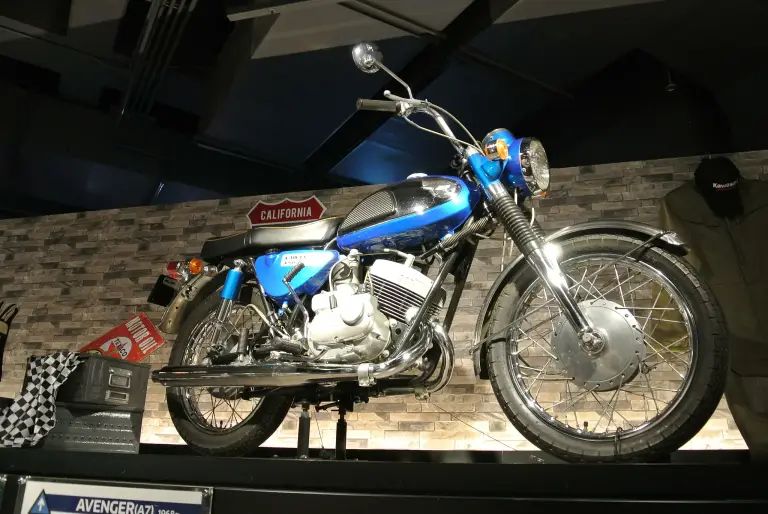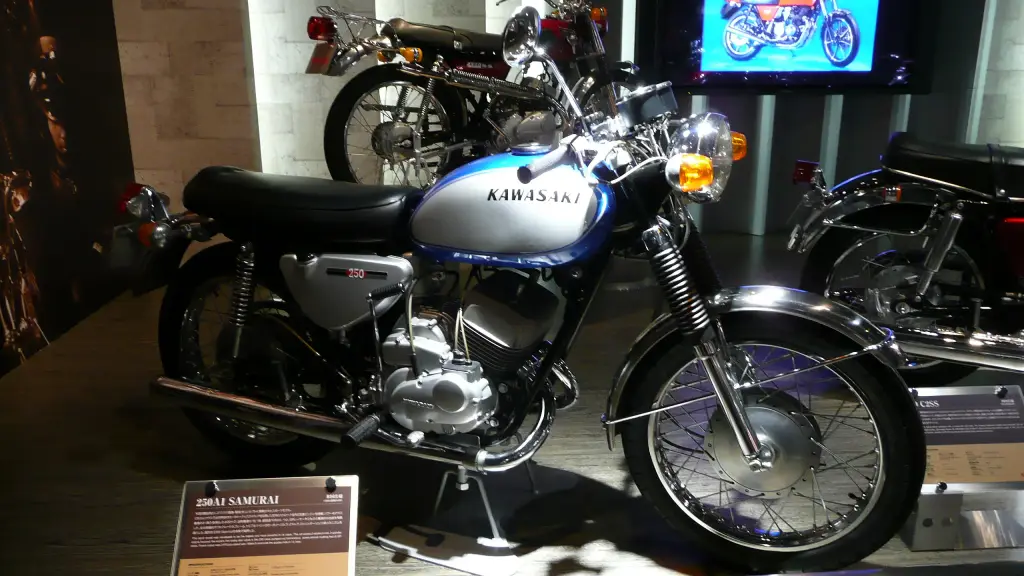
The Kawasaki A1 Samurai is a 250 cc standard motorcycle that Kawasaki sold from 1967 to 1971. It was the lighter, faster machine the company needed after the W1 had failed to sell as expected, and it was soon joined by the larger A7 Avenger.
Kawasaki A1 Samurai at a glance
| Maker | Kawasaki |
|---|---|
| Sold | 1967–1971 |
| Class | 250 cc standard |
| Engine | 247 cc air-cooled two-stroke parallel twin |
| Induction | two Mikuni carburettors, dual rotary disc valves |
| Bore × stroke | 53.0 × 56.0 mm |
| Compression | 6.8:1 |
| Power | 31 hp (23.1 kW) at 8,000 rpm |
| Lubrication | Superlube, oil injected into the intake tract |
| Ignition | points; CDI with thyristor switching from 1969 |
| Transmission | five-speed, wet clutch, chain drive |
| Frame | double tubular steel cradle |
| Suspension | telescopic front fork; swing arm with three-position preload |
| Brakes | 180 mm drum, front and rear |
| Acceleration | 0–60 mph in 6.6 seconds |
Based on one source, the English Wikipedia article on the A1 Samurai.
History of the Kawasaki A1 Samurai
Kawasaki’s first big four-stroke, the W1, did not sell as expected because rival bikes were faster, lighter and steered better. In 1967 the company answered with the A1 Samurai, a much lighter two-stroke that put roughly 80 hp per litre on the road and took centre stage as a high-performance 250. It was quickly followed by a larger-bore model, the A7 Avenger, which shared most of the Samurai’s components apart from the engine.
Engine and chassis
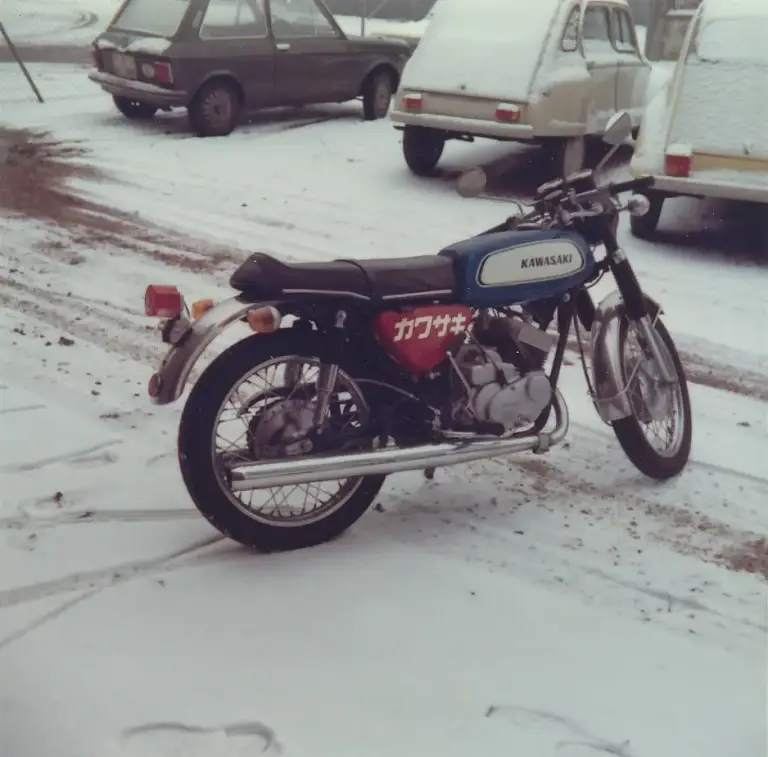
The engine was a straight twin, air-cooled and oil-injected, with dual rotary disc valves. Air came in through a filter canister below the seat, then through a plenum chamber above the transmission and behind the cylinder head into passages leading to the carburettors. The two Mikuni carburettors sat on either side of the engine in line with the crankshaft and were enclosed behind covers fixed to the crankcase, with the rotary disc valves inboard of them. The 247 cc combination of disc valves, carburettors and, from 1969, capacitor discharge ignition gave 31 hp at 8,000 rpm, about one horsepower for every 11 pounds of weight.
Colours and the A1SS
The A1SS Samurai differed from the standard A1 only in its crossover dual exhaust, mounted on the left below the seat. Paint changed almost every year: candy red or candy blue with chrome and a black frame in 1966–1967, a fully painted tank with a KAWASAKI word logo in 1968, an oval-sided tank in 1969, pearl candy red and white in 1970 and a flat-topped white pearl tank with gold, yellow and orange decals in 1971.
In its class
Against its 1969–1970 contemporaries the Samurai was at least as quick: the Honda Dream CB250 claimed 30 hp and 0–60 mph in 7.6 seconds, the Suzuki T250 Hustler 33 hp and 7.2 seconds, and the Yamaha DS6 28 hp and 6.5 seconds. The type is still eligible for American Historic Racing Motorcycle Association events.
Design and features
- Rotary disc valves: the intake is timed by a disc rather than the piston skirt, so the fuel charge is used instead of partly lost, giving more power and better low-rev response.
- Superlube: two-stroke oil is injected directly into the intake tract rather than pre-mixed with petrol.
- CDI from 1969: thyristor-switched capacitor discharge ignition raised the spark voltage to 25,000–30,000 volts and cut unburnt mixture in the cylinders.
- Light weight: a double tubular steel cradle frame and simple cycle parts kept the 250 close to the weight of a 125.
Kawasaki A1 Samurai versions
- A1 Samurai (1967–1971): the standard model with two exhausts.
- A1SS Samurai: identical apart from a crossover dual exhaust on the left below the seat.
- 1969 specification: capacitor discharge ignition introduced.
- 1971 colours: angular tank and fading decals shared with the rest of the range.
The Samurai was enlarged into the A7 Avenger, and its engine ideas led towards the H1 Mach III. More Kawasaki models are in the Kawasaki collection.
Video: Kawasaki A1 Samurai 250 rotary valve twin
Video by Murray Robert Barnard on YouTube.
Sources
- Kawasaki A1 Samurai, English Wikipedia: development, engine, colours, specifications, rivals