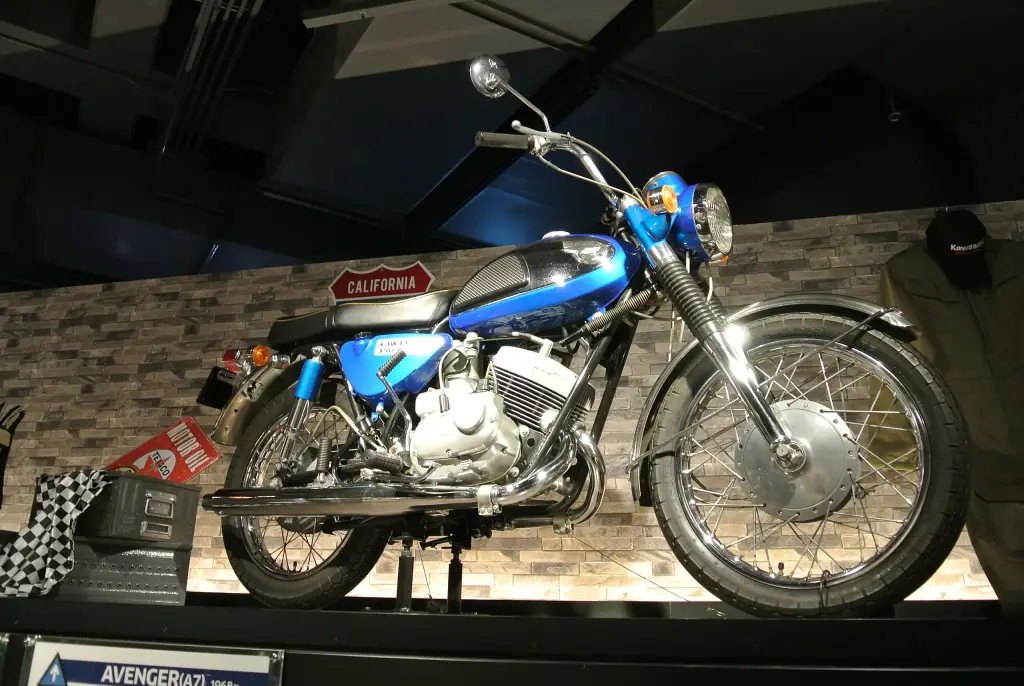
The A7 Avenger is a 350 cc Kawasaki motorcycle sold from 1967 through 1971. It followed the 250 cc A1 Samurai, sharing almost all of that machine’s components apart from its pistons, rings, mufflers and lubrication system.
Kawasaki A7 Avenger at a glance
| Maker | Kawasaki |
|---|---|
| Sold | 1967–1971 |
| Class | 350 cc standard |
| Based on | Kawasaki A1 Samurai |
| Engine | two-cylinder, two-stroke, air-cooled |
| Induction | dual rotary disc valves, two Mikuni carburettors |
| Lubrication | Injectolube, oil also fed to the main bearings |
| Ignition | points; CDI with thyristor switching from 1969 |
| Frame | shared with the A1 Samurai |
| Difference from A1 | pistons, rings, reverse-cone mufflers, crankcases and crank |
| Racing | eligible for AHRMA historic events |
Based on one source, the English Wikipedia article on the A7 Avenger.
History of the Kawasaki A7 Avenger
Kawasaki came to motorcycles later than the other three big Japanese makers. It bought a share of Meguro in 1960, took full control in 1963 and re-badged the Meguro K 500 as a Kawasaki; the W1 650 four-stroke twin grew out of the same line, which Meguro had developed from a BSA A7 under licence. The lightweight Kawasaki A1 Samurai was developed during 1966, and the A7 Avenger followed as the larger-bore version, sharing all the Samurai’s components except pistons, piston rings, different reverse-cone mufflers and a race-developed oiling system called Injectolube.
Engine
The A7 used the same two-cylinder, air-cooled, two-stroke layout with dual rotary disc valves that Kawasaki had pioneered on the 250. Rotary disc induction makes sure all the fuel charge is used rather than partly lost as in a piston-ported engine, which gives more power, more torque at low revs and better response across the range. Only Kawasaki and Bridgestone built twin-cylinder machines with the system. Air entered through a canister below the seat, a plenum chamber above the transmission and internal passages to the carburettor housing; the two Mikuni carburettors sat on either side of the engine, in line with the crankshaft, behind covers fixed to the crankcase.
Injectolube
Where the 250 injected oil with the petrol, the Avenger also fed oil to the main bearings, and its crankcases and crank were redesigned for the system. In 1969 the ignition was changed to capacitor discharge with thyristor switching, raising the voltage to 25,000–30,000 volts and reducing the unburnt mixture in the cylinders.
Racing and legacy
Avengers still race in American Historic Racing Motorcycle Association events. During the development of the H1 Mach III, Kawasaki engineers considered boring out the Avenger’s twin to make the 500 cc two-stroke called for by the N100 plan.
Design and features
- Rotary disc valves: a race-derived induction system that gives a fuller fuel charge than piston-port engines.
- Injectolube: oil is injected into the intake and also fed to the main bearings, and the crankcases and crank were redesigned to suit.
- CDI from 1969: capacitor discharge ignition with thyristor switching for a stronger spark.
- Shared cycle parts: the frame, suspension and brakes came straight from the 250 cc Samurai.
Kawasaki A7 Avenger versions
- A7 Avenger (1967–1971): the standard model.
- A7SS Avenger: crossover dual exhaust on the left below the seat; otherwise unchanged.
- 1969 specification: capacitor discharge ignition introduced.
The Avenger was the larger brother of the A1 Samurai, and its twin was considered for what became the H1 Mach III. More Kawasaki models are in the Kawasaki collection.
Video: Kawasaki A7 Avenger
Video by gcwhitin on YouTube.
Sources
- Kawasaki A7 Avenger, English Wikipedia: development, engine, Injectolube, racing