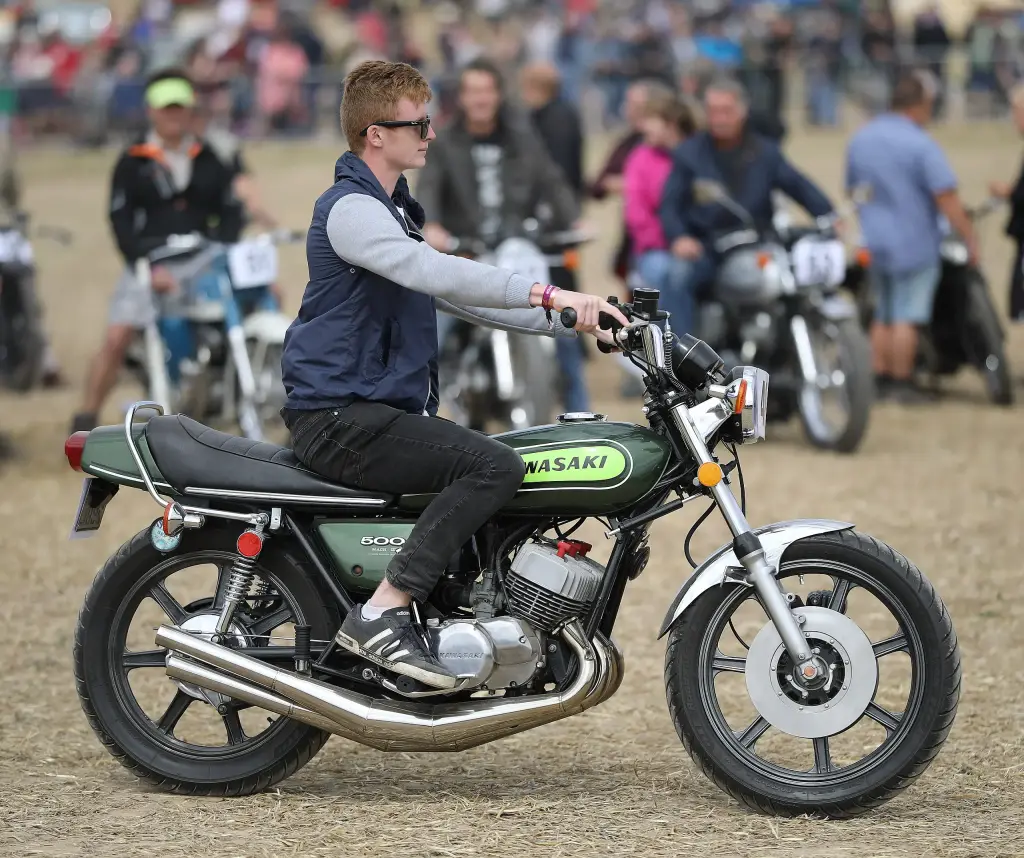
The Kawasaki H1 Mach III was a 500 cc two-stroke sport bike that Kawasaki built from 1969 to 1975. It came out of the secret N100 plan, which aimed at a machine no road bike of the time was supposed to be able to match.
Kawasaki H1 Mach III at a glance
| Maker | Kawasaki |
|---|---|
| Produced | 1969–1975 |
| Class | 500 cc sport bike |
| Engine | 499 cc three-cylinder two-stroke |
| Carburettors | three Mikuni VM 28 mm |
| Ignition | thyristor capacitor discharge, 25,000–30,000 volts |
| Frame | double cradle tube frame with twin top tubes |
| Front brake | 200 mm drum, later a 296 mm disc |
| Rear brake | 180 mm drum |
| Tested top speed | 119.14 mph (Cycle World, 1969) |
| Tested quarter mile | 13.20 seconds (Cycle World, 1969) |
| Successor | KH500, 1976 |
Based on one source, the English Wikipedia article on the H1 Mach III.
History of the Kawasaki H1 Mach III
By the mid-1960s the United States had become the largest motorcycle market, and American riders wanted more power and higher speeds. Kawasaki had the largest Japanese machine in the 650 cc four-stroke W series, but it did not fit the niche the company was aiming at. Honda launched the CB450 in 1965, the Suzuki T500 Titan appeared in 1969, and Yamaha was developing the XS 650, so in 1967 Kawasaki began work on the top-secret N100 plan: a 500 cc motorcycle with 60 hp and 13-second quarter-mile times, then thought beyond the limit for a road bike.
Launch and reception
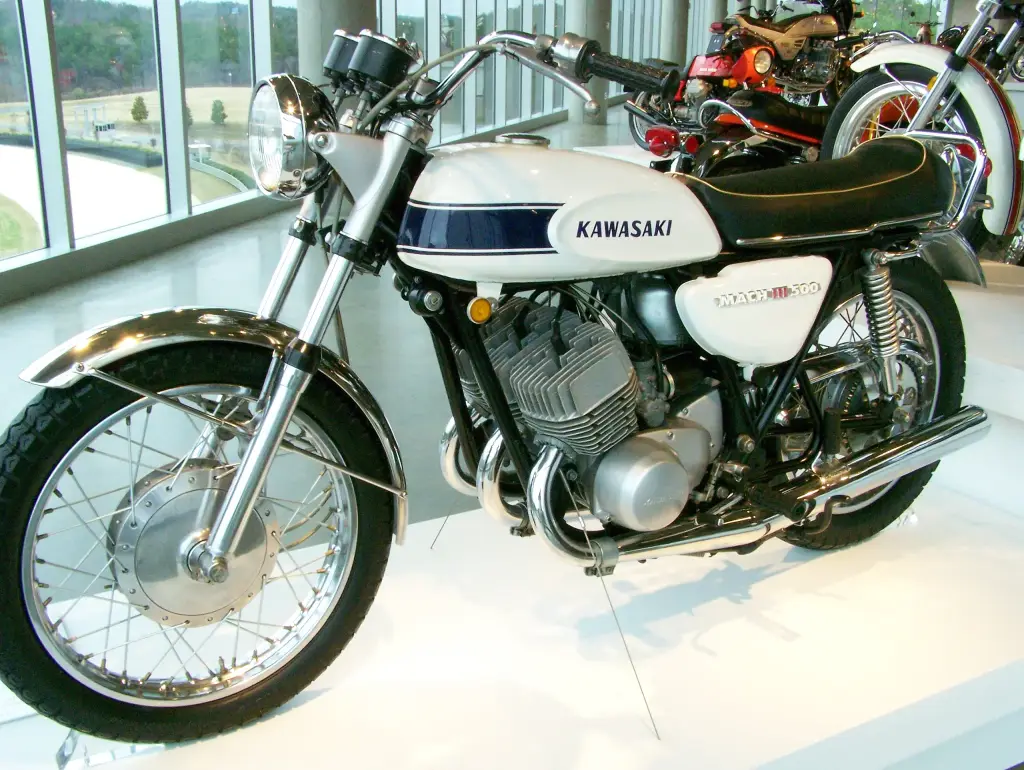
The Mach III appeared in the United States in 1969 with a white sculpted fuel tank, a blue racing stripe along its lower half and special Dunlop K77 tyres. British magazines mocked Kawasaki’s claim of “the fastest and best accelerating road machine ever produced”, quoted at 124 mph and 12.4 seconds for the standing quarter mile. Cycle World’s 1969 test measured 119.14 mph and 13.20 seconds, a London retailer 109 mph and 13.5 seconds, and the Dutch importer Henk Vink 13.48 seconds. Motorcyclist called the Mach’s power-to-weight ratio the best “ever produced in a motorcycle meant to sell to anyone who has the money to purchase it”.
The other side
Handling was another matter. “Viewed logically, the Kawasaki H1 had many flaws,” one summary notes: a gearbox with neutral below first, questionable brakes and handling that was marginal in every situation except standing still with the engine off — hence the nickname “the triple with the ripple”. The three-cylinder 500 was effectively succeeded in 1979 by the four-stroke four-cylinder Z500/Z550.
Year by year
The 1971 H1A brought a new tank without knee recesses. The 1972 H1B replaced CDI with battery ignition and added a front disc brake and a steering damper. The 1973 H1D had a second-generation race tail partly covering the taillight, the H2’s CDI unit, no steering damper or rear brake air scoop, and a cable instead of a rod for the rear brake. The 1974 H1E had a new CDI unit and a crankcase check valve, and the 1975 H1F was the last H1. The 1976 KH500 had slightly less power at 52 hp and a different shift pattern, one down and four up instead of five up, with water-resistant brake pads.
Racing
Kawasaki built a racing derivative, the H1R. In 1970 Ginger Molloy finished second to Giacomo Agostini on the MV Agusta in the 500 cc world championship, and in 1971 Dave Simmonds won the Spanish Grand Prix at Jarama, Kawasaki’s first victory in the premier 500 class. A standard H1 ridden by Keith Martin won the 500 cc Production class at the 1974 Isle of Man TT.
Design and features
- Three-cylinder two-stroke: 499 cc with three Mikuni VM 28 mm carburettors and capacitor discharge ignition.
- Performance first: the N100 plan asked for 60 hp and 13-second quarters, figures then considered impossible for a road bike.
- Light, twin-tube frame: a double cradle with twin top tubes reinforced at three points, strong enough but not matched to the engine.
- Weak points: a neutral-below-first gearbox, marginal brakes and handling that earned the bike its nickname.
Kawasaki H1 Mach III versions
- H1 (1969–1970): the original white-and-blue Mach III.
- H1A (1971): new tank without knee recesses.
- H1B (1972): battery ignition, front disc, steering damper.
- H1D (1973): race tail, H2 ignition, cable rear brake.
- H1E (1974) and H1F (1975): new CDI and crankcase check valve.
- KH500 (1976): 52 hp, one-down-four-up shift pattern.
The racing version is covered in Kawasaki H1R, and the H1 grew out of the ideas first tried on the A7 Avenger. More models are in the Kawasaki collection.
Video: Kawasaki 500 H1-D Sound
Video by Kawasakitriplenet Silvio Ragoni on YouTube.
Sources
- Kawasaki H1 Mach III, English Wikipedia: history, tests, changes by year, racing, specifications