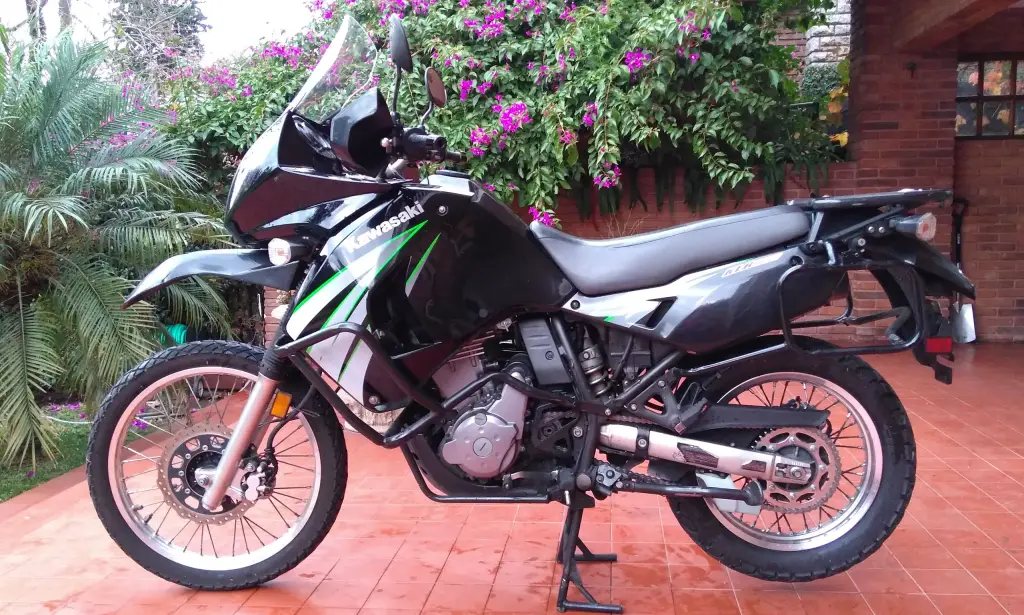
The Kawasaki KLR650 is a 652 cc dual-sport motorcycle intended for both on-road and off-road riding. Introduced in 1987 to replace the 564 cc KLR600 of 1984–1986, it stayed almost unchanged through 2007 and remains in production after redesigns in 2008 and 2022.
Kawasaki KLR650 at a glance
| Maker | Kawasaki |
|---|---|
| Introduced | 1987 |
| Class | dual-sport |
| Engine | 652 cc liquid-cooled single-cylinder, DOHC, counterbalanced |
| Replaced | KLR600 (1984–1986) |
| First generation | 1987–2007 |
| Second generation | 2008–2018 |
| Third generation | 2022 onwards, with fuel injection and ABS |
| A model | the standard bike, not sold in Europe because of emissions rules |
| B model (Tengai) | Dakar-style fairing, unsprung front mudguard |
| C model | more off-road focused: 41 mm forks, 14 litre tank, steel rims |
| Military version | M1030M1 diesel conversion by Hayes Diversified Technologies |
The three articles overlap; the English one is the base, the German one adds the European history and the Italian one the Tengai and fuel figures.
History of the Kawasaki KLR650
The KLR650 was introduced in 1987 to replace the KLR600, which had been sold since 1984 with a 564 cc engine. The new machine had a 652 cc four-stroke, DOHC, dual-counterbalanced, single-cylinder, liquid-cooled engine and became a long-standing model, remaining almost unchanged through the 2007 model year. The KLR is widely used as an inexpensive adventure and touring bike: luggage, GPS, heated grips and larger screens make it more useful on long trips, and the type has been ridden on intercontinental and round-the-world journeys, including Dr Gregory Frazier’s in 2001 and 2002.
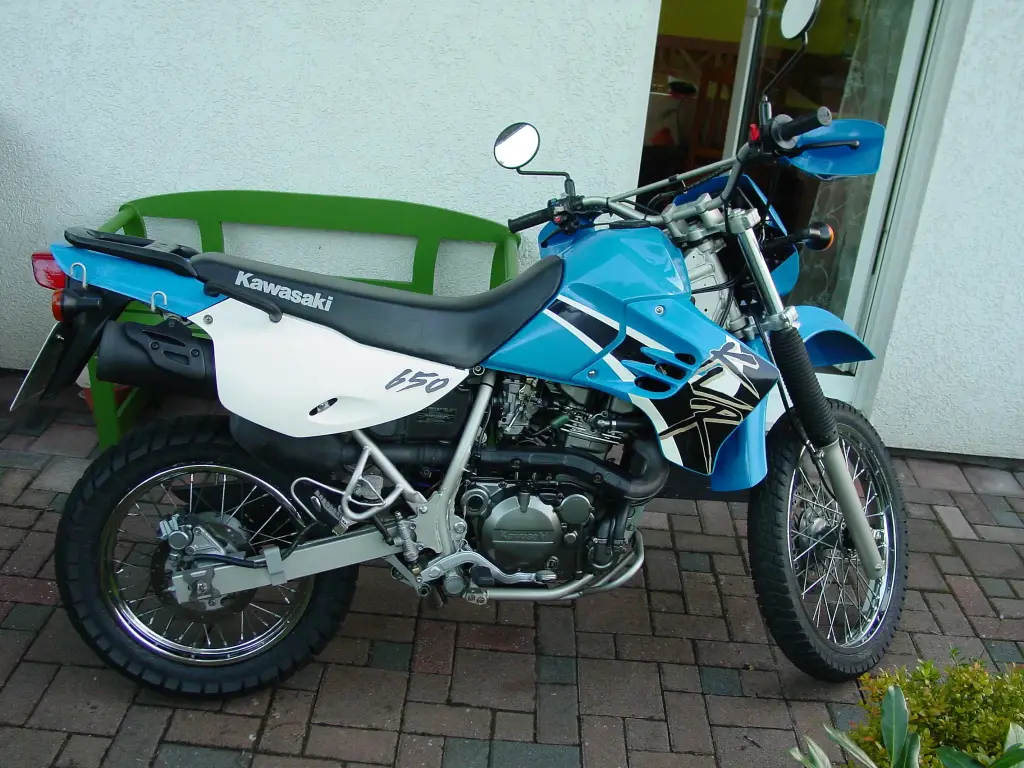
First generation, 1987–2007
The A model was introduced in 1987 and stayed nearly unchanged until the 2008 redesign in the USA, Canada, Australia and South Africa; it was not sold in Europe because of emission regulations. The B model, or Tengai, got adventure and Dakar styling with a full fairing blending into the tank, different side panels and an unsprung front mudguard; it went on sale in the United States in 1990 and for two more years elsewhere. The C model had completely new bodywork and a more dirt-oriented specification with stiffer 41 mm forks, improved brakes, a tubular engine guard, a smaller 14 litre tank and steel wheel rims; lacking a temperature gauge, it used an overheat lamp. The US military ran KLR650s modified by Hayes Diversified Technologies to burn military fuels including diesel, under the designation M1030M1.
Incremental changes
Beyond colours, the first generation changed little between 1987 and 2008. The 1987 crankshaft was unique to that year; 1988 brought stronger engine cases; 1990 longer countershaft splines; 1992 a new front brake master cylinder; mid-1996 a changed valve cover, heavier crank, an improved clutch basket with one more plate, a large nut instead of a slotted plate for the front sprocket and new second and third gear ratios. Around 2001 final assembly moved from Japan to Thailand, with all major parts still made in Japan, and 2007 brought a new shift lever.
Second generation, 2008–2018
The 2008 model was extensively redesigned, mostly for comfort and quality rather than performance: new trim, fairings and indicators, a new instrument panel and switchgear, a twin-piston rear caliper, a 17 A alternator, a smaller main jet, a reinforced idler-shaft lever, 41 mm forks instead of 38 mm, a new swingarm, larger petal brake rotors, more radiator capacity, a dual-beam headlight, a larger luggage rack, a firmer seat and larger spokes. The second generation gained 16 lb of dry weight. Later changes included thinner piston rings in 2009, a six-plate clutch basket from mid-2011 and, from mid-2014, 40 percent firmer fork springs, a 63 percent stiffer rear spring and a narrower seat front.
Third generation, 2022
After three years out of production, the third-generation KLR650 was unveiled on 26 January 2021 and released in Thailand at 268,500 baht. It added electronic fuel injection and an anti-lock braking system.
Design and features
- Single-cylinder simplicity: one 652 cc liquid-cooled DOHC engine with dual counterbalancers, easy to service on the road.
- Long model life: the first generation ran from 1987 to 2007 with only detail changes.
- Tengai variant: a Dakar-styled version with a full fairing and unsprung front mudguard.
- Military diesel conversion: the M1030M1 for the US military, able to run on diesel and other military fuels.
- Modern generation: fuel injection and ABS since 2022.
Kawasaki KLR650 versions
- KLR650-A (1987–2007): the standard first-generation bike.
- KLR650-B Tengai: adventure styling and full fairing, 1990 onwards.
- KLR650-C: more off-road focused, with a 14 litre tank and steel rims.
- KLR650-E (2008–2018): the second generation, over 100,000 sold in Australia, Canada, South Africa and the USA.
- KLR650 (2022 onwards): third generation with fuel injection and ABS.
The KLR650 succeeded the KLR600 and has been joined in Kawasaki’s range by the smaller KDX enduro and the road-biased KLE500. More models are in the Kawasaki collection.
Video: KLR650 / @motogeo Review
Video by MotoGeo on YouTube.
Sources
- Kawasaki KLR650, English Wikipedia: generations, variants, changes, military version
- Kawasaki KLR 650, German Wikipedia: model history, technical data, sales figures
- Kawasaki KLR, Italian Wikipedia: Tengai, versions, fuel consumption