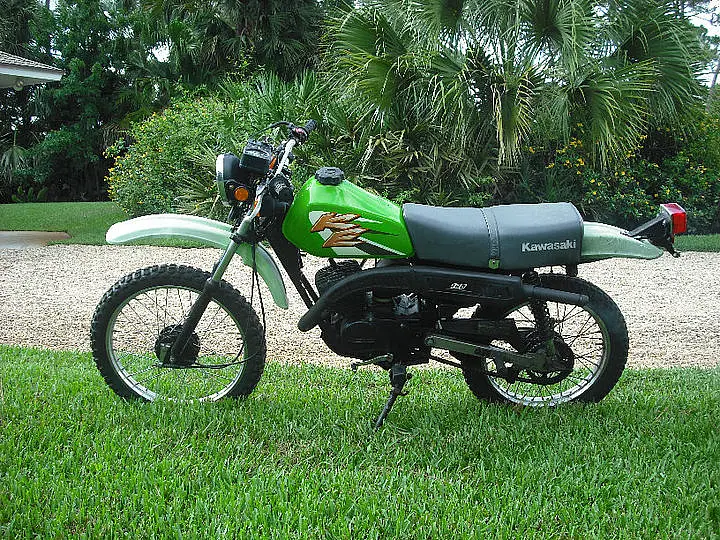
The Kawasaki KE100 is a dual-sport motorcycle that Kawasaki produced from 1976 to 2001. A direct successor to the G5, it changed little over a quarter of a century and remained one of the last simple two-stroke trail bikes on sale.
Kawasaki KE100 at a glance
| Maker | Kawasaki |
|---|---|
| Produced | 1976–2001 |
| Class | dual-sport two-stroke |
| Predecessor | Kawasaki G5 |
| Gearbox layout | 1-N-2-3-4-5 (the G5 had N-1-2-3-4-5) |
| Lubrication | Superlube oil injection |
| Fuel tank | 2.5 US gal (9.5 litres) |
| Frame details | two small hooks at the rear for indicators or luggage |
| Changes | minor engine and gearbox revisions; different tanks after the B4 |
A short article based on one source, the English Wikipedia article on the KE100.
History of the Kawasaki KE100
The KE100 replaced the G5 as Kawasaki’s small dual-sport machine in 1976. The main differences from its predecessor were new ergonomics and a changed transmission layout, with neutral placed between first and second instead of before first.
An unusually long life
The model did not change much through the years. Kawasaki made minor changes to the engine and transmission over successive model years and switched to different fuel tanks after the B4 model, but the basic machine stayed the same from 1976 until production ended in 2001.
Oil injection and practicality
The KE100 used an oil injection system Kawasaki calls Superlube, which removes the need to mix fuel and oil by hand and gives a precise mixture in the two-stroke cycle, cutting emissions enough that the bike roughly passed United States emissions tests. Its 9.5 litre tank carried two small hooks on the rear of the frame, which could be used either to mount turn signals or to tie a spare fuel tank for longer journeys.
Design and features
- Superlube oil injection: no pre-mixing, and a more precise fuel-oil ratio than manual mixing.
- Simple two-stroke engine: easy to maintain, which helped the model survive for 25 years.
- Practical details: a 9.5 litre tank and hooks on the rear frame for indicators or extra luggage.
- Dual-sport layout: light enough for trails, legal for the road.
Kawasaki KE100 versions
- KE100 (1976–2001): essentially one model with year-by-year detail changes.
- Post-B4 models: different fuel tanks.
- Late models: the last of Kawasaki’s simple two-stroke trail bikes.
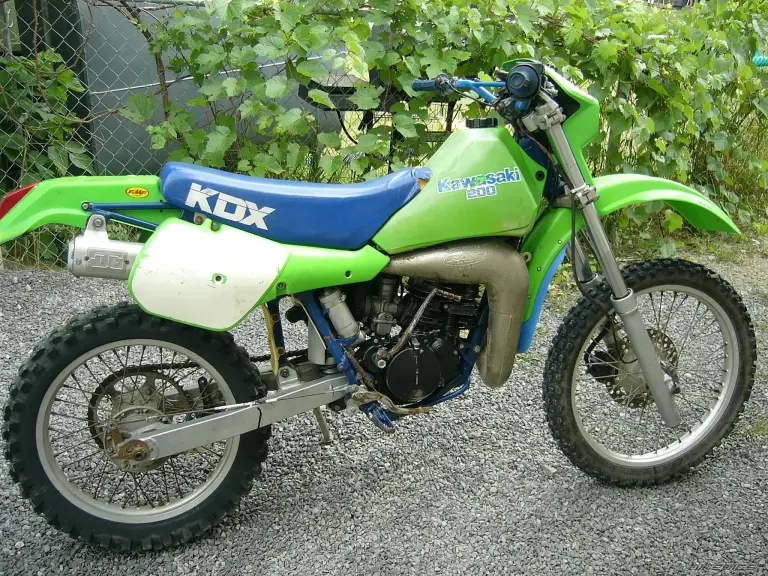
The KE100 sat below the KDX enduro in Kawasaki’s off-road range. More models are in the Kawasaki collection.
Sources
- Kawasaki KE100, English Wikipedia: production years, gearbox, oil injection, tank