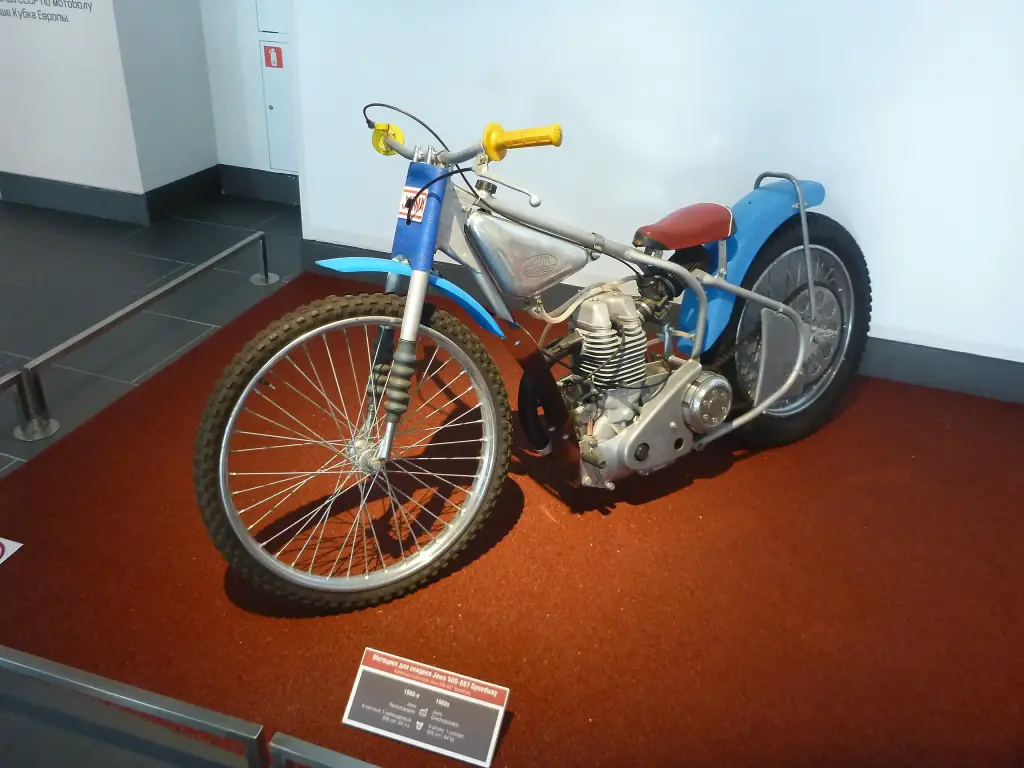
Jawa speedway motorcycles were not built in the main Jawa factory but in Divišov, south of Prague, by a works that began as ESO. For decades its single-cylinder racers were the standard machine of world speedway, and Jawa riders took the world title almost every year from 1966.
Jawa speedway at a glance
| Works | Divišov, originally ESO, later Jawa and JRM |
|---|---|
| Founder | Jaroslav Simandl, workshop from 1949 |
| First own engine | S-45 of 1950, about thirty built |
| Complete bike | ESO DT-1 from 1953 |
| Joined Jawa | January 1964 |
| First world title | 1966 |
| Type 890 | 1969, 497 cm³ OHV single, 50 hp |
| Type 894 | mid-1970s, four-valve 2× OHC, methanol |
| Type 897 | 1984, 1× OHC, 44 kW at 8,800 rpm |
| Types 886 and 889 | after 2010, 494 cm³, JRM branding |
There is no English article on the Divišov works; this page is based on the Czech article, with the date of the ESO amalgamation from the English history of Jawa.
History of the Jawa speedway
The works grew out of the workshop of the racing rider Jaroslav Simandl, who moved his business from the borderland in 1948 and set up a toolmaking shop at Divišov in 1949. He began by making spare parts for the long-stroke JAP engines of English design, which made him practically the only supplier for Czechoslovak speedway riders, since imports from the West were impossible. The shop was nationalised in 1950, and in the same year the first engine of its own design, the S-45, was built; only a little over thirty were made before the works moved to short-stroke engines of the kind still used today.
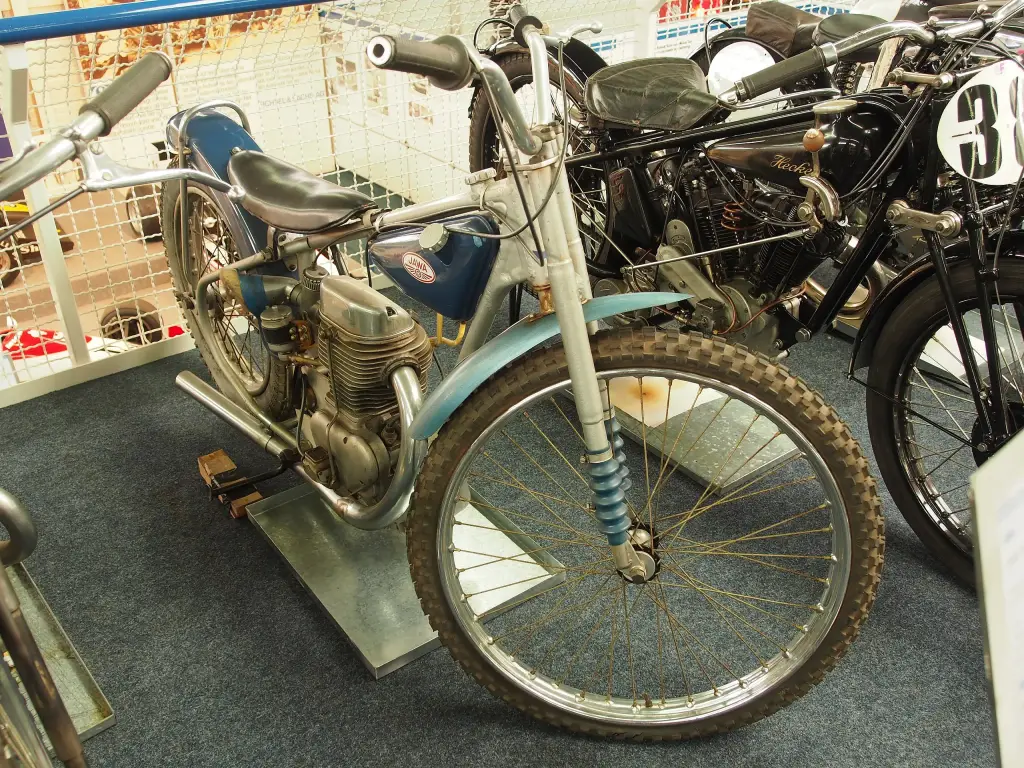
From ESO to Jawa
The engines marked ESO S45 were fitted from 1953 into frames of the works’ own make, which began the production of complete ESO speedway motorcycles, type DT-1. The works also built motocross machines from 1954 to 1963 and road racers from 1951 to 1958. A more modern engine for the ESO DT-5 appeared in 1959. In January 1964 the works was absorbed into the Jawa group at Týnec nad Sázavou, the road and motocross programmes were dropped, and from then on Divišov built speedway machines only, under the Jawa name.
The Divišov machines soon reached the top of the sport. The Soviet rider Plechanov started on an ESO at the individual world championship in Gothenburg in 1961. Jawa took its first world title in 1966 and from 1968 held the crown for many years, adding team and pairs titles. At its peak, at the end of the 1960s, the works built about ten thousand machines a year; in 1969 all sixteen finalists of the individual world championship rode Jawas, type 890. That engine was a 497 cm³ air-cooled OHV single of 88 by 81.7 mm, with a compression ratio of 14, 50 hp at 6,600 rpm and a remarkably simple layout.
Four valves and methanol
Ove Fundin of Sweden was the first works rider, but he qualified on Jawas and then raced a JAP in the final. The world crowns came with his successors: Barry Briggs in the 1960s and Ivan Mauger and Ole Olsen in the 1970s and 1980s. New four-valve Jawas appeared on the ice tracks in the early 1970s, taking ice titles with Antonín Šváb in 1970 and Milan Špinka in 1974. When two-valve Jawas fell behind the four-valve Weslake, Divišov answered with the type 894, a completely new design with 2× OHC and four valves. From 1982 the range was the 894-3 for short tracks, the 895-3 for long tracks and the 891-6 for ice, with 493 cm³ engines of 85 by 87 mm, compression 13.5 and 39.5 to 46.5 kW running on methanol. In 1984 came a new 1× OHC series: the 897 for speedway with 44 kW at 8,800 rpm, the 896 for long tracks with 48 kW at 9,000 rpm and the 893 for ice. The 898 and 899 followed at the end of the 1980s.
After 1989
The works became independent and a joint-stock company on 29 March 1991, building its own engines for short tracks (type 871), long tracks (type 875), ice (type 866) and a Junior 125 for young riders. After 1994 the JRM name, for Jawa Racing Motors, was used because no agreement could be reached with Týnec over the Jawa trademark. The works team took a remarkable run of medals from 1995 to 2005: Hans Nielsen in 1995, Tony Rickardsson in 1998, 1999, 2001, 2002 and 2005, and Lukáš Dryml as junior world champion in 2002. At the turn of the century 92 per cent of production was exported, above all to New Zealand, Australia, the USA, Britain, France, Denmark, Germany, Poland, Scandinavia and Russia. After 2010 the range was built around upright four-valve OHC singles, the JRM 875 for long tracks and the 886 and 889 for short tracks, with 494 cm³ engines of 87 by 85 mm, a compression ratio of 13.2 and Cr-Mo steel tube frames.
Design and features
- Purpose-built racers: single-cylinder speedway machines with no brakes and no gearbox.
- Type 890: the 1969 engine that powered all sixteen world finalists.
- Methanol fuel: the later four-valve engines ran on methyl alcohol.
- World titles: Jawa and JRM riders won championships from 1966 into the 2000s.
Jawa speedway versions
- ESO DT-1 (from 1953): the first complete ESO speedway motorcycle.
- Type 890 (1969): 497 cm³ OHV, 50 hp.
- Type 894 (mid-1970s): four-valve 2× OHC for short, long and ice tracks.
- Type 897 (1984): 1× OHC speedway engine, 44 kW.
- JRM 875, 886 and 889 (after 2010): 494 cm³ engines under the JRM name.
The road-going side of the same firm is described in the Jawa 350 and Jawa 500 OHC articles. More are in the Jawa collection.
Sources
- Jawa Divišov, Czech Wikipedia: history, types, engines, riders, exports
- Jawa Moto, English Wikipedia: amalgamation with ESO in 1962