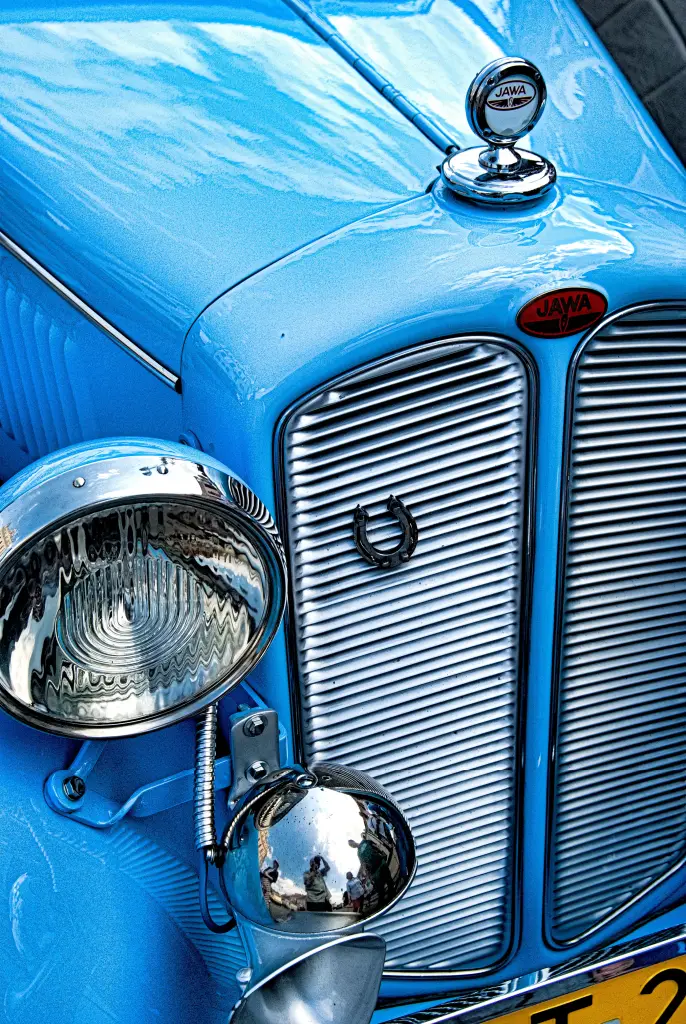
The Jawa 700 was the first car to wear the Jawa badge. Built from 1934 to 1937 under licence from DKW, it was a small front-wheel-drive two-stroke car that led the motorcycle factory into car production.
Jawa 700 at a glance
| Maker | Zbrojovka Ing. F. Janečka, Prague–Nusle |
|---|---|
| Production | 1934–1937 |
| Based on | DKW F2 Meisterklasse 701 |
| Licence signed | 20 July 1933 |
| Engine | 692 cm³ water-cooled two-stroke twin |
| Power | 14.7 kW (20 hp) |
| Drive | front-wheel drive |
| Gearbox | three-speed, unsynchronised |
| Wheelbase | 2,700 mm |
| Top speed | 85–90 km/h |
| Fuel consumption | 8–9 l/100 km |
| Price | 22,900 Kč for the four-seat open car |
| Built | 1,002 |
History of the Jawa 700
František Janeček, the founder of Jawa, had built German Wanderer motorcycles under licence since 1929. On 20 July 1933 he signed a licence agreement with Jørgen Skafte Rasmussen of DKW to build the German company’s cars in Czechoslovakia, and the first result was the Jawa 700, based on the DKW F2 Meisterklasse, known internally as the 701. Janeček explained in an interview with the magazine Auto in April 1934 that he chose a DKW licence because the design was proven and the model had already succeeded in Germany.
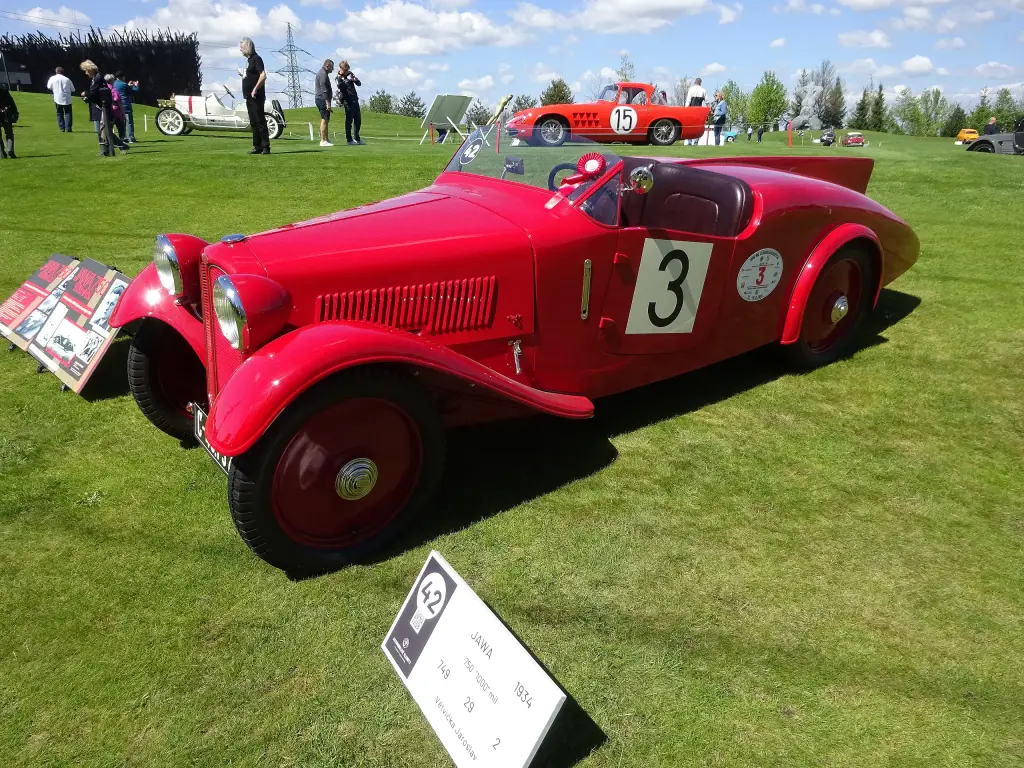
The Prague show of 1934
The car was presented at the 24th International Motor Show in Prague, held from 7 to 15 April 1934. Compared with the DKW it had a longer wheelbase of 2,700 mm, which gave more interior space, and smaller 18-inch wheels in place of the original 19-inch ones. The price of the open four-seat semi-cabriolet was 22,900 Kč in 1934; from 1936 the tudor, described as a limousine, cost 24,400 Kč and a two-seat roadster 22,900 Kč, while in the last year of production the four-seat limousine was cut to 23,700 Kč. A few dozen closed two-door cars were bought by the Ministry of the Interior in 1937 for police stations in Prague, Liberec, Most, Chomutov and Česká Lípa.
Engineering
The engine was a water-cooled two-stroke inline twin of 76 mm bore and stroke, 692 cm³, rated at 14.7 kW (20 hp). It used Schnürle reverse-loop scavenging, which allowed flat aluminium-alloy pistons without deflectors and gave better fuel economy. The engine sat across the car ahead of the front axle, driving through a multi-plate wet clutch on the input shaft, a double roller chain and an unsynchronised three-speed gearbox with a disengageable freewheel; the gear lever was on the dashboard. Cooling was by thermosiphon, without a fan or pump, and the car had a combined 6 V dynamo and starter on the crankshaft.
The chassis was a narrow backbone frame of pressed U-sections, and both axles were split and sprung by pairs of transverse leaf springs with hydraulic dampers. Steering was by worm and left-hand drive from the start, even though Czechoslovakia still drove on the left and the planned switch to the right kept being postponed. The car was deliberately low, which helped stability. Bodywork began as a four-seat two-door tudor or semi-cabriolet on a wooden frame, covered first with plywood and leatherette and from 1936 with steel; the steel bodies were developed and built at Kvasiny, with final assembly at Týnec nad Sázavou. Production ended in June 1937 after 1,002 cars.
Design and features
- Front-wheel drive: the layout came straight from the DKW F2 licence.
- Two-stroke twin: 692 cm³ with Schnürle scavenging and flat pistons.
- Freewheel: in the mid-1930s the 700 was the only Czechoslovak car with a freewheel.
- Left-hand drive: unusual in a country that still drove on the left.
Jawa 700 versions
- Four-seat semi-cabriolet: the launch body of 1934 at 22,900 Kč.
- Tudor and limousine: closed four-seat bodies from 1936 at 24,400 Kč.
- Two-seat roadster: offered at 22,900 Kč.
- Coupé and light vans: a few special bodies and small commercials.
The 700 was the car side of the same firm that built the Jawa 350 and Jawa 250 motorcycles. More are in the Jawa collection.
Sources
- Jawa 700, English Wikipedia: licence, design, production, performance
- Jawa 700, Czech Wikipedia: bodywork, engine, prices, police cars