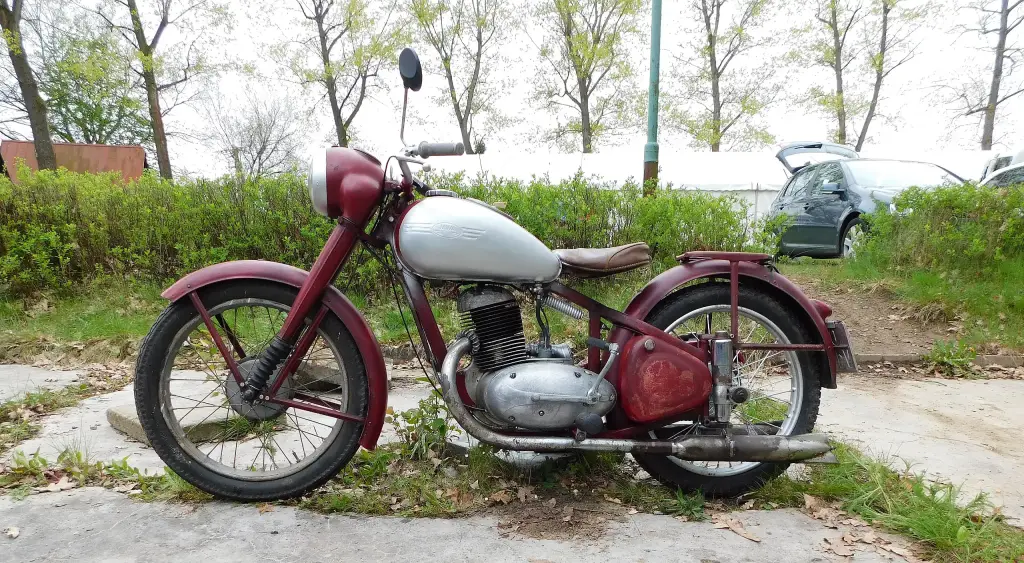
The Jawa 250 was the middleweight of the Jawa range for most of the 20th century. Built from 1934 to 1972 and again from 1994 to 2013, it is best remembered as the 250/559 Panelka of the 1960s, the everyday motorcycle of Czechoslovakia.
Jawa 250 at a glance
| Maker | Jawa Moto, Czechoslovakia, later the Czech Republic |
|---|---|
| Production | 1934–1972 and 1994–2013 |
| First version | Jawa 250 Special, 1934–1940 |
| Best-known type | 250/559 Panelka, 1962–1974 |
| Engine | 249 cm³ air-cooled two-stroke single |
| Panelka power | 14 hp, against 12 hp of the 250/353 |
| Top speed | 110 km/h |
| Dry weight | 128 kg |
| Fuel consumption | 3.8 l/100 km |
| Gearbox | four-speed |
| Last own engine | 250/597 Travel, 2007–2013 |
History of the Jawa 250
The 250 appeared in 1934 as the Jawa 250 Special, a four-stroke single, and was followed by the 250 Duplex-Blok of 1939–1945. The post-war line began with the 250 Pérák of 1946–1954, the two-stroke twin’s smaller brother, and continued with the 250/353 Kývačka from 1954. The name Kývačka came from the new swinging-arm rear suspension, which the earlier rigid models did not have.
The Panelka
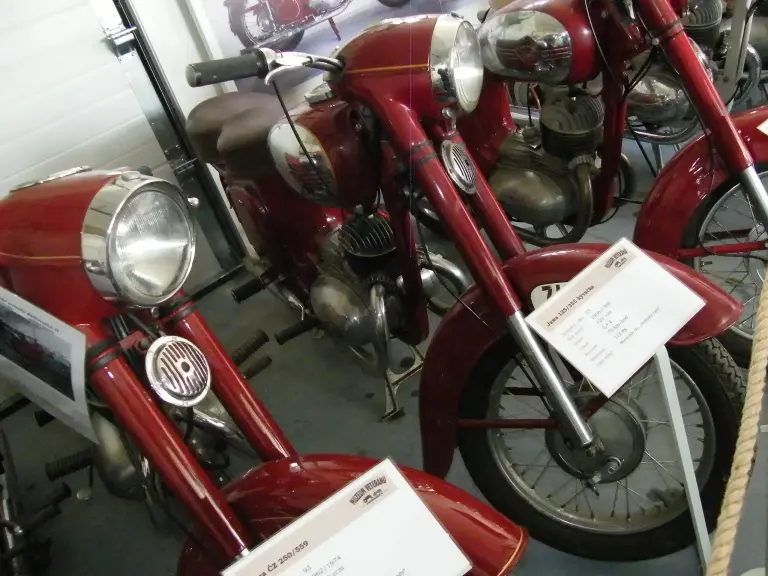
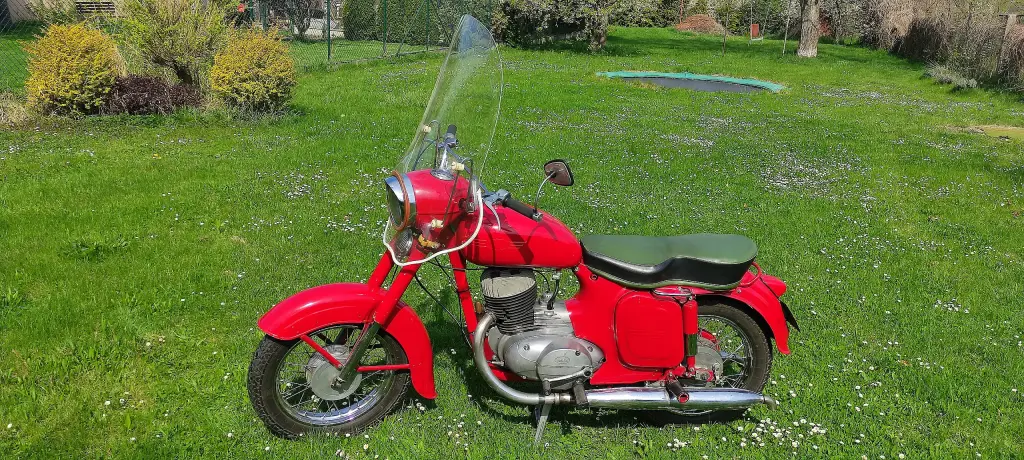
In 1962 came the 250/559, known as the Panelka. The name came from the front headlamp mask that ran back to the ends of the handlebars and held an oval speedometer instead of the round one of the Kývačka. The ignition switch used a FAB lock, as on the last Kývačkas, and the tail light was made of translucent red plastic rather than pressed steel. The engine produced 14 hp instead of the 12 hp of the last 250/353, thanks to a new piston and cylinder with larger inlet ports; the carburettor was mounted directly on the cylinder and the choke was worked at the twistgrip. Because the cylinder was taller, the exhaust headers were made shorter and higher.
The crankshaft was larger, and on the 250/559/02 it ran on one ball bearing at each end. On the 250/559/04 the crankcases were modified and the crankshaft was carried on three ball bearings, as on the 250/353: one on the dynamo side and two on the primary drive side, separated by a labyrinth seal. Four versions were catalogued: the 559/02 built until 1965, the rare 559/03 supersport of 1963–1964, the 559/04 from 1964 to 1974 and the 559/05 Automatic with a centrifugal automatic clutch.
The Panelka weighed 128 kg dry and 140 kg ready to ride, was good for 110 km/h and used 3.8 litres per 100 km. It remained in production until 1974 and was followed in the range by the 250/592, while the Californian and Bizon versions of the 1960s offered other styles.
After the two-strokes
Jawa returned to the 250 name in 1994 with the 250/593 Vodník and in 2007 with the 250/597 Travel. By 2019 the Travel still used the last engine of Jawa’s own design; it was almost mechanically unchanged since the 1970s but very reliable. Production of the 250 ended in 2013.
Design and features
- Panelka mask: the front lamp housing ran back to the handlebar ends, with an oval speedometer.
- More power: 14 hp against 12 hp for the 250/353, with a new piston and cylinder.
- Three-bearing crank: the 559/04 carried the crankshaft on three ball bearings.
- Automatic version: the 559/05 had a centrifugal automatic clutch.
Jawa 250 versions
- 250 Special (1934–1940): the first 250, a four-stroke single.
- 250 Pérák (1946–1954): post-war two-stroke.
- 250/353 Kývačka (1954–1962): first with a swinging-arm rear end.
- 250/559 Panelka (1962–1974): the classic 1960s model in four versions.
- 250/593 Vodník and 250/597 Travel: the 1990s and 2000s revival.
The bigger sister of the 250 is the Jawa 350, and the sporting four-stroke of the 1950s is the Jawa 500 OHC. More are in the Jawa collection.
Sources
- Jawa 250, English Wikipedia: production years, versions, Travel
- Jawa 250/559, Czech Wikipedia: Panelka details and technical data