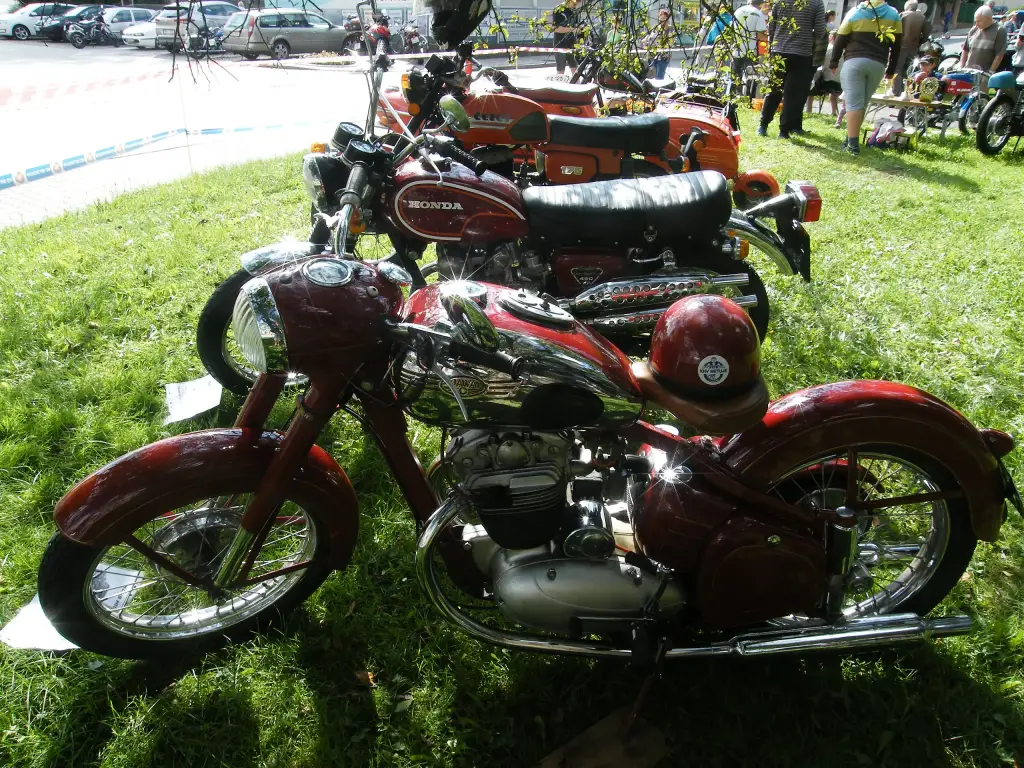
The Jawa 500 OHC was the sporting flagship of the early 1950s: a 488 cc air-cooled four-stroke twin whose camshaft was driven by a vertical king shaft. Built from 1952 to 1958, it was the last four-stroke of Jawa’s own design to reach series production.
Jawa 500 OHC at a glance
| Maker | Jawa, Prague–Nusle |
|---|---|
| Production | 1952–1958 |
| Predecessor | Jawa 500 OHV, known as Rumpál |
| Engine | 488 cm³ air-cooled four-stroke twin, OHC |
| Camshaft drive | king shaft |
| Gearbox | four-speed with semi-automatic clutch |
| Type 15/00 | 1952, worm drive, 26 hp, 135 km/h |
| Type 15/01 | 1954, bevel drive, 26 hp, 135 km/h |
| Type 15/02 | 1956, ribbed full-width drums, 28 hp, 147 km/h |
| Dry weight | 156 kg (00), 168 kg (01), 178 kg (02) |
| Fuel consumption | 4 l/100 km |
| Built | about 7,000 |
There is no English article on the 500 OHC; this page is based on the Czech Wikipedia article.
History of the Jawa 500 OHC
The 500 OHC, type 15, was developed for sporting riders rather than everyday transport, unlike the Pérák twins. The first prototype, in a frame derived from the Pérák, was built around 1948. The series machines of 1950–1951 still had a Pérák-like front end, mudguards, boxes and an unusual fork with a wide parabola, a small oil tank called the kidney and a tall PAL magneto-dynamo, with Bosch also tried. The 1952 bikes had a Lucas magneto-dynamo and a large oil tank, and from 1953 the classic Jawa dynamo of types 01 and 02.
Three versions
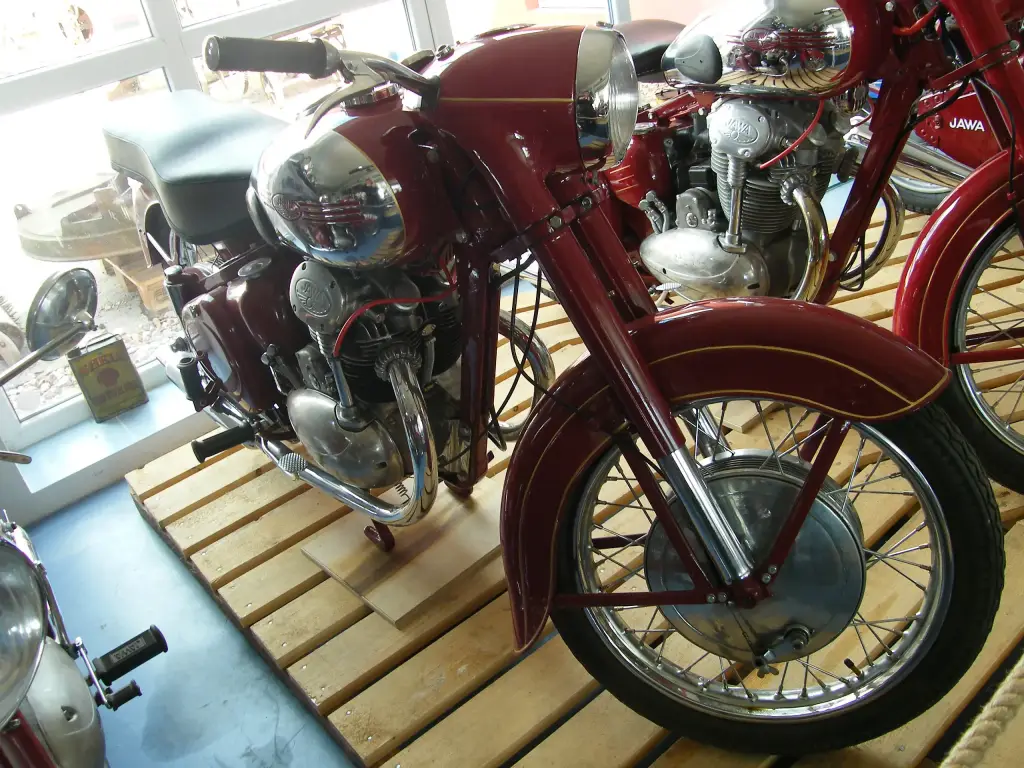
The type 15/00 of 1952, nicknamed Šnek (snail), drove the camshaft through worm gears, had one-sided steel drum brakes, a single seat, 26 hp and 135 km/h. The 15/01 of 1954 used bevel gears for the same 26 hp and 135 km/h. The 15/02 of 1956 had ribbed full-width aluminium drums, two seats, mudguards with a lip, 28 hp and 147 km/h, at the cost of extra weight. Each version was a little heavier than the last: 156 kg dry for the 00, 168 kg for the 01 and 178 kg for the 02.
The engine was a four-stroke, air-cooled twin of 488 cm³ with a four-speed gearbox and a semi-automatic clutch, chain primary and secondary drives. The OHC valve gear was driven by the king shaft, a system that was more expensive to make than a chain. A prototype with a chain-driven camshaft between the cylinders was built but proved useless because the chains available at home were not strong enough.
The one-off racer
In 1957 Richard Dusil, a factory rider and production worker at Jawa, built a special with a rear swinging arm and 16-inch wheels in the new frame. František Šťastný rode it on the Isle of Man that year while learning the course before the Tourist Trophy. In Dalibor Janek’s book on Šťastný he recalled a quiet twin that reached 155 km/h at 4.5 l/100 km, and crowds gathering round it in England as they gather round Japanese bikes today. Little more is known of it and the original probably does not survive; it was shown at the motorcycle museum at Kámen castle in 1975.
About 7,000 Jawa 500 OHCs were built, most of them type 15/02 in 1955–1958. The 15/00 is the rarest, and the 15/01 is not much more common. Production ended in 1958, and Jawa never again put a four-stroke of its own design into series production.
Design and features
- King-shaft OHC: the camshaft was driven by a vertical shaft through worm or bevel gears.
- Four-stroke twin: 488 cm³, air-cooled, with chain primary drive.
- Semi-automatic clutch: paired with a four-speed gearbox.
- Sporting focus: 135–147 km/h and 4 l/100 km in the 1950s.
Jawa 500 OHC versions
- 15/00 (1952): worm drive, 26 hp, single seat, one-sided steel drums.
- 15/01 (1954): bevel drive, 26 hp.
- 15/02 (1956–1958): ribbed full-width drums, two seats, 28 hp, 147 km/h.
- Dusil special (1957): one-off with swinging arm and 16-inch wheels.
The 500 OHC was the sporting alternative to the two-stroke Jawa 350 and Jawa 250. More are in the Jawa collection.
Sources
- Jawa 500 OHC, Czech Wikipedia: versions, engine, production, the 1957 special