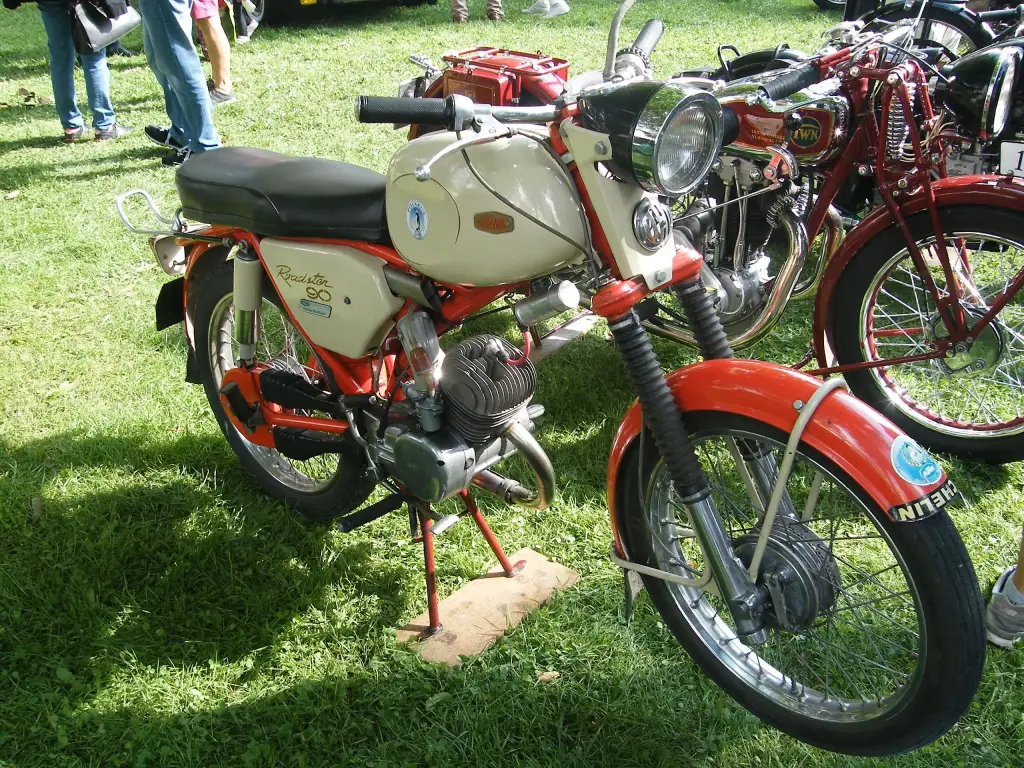
The Jawa 90 was the small, light motorcycle from Jawa’s Slovak works at Považská Bystrica. Made from 1967 to 1973 in roadster and cross forms, it was the only motorcycle built in Czechoslovakia with a five-speed gearbox.
Jawa 90 at a glance
| Maker | Považské strojárne, Považská Bystrica |
|---|---|
| Production | 1967–1973 |
| Sold as | Jawa 90, also known as SK-90 |
| Engine | 90 cm³ two-stroke single, rotary valve |
| Gearbox | five-speed |
| Frame | backbone |
| Dry weight | 84 kg |
| Ready weight | 92 kg |
| Top speed | 95 km/h |
| Fuel consumption | 3 l/100 km |
| Built | 36,942 |
There is no English article on the Jawa 90; the details come from the Czech article, with the date of production from the English history of Jawa.
History of the Jawa 90
The Jawa 90 was developed by the Považské strojárne in Považská Bystrica and built in Slovakia from 1967 to 1973. It carried the Jawa name for sales reasons, but it came from the same works that later built the Babetta moped and the Mustang. Its two-stroke single-cylinder engine used rotary valve induction, a rare arrangement in Czechoslovak small motorcycles, and the gearbox had five speeds – no other motorcycle made in the country had one.
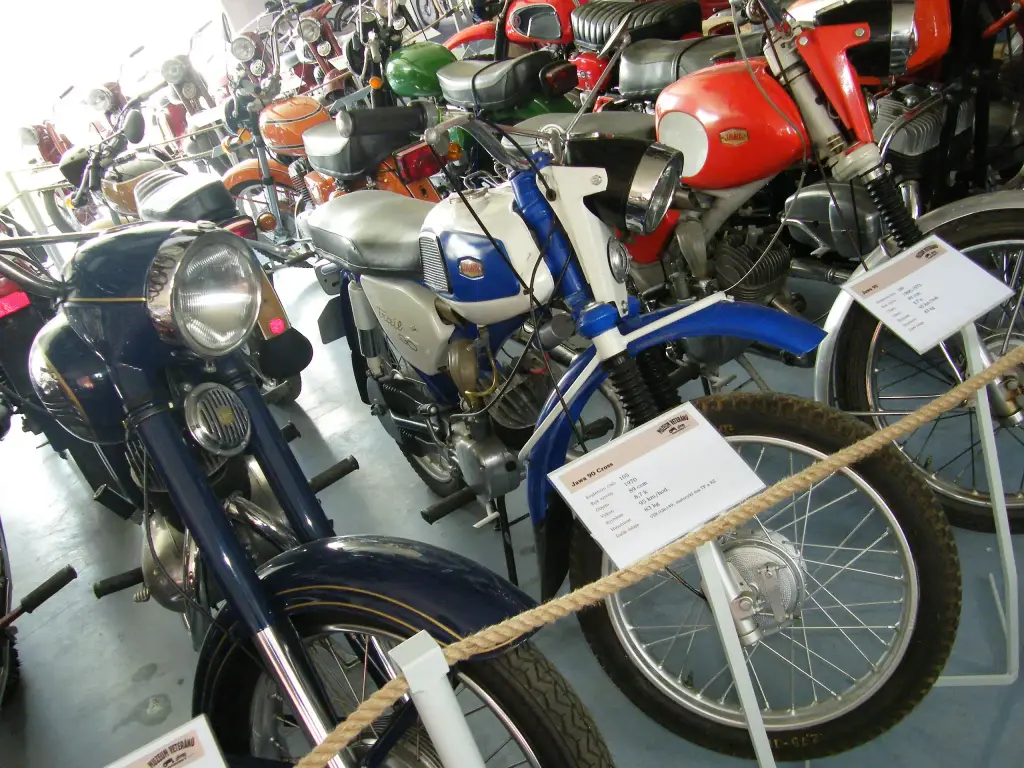
Two versions were offered. The Jawa 90 Roadster was the road machine, with narrow handlebars and an exhaust running under the engine. The Jawa 90 Cross, later catalogued as the Trail, had wider handlebars with a brace and an exhaust running over the top, and it is the version most often found at veteran events today.
Three generations
The first generation, both Roadster and Cross, was built from 1967 to 1970. It is recognised by a round tank whose colour differed from the frame and matched the tool boxes, shock absorbers, headlamp brackets and front mudguard. The second generation arrived in the second half of 1970 with an elongated tank, mostly in the colour of the frame; the Trail kept the name Cross in its technical certificate. The third generation of 1972–1973 had longer and more effective front forks, a fan-shaped cylinder head and a longer reflector with a round speedometer. Export machines often had different headlamps and tail lights because the Czechoslovak type approval was not valid abroad.
The bike weighed 84 kg dry and 92 kg ready to ride, reached 95 km/h and used 3 litres per 100 km. Its backbone frame kept the machine simple and light, and 36,942 examples were built before production ended in 1973.
Design and features
- Rotary valve: induction through a rotating disc instead of a piston-port or reed valve.
- Five-speed gearbox: the only five-speed gearbox on a Czechoslovak motorcycle at the time.
- Two bodies: a roadster with an under-engine exhaust and a cross with the exhaust over the top.
- Light weight: 84 kg dry with a 90 cm³ engine.
Jawa 90 versions
- Roadster: narrow handlebars and low exhaust for the road.
- Cross / Trail: wider braced handlebars and high exhaust.
- First generation (1967–1970): round tank in a contrasting colour.
- Second generation (1970–1972): elongated tank in frame colour.
- Third generation (1972–1973): longer forks, new cylinder head and instruments.
The Jawa 90 was built in the same Slovak works as the Jawa 50/23 Mustang and the Babetta moped. More are in the Jawa collection.
Sources
- Jawa 90, Czech Wikipedia: production, versions, generations, technical data
- Jawa Moto, English Wikipedia: start of SK 90 production in 1967