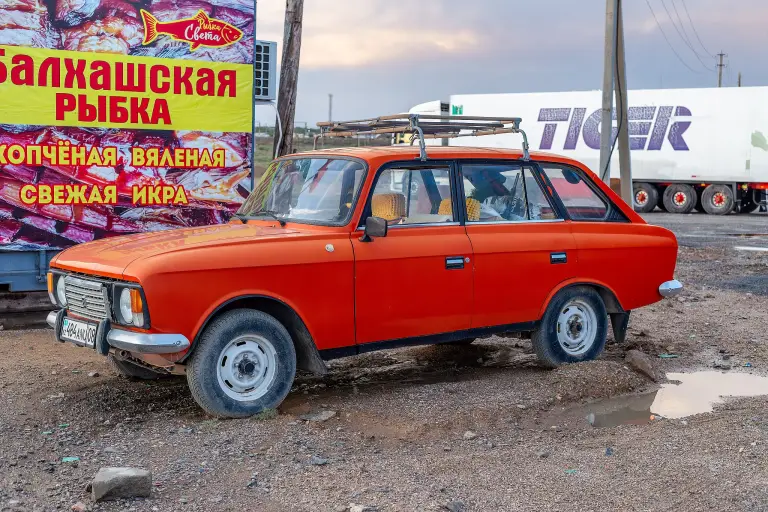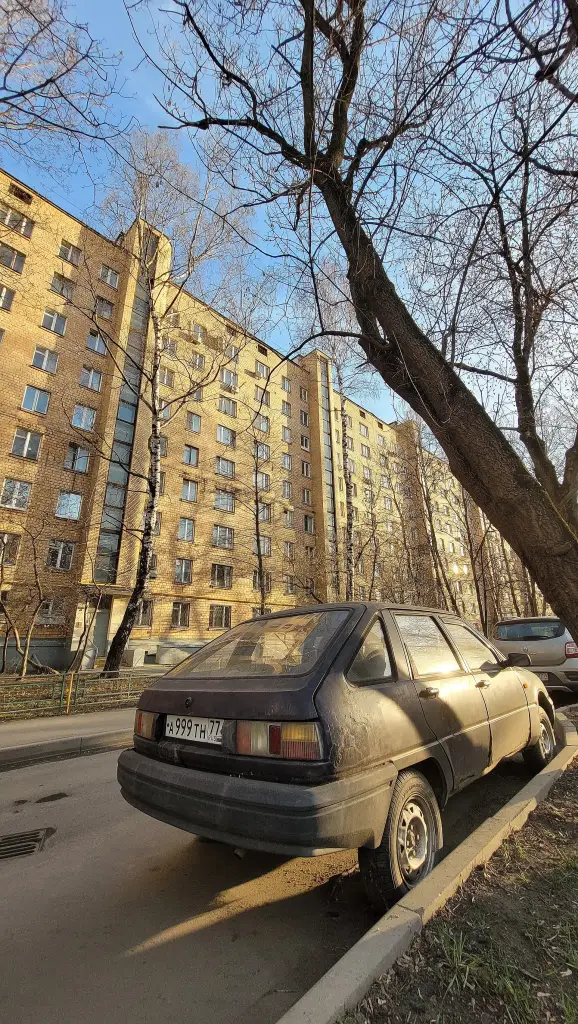
The IZh-2126 was the last passenger car designed entirely in Izhevsk. A five-door hatchback with rear-wheel drive, it replaced the IZh-2125 Kombi and was built from 1990 to 2005; until 2000 it carried the name Orbita, and from then on the better-known Oda.
IZh-2126 at a glance
| Maker | Izhmash, later IzhAuto, Izhevsk |
|---|---|
| Production | 1990–2005 |
| Names | IZh-2126 Orbita until 2000, Oda from 2000 |
| Body | five-door hatchback, rear-wheel drive |
| Engine | the VAZ-2106 1.6 four after the merger with AvtoVAZ |
| Gearbox | five-speed manual with a floor lever |
| Front suspension | MacPherson struts |
| Rear suspension | dependent |
| First prototype | 1977, series T |
| Built (2126) | 141,510 |
| Whole family | 230,781 cars |
| Safety | zero stars, ARCAP 2001 |
History of the IZh-2126
When Izhevsk began planning the car in the 1970s, its engineers had already tried front-wheel drive in experimental prototypes such as the IZh-13 Start, but the programme died for lack of money. Calculations showed that with a modern body, MacPherson front suspension and light alloy and plastic parts, rear-wheel drive lost little in weight, compactness or fuel consumption: a transverse front-wheel-drive layout with the Ufa engines then available would have saved only 15–20 kg, or 0.27–0.44 per cent of fuel. Rear-wheel drive also suited the plant’s commercial versions. The result was a compromise: a modern hatchback body with rear-wheel drive and heavily modernised mechanicals from the existing models.
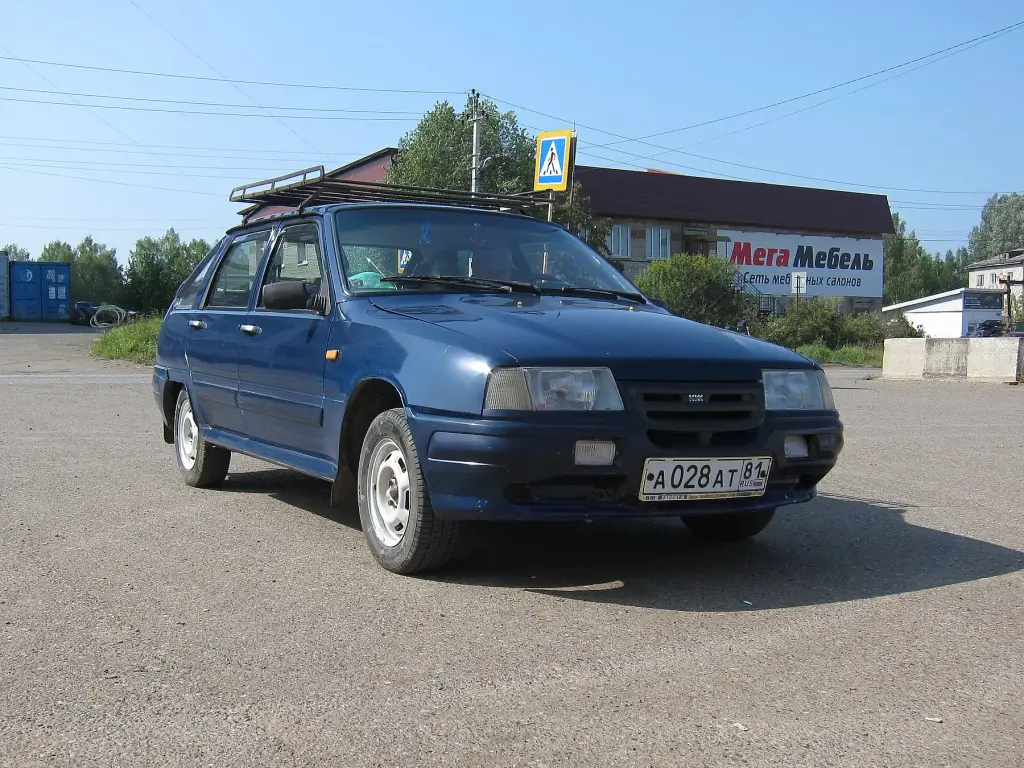
The first prototype series, known as series T, appeared in 1977. The body was modern for its time, with round headlights in square black surrounds; to make the cabin roomy without lengthening the car, the engine and rear axle were offset to the right, which shortened the nose and improved the pedals. The windscreen was steeply raked, the side glass curved, the body’s strength calculated on a computer by finite elements, and the aerodynamics developed with models at Moscow State University and with full-size cars in France on Renault equipment. The Moskvitch-412 gearbox was thoroughly reworked with a fifth gear and a lever mounted directly on the casing instead of the troublesome remote linkage, the worm steering gave way to rack and pinion, and the brakes became dual-circuit with a diagonal split. A hydro-mechanical automatic gearbox and a limited-slip differential were designed but never put into production. In the series the front suspension was a MacPherson layout with straight lower arms and an anti-roll bar acting as a locating strut; the rear remained dependent.
Production, 1990–2005
The Oda went into production in late 1991 alongside the Kombi, but the early years were lean. As AZLK, then effectively Izh’s parent, lost revenue after the collapse of the USSR, the plant converted about half its lines to other products such as firearms, and only about 5,000 cars were built between 1992 and 1995. In 1996 Izh dropped the Moskvitch brand and merged with AvtoVAZ to form IzhAuto; the car then received VAZ-derived parts, among them the Lada 110 interior and the VAZ-2106 engine. In 1997 the last Moskvitch-based models were dropped and the plant built only the 2126 and its 2717 derivative. Sales peaked between 1998 and 2002, helped by the price of imported cars, and the Oda was briefly sold in Kazakhstan, Ukraine and Belarus around 2003.
In early 2005 Russia moved to European emission standards. IzhAuto had no money to redesign its cars for them, and the last Odas were completed in September of that year. From 2008 parts of the old 2126 and 2717 lines were reused for the Lada Priora, and in 2014 the plant was rebuilt again for the Lada Granta, XRAY and Vesta. The family was the first designed by the plant itself rather than derived from a Moscow Moskvitch, although long front lamps from the Lada Sputnik family had to be used for lack of supply. Total production of the family was 230,781 cars: 141,510 IZh-2126 (1990–2005), 3,695 IZh-27171 pickups (1995–2005), 73,442 IZh-2117 Kombi (1998–2005) and 12,134 IZh-21261 Fabula (2003–2005). In 2001 the ARCAP safety programme gave the design, by then dating from 1977, zero stars out of four.
Design and features
- A modern body with rear-wheel drive: hatchback shape, MacPherson front suspension and rack-and-pinion steering, while the ZAZ, AZLK and VAZ rivals moved to front-wheel drive.
- Practical hatchback: five doors and a folding rear seat, replacing the Kombi as the passenger car of the range.
- Two names: Orbita until 2000, Oda afterwards.
- VAZ parts after 1996: Lada 110 interior fittings and the VAZ-2106 engine came with the merger.
- The end of the line: 141,510 cars in fifteen years, and the last Izhevsk design before the plant became a Lada assembly site.
IZh-2126 versions
- IZh-2126 Orbita (1990–2000): the original name of the hatchback.
- IZh-2126 Oda (2000–2005): the same car under its later name.
- IZh-2117 Kombi (1998–2005): the estate-bodied member of the family, 73,442 built.
- IZh-21261 Fabula (2003–2005): the short-lived last version, 12,134 built.
- IZh-2126-060: a four-wheel-drive version whose units were later used for the Okhotnik pickup.
- IZh-27171 pickup (1995–2005): 3,695 built on the same platform; it has its own page.
The Oda replaced the IZh-2125 Kombi, and the older IZh-412 supplied the mechanical basis for the whole Izhevsk range. Its commercial relative is the IZh-2717. More cars and motorcycles are in the IZh collection.
Sources
- Izh 2126, English Wikipedia: history, production totals, safety rating
- Иж-2126, Russian Wikipedia: development, prototypes, suspension, names