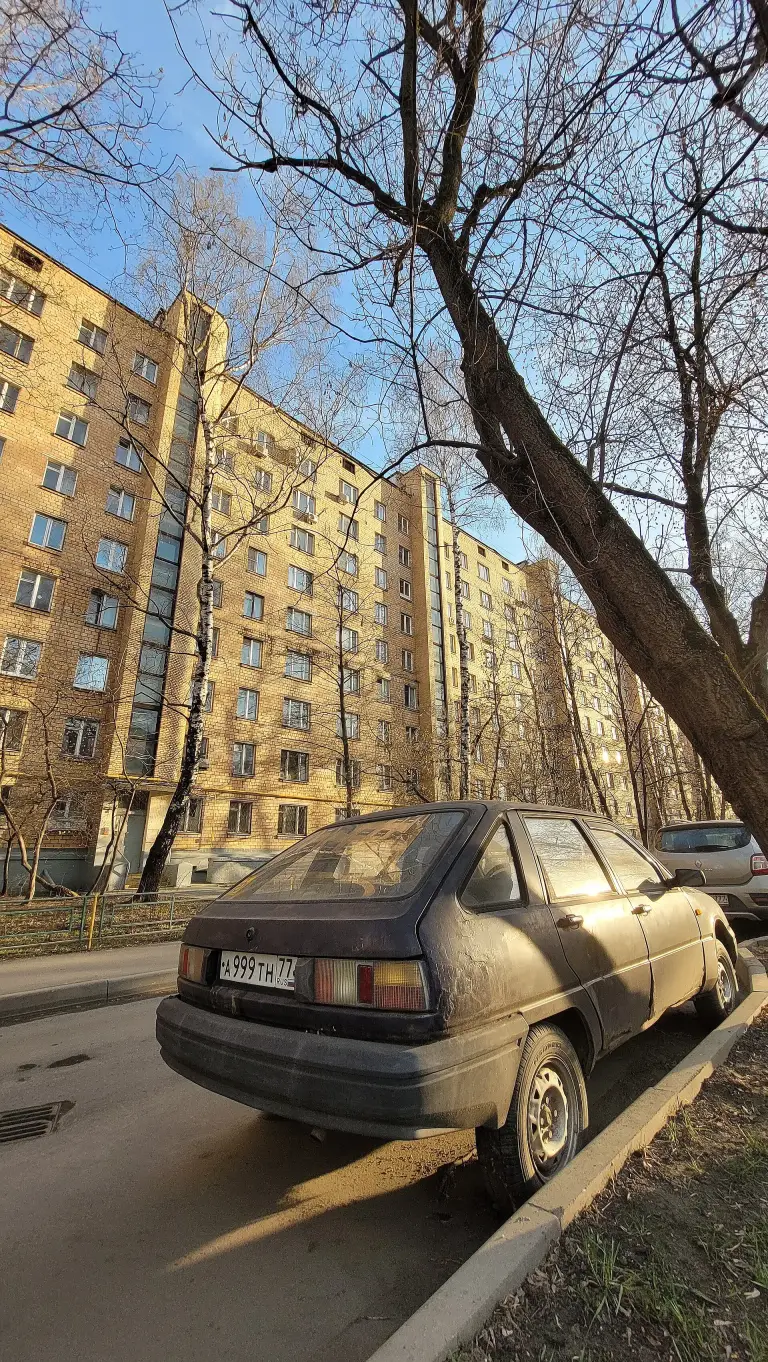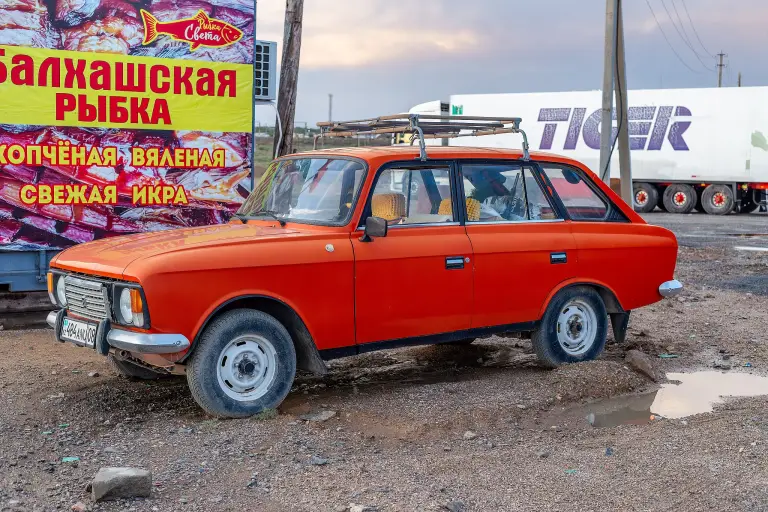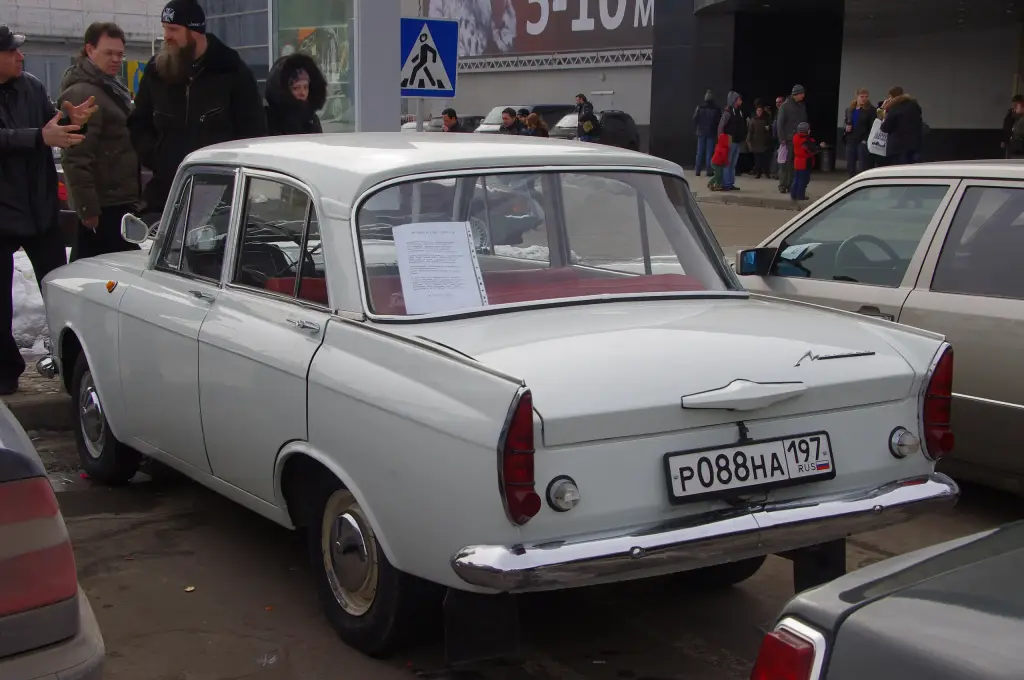
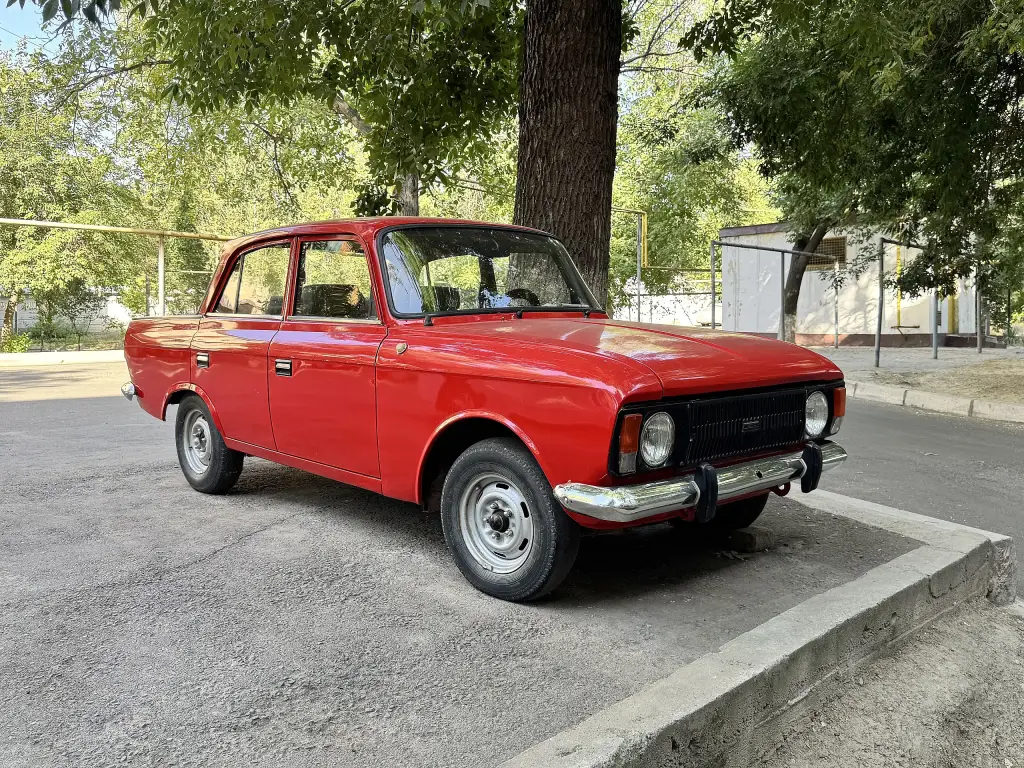
The Moskvitch-412 was the 1.5-litre development of the Moskvitch-408, built in Moscow from 1967 to 1976 and, as the IZh-412, in Izhevsk until 1997. Its aluminium overhead-cam engine made it the quickest small Soviet car of its day, and in Izhevsk it outlived every other Moskvitch.
IZh-412 at a glance
| Makers | MZMA/AZLK in Moscow; IZh in Izhevsk |
|---|---|
| Production | 1967–1976 in Moscow; 1967–1997 in Izhevsk |
| Engine | 1,478 cc UZAM-412, 75 hp |
| Engine layout | overhead cam, aluminium block and head, slanted 20 degrees |
| Sports version | 412-2V, 100 hp |
| Gear lever | on the floor from early 1969 |
| Facelift | December 1969: rectangular headlights, horizontal rear lights |
| Safety | 412IE: dual-circuit brakes, front disc brakes from 1970 |
| Export names | Moskvitch 1360 and 1500 |
| Racing | SATRA Motors, Group One Production Saloons, 1972–73 |
History of the IZh-412
A bigger engine in a familiar body
Work on a more powerful and faster version was planned while the Moskvitch-408 was still being designed. To win state money for the new engine, a sporting variant called the Tourist, an open grand-tourer, was proposed, but it was never built and did not even receive its own model number; the engine work went on and in the mid-1960s produced the 1.5-litre overhead-cam M-412. With no other engine available it was dropped into a modified 408 body, and the car’s performance rose so sharply that it reached the practical limit of the chassis. The 412 stood out among Soviet cars: at 13.9 kg per horsepower it was far better than the contemporary GAZ-21 Volga at 19 kg/hp and even the future GAZ-24 at 15.5 kg/hp. Nothing so small and relatively powerful had been built in the USSR before, which was a novelty for drivers used to the old hierarchy of Soviet cars.
The wider radiator and other parts of the 412 did not fit the 408’s engine bay, so the earliest cars left the line with specially reworked bodies; later in 1967 a “unified” body appeared, still with the old styling but able to take either the 408 or the 412 powertrain without modification. The engine itself had a slanted inline four, tilted 20 degrees because the overhead-cam head made it taller than the old OHV unit, with an aluminium alloy block, head and inlet manifold, a hemispherical combustion chamber and replaceable steel liners so that worn cylinders could be repaired rather than the whole engine replaced. It was designed by Igor Okunev, and some observers saw a resemblance to the BMW M115 of the BMW 1500, though the similarity was superficial and limited to the tilt and the valve and camshaft layout. The gearbox inherited from the 408 was improved with revised ratios. Until early 1969 the 412 still had a column gear lever and a front bench, making it hard to tell from a 408; from early 1969 it got a floor lever, separate front seats from January 1968, and a collapsible steering column.
The December 1969 facelift
At the end of 1969 both the 408 and the 412 received a redesigned body, the first Moskvitch models with rectangular headlights instead of round ones. Those lights were East German VER units shared with the Wartburg 353 and were later inherited by the 2138/2140 line in 1976. The rear lights became horizontal, with triangular turn-signal arrows above them on the vestigial fins, replacing vertical lamps on full fins. Some cars carried “parking signals”, two-colour side markers on the C-pillars rather like American opera lights, as on the GAZ-24 Volga; they were dropped early in the life of the Moskvitch-2140. The facelift also brought real attention to passive safety: soft interior parts, a padded dashboard, seat belts as standard from 1969, and a dual-circuit braking system with a servo; front disc brakes arrived in 1970 for some markets. The modernised car was coded M-412IE to show that it met the new safety requirements. It was the first Moskvitch to pass safety tests in France, Bulgaria, Czechoslovakia and Sweden in 1970–71 and in West Germany in 1972, receiving an international safety certificate after almost five months of testing in France. In Izhevsk the soft interior parts appeared only in 1976.
Racing and a long life in Izhevsk
SATRA Motors entered M-412s in the Group One Production Saloon Car Championship in 1972 and 1973, where the car easily beat the sharp-handling but underpowered Hillman Imp and Austin Mini. It also finished first, second and third in the 1973 Avon Round Britain Rally and took a class win in the South Africa Safari Rally the same year. In Moscow the 412 gave way to the restyled 2140 in 1976, but Izhevsk kept building its own 412 until 1997, modernising it on a separate programme; the Izhevsk cars are the ones usually called IZh-412, and they became the base for the IZh-2125 Kombi and the IZh-2715 van.
Design and features
- Aluminium overhead-cam engine: 1,478 cc and 75 hp, with a hemispherical combustion chamber and replaceable liners.
- Real performance: 13.9 kg per horsepower, better than the Volga GAZ-21 and GAZ-24.
- Safety work: the 412IE was the first Moskvitch to pass Western European safety tests.
- Racing record: victories over Hillman and Mini in Group One saloon racing and a 1-2-3 in the 1973 Round Britain Rally.
- Longevity: thirty years of Izhevsk production, and the base for the Kombi and the 2715 van.
IZh-412 versions
- M-412 saloon (1967–1976): the four-door built in Moscow.
- M-427 estate (1969–1976): five-door wagon with a two-piece tailgate until late 1972.
- M-434 panel van (1968–1976): three-door commercial version derived from the 427.
- Moskvitch-412-2V: 100 hp version used in sports cars.
- M-412IE: the safety-certified facelift with rectangular headlights.
- IZh-412: the Izhevsk-built line, produced until 1997 and modernised separately.
The 412 underpinned the IZh-2125 Kombi and the IZh-2715 van and pickup. Its Izhevsk successor in the passenger range was the IZh-2126 Oda. More are in the IZh collection.
Sources
- Moskvitch 412, English Wikipedia: engine, facelift, safety tests, racing
- Москвич-412, Russian Wikipedia: origins, performance figures, Izhevsk production