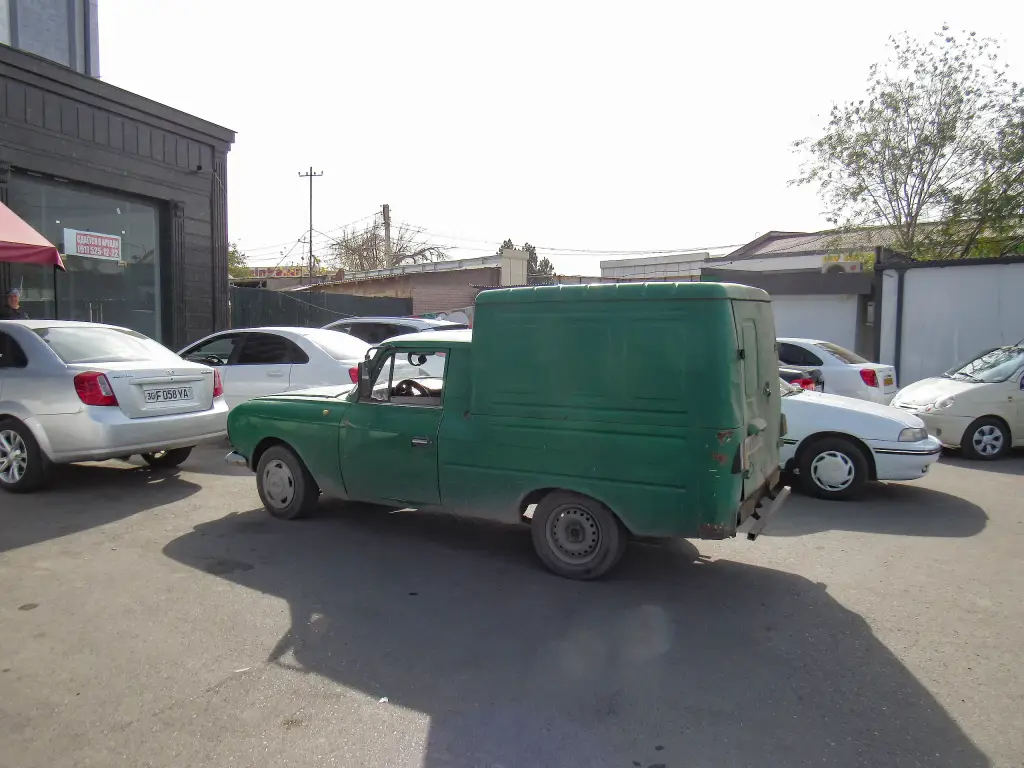
The IZh-2715 was the Soviet Union’s light delivery van, and its IZh-27151 sister was the pickup version. Both were built in Izhevsk from 1972 to 2001 on Moskvitch-412 mechanicals with barely any change through twenty-nine years, and 2,317,493 of them were made.
IZh-2715 at a glance
| Maker | Izhevsk Automobile Plant (IzhAuto) |
|---|---|
| Production | 1972–2001 |
| Bodies | panel van (2715) and pickup (27151) |
| Based on | Moskvitch-412 |
| Engine | 1.5 l UZAM-412, 75 hp |
| Payload | 400 kg nominal, 500–600 kg in practice for the pickup |
| Load volume, van | 2.6 m³, 1,170 mm high |
| Rear doors, van | 1,060 mm high, 1,040 mm wide |
| Badge until 1977–78 | ИЖ 1500 ГР |
| Update 1982 | 2715-01 and 27151-01: black grille, recessed handles, dual-circuit brakes |
| Built | 2,317,493 |
| Nicknames | pirozhok, bashmak, kabluk |
History of the IZh-2715
Between 1968 and 1973 Izhevsk built the Moskvitch 433/434 van, developed in Moscow on the Moskvitch-412 and fitted with a three-door body like the estate car, a low roof and an upward-opening rear hatch that made loading awkward. The Izhevsk engineers worked on their own initiative to improve it, and by 1970 had prototypes of a utility vehicle cut off behind the cabin and given either a box body (IZh-6F) or a cargo bed (IZh-6G); the van was too tall and needed more work. The refined vehicle went into production as the IZh-2715. Unlike the prototypes, the cargo compartment became an integral part of the lower body while the upper housing was a separate part fitted at the end of assembly — a necessity, because the commercial vehicles had to be built on lines designed for Moskvitch-412 saloons. The cargo box was no wider than the body, but its sides rose almost vertically behind the cabin, so it was much wider than the Moskvitch’s load area; the roof was raised and the rear given symmetrical double doors.
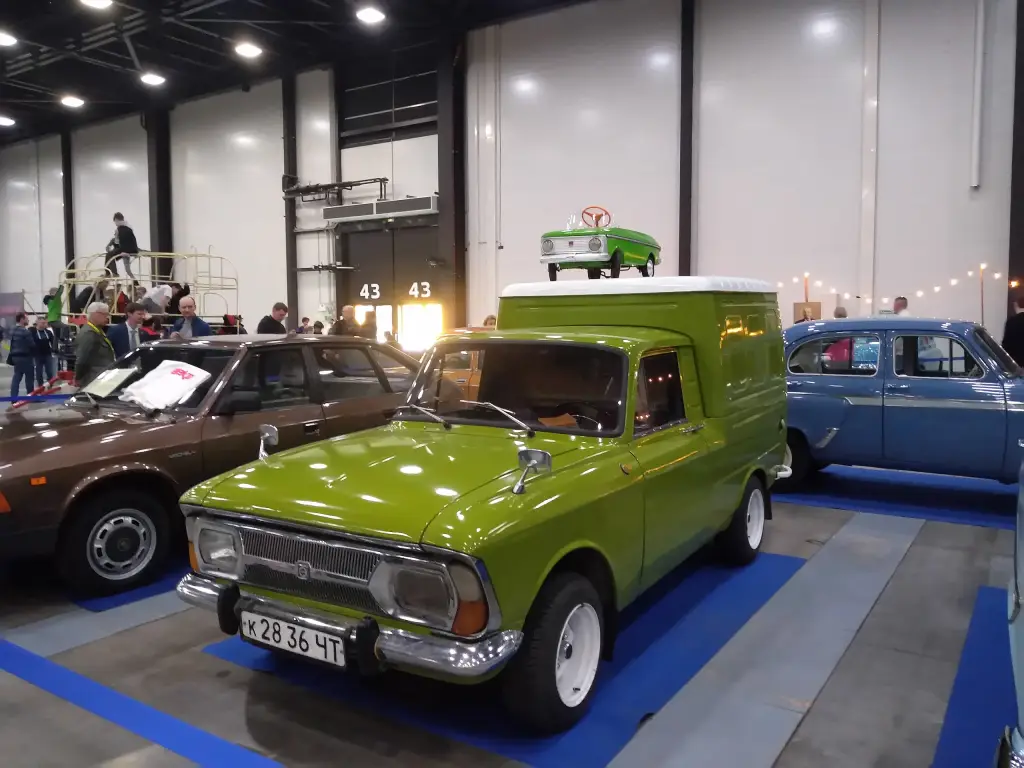
The load volume was 2.6 m³ at a height of 1,170 mm, against 1.5 m³ and 875 mm in the Moskvitch. The price was less rigidity and worse sealing of the cargo compartment, which made the Izh less suitable for some goods. A partition with a window separated cabin and cargo area, the spare wheel lived behind the passenger seat, and the payload was 350–400 kg. If needed, the upper housing could be removed together with the rear doors to make a pickup without a tailgate, though in practice this was rarely done. The body sourced the 1.5-litre UZAM-412 engine of 75 hp from Ufa, and the floor and suspension were left much as on the passenger car.
Production began with a first batch of 829 vehicles between November and the end of 1972; 33,271 were built in 1973 and 45,800 in 1974. The van and pickup were originally badged “ИЖ 1500 ГР” on the rear doors and the tailgate, but the badge was dropped around 1977–78, after which “ИЖ 2715” or “ИЖ 27151” was pressed directly into the metal.
The 27151 pickup
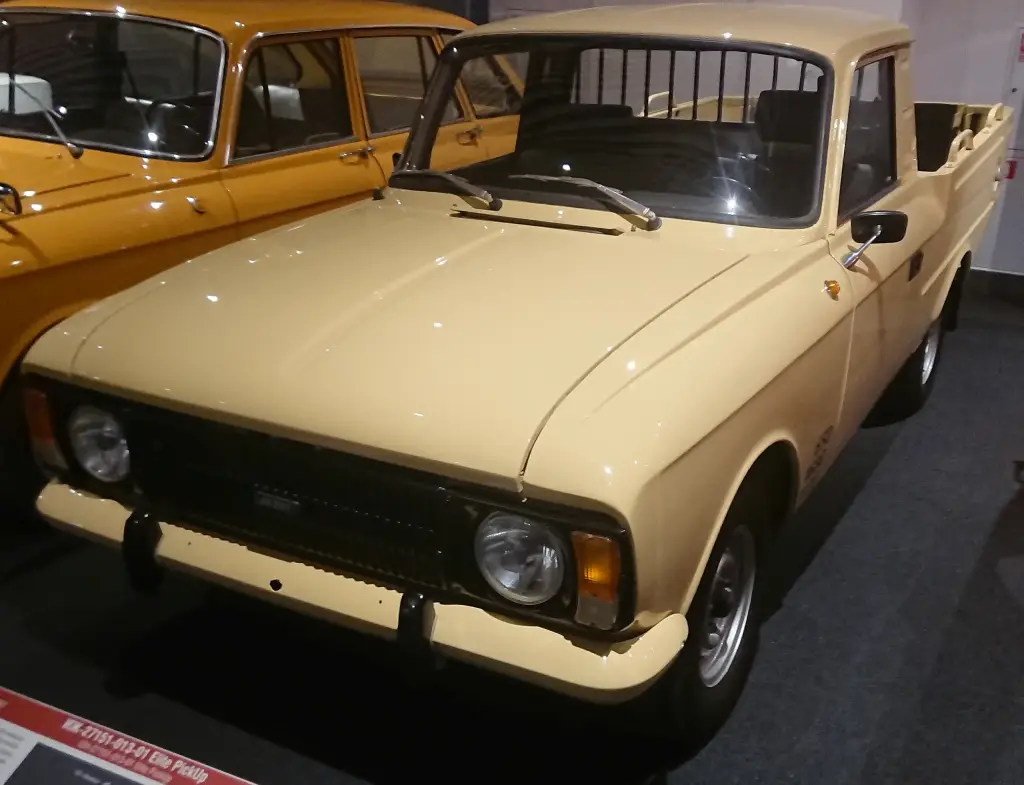
The IZh-27151 pickup with a folding tailgate appeared in 1974, driven mainly by export demand, since in the Soviet Union a pickup protected goods badly from weather and theft. It was built in much smaller numbers than the van — 4,200 in 1974 and 5,000 in 1975 — and its nominal payload of 400 kg could reach 500–600 kg in practice. A window with a vertical grille was set in the rear wall of the cabin. Export vans and pickups were better finished, with rectangular headlights, a chrome grille and chrome bumpers, while home-market cars generally had round headlights and body-coloured grilles and bumpers; abroad the pickup was sold as the Moskvitch 1500 GR and, in Western markets, as the Elite Pick Up. Its platform measured 1,655 mm by 1,440 mm, with 940 mm between the wheel arches and a floor 565 mm above the ground.
Second generation and the end
In 1982 the range was modernised along with the Izhevsk-built Moskvitch-412 and became the IZh-2715-01 van and IZh-27151-01 pickup: a black-painted sheet-metal grille, indicators and side lights moved vertically beside the grille instead of under the round headlights, recessed door handles of the Moskvitch-2140 type set lower on the door, a dual-circuit braking system, better electrics, more comfortable seats and the light switch moved from the floor to the steering column. In the 1980s the 2715 was the only light delivery vehicle in the USSR, with a payload of 450–500 kg, and until then shops had relied on old saloons and estate cars converted by repair works. Further versions followed: a six-seat cargo-passenger IZh-27156 from 1988 to 2001, with two folding two-place benches along the sides and windows in the body; and from 1997 the IZh-2715-016-01 with the 1.6-litre UZAM-0102 of 80 hp, a VAZ-2108 steering wheel and IZh-2126 seats. An export IZh-27151 Elite PickUp with a longer platform and rectangular headlights, known at home as the IZh-27151-013-01, was first sold to Latin America, Panama among others, and later to Finland. In 1997 the IZh-2717 took over, and the last 2715s were built in 2001.
Design and features
- Purpose-built cargo body: 2.6 m³ of load space and double rear doors, far more usable than the Moskvitch van it replaced.
- Standard mechanics: the 1.5-litre UZAM-412 engine and Moskvitch-412 running gear meant parts everywhere.
- Long service: twenty-nine years with minimal change, and over two million built.
- Many bodies: van, pickup, six-seat cargo-passenger version and a long-platform export pickup.
- A national nickname: the shape earned it the names pirozhok, bashmak and kabluk.
IZh-2715 versions
- IZh-2715 van (1972–1982): the original panel van with double rear doors.
- IZh-27151 pickup (1974–1982): folding tailgate and a window in the cabin wall.
- IZh-2715-01 and IZh-27151-01 (1982–1997): the facelifted generation with a black grille.
- IZh-27156 (1988–2001): six-seat cargo-passenger version with side windows and folding benches.
- IZh-2715-016-01 (1997–2001): 1.6-litre UZAM-0102, 80 hp, with VAZ and 2126 fittings.
- IZh-27151-013-01 Elite PickUp: longer platform and rectangular headlights for export.
The van was built on the IZh-412 and shared its front end with the IZh-2125 Kombi. Its successor was the IZh-2717. More are in the IZh collection.
Sources
- Izh 2715, English Wikipedia: development, body, load volume, pickup, 1982 changes
- Иж-2715, Russian Wikipedia: production total, versions, engine, nicknames