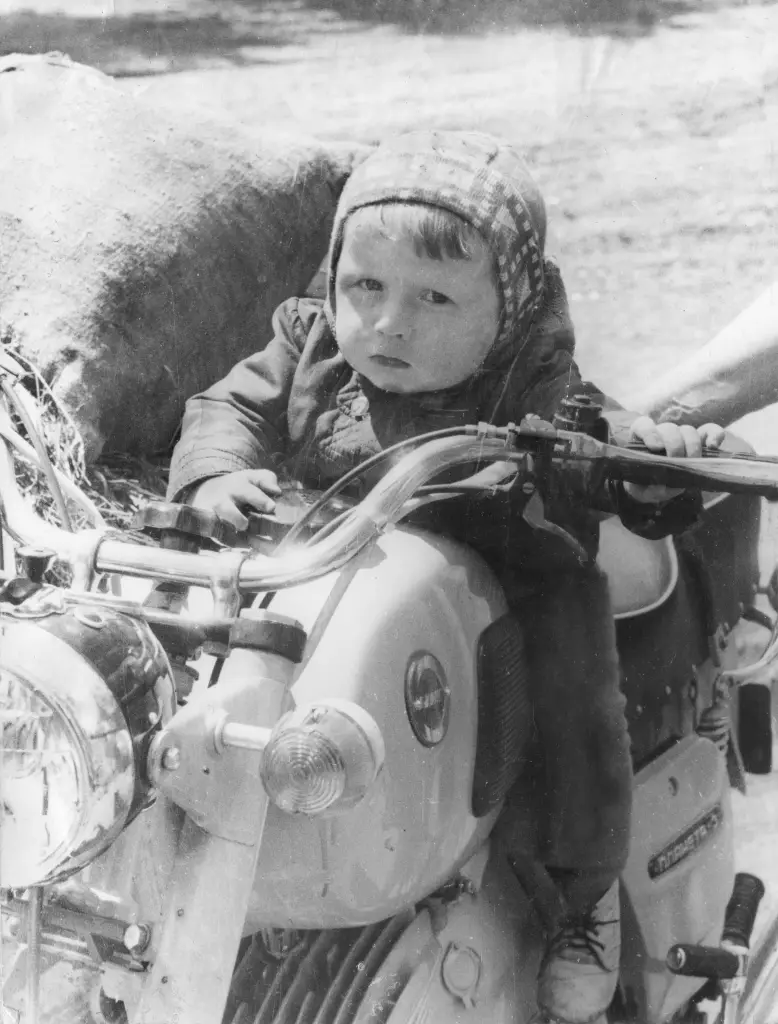
The IZh Planeta was the road motorcycle that replaced the IZh-56 in 1962 and gave its name to a family built until 2008. The first version alone accounted for 405,303 machines between 1962 and 1967.
IZh Planeta at a glance
| Maker | Izhevsk Machine-Building Plant |
|---|---|
| Production | 1962–1967 (Planeta); family to 2008 |
| Built (original model) | 405,303 |
| Engine | single-cylinder two-stroke, air-cooled, 346 cc |
| Power | 13 hp at 4,400 rpm (Planeta-3) |
| Gearbox | four-speed |
| Top speed | 100 km/h |
| Dry weight | 158 kg |
| Fuel tank | 18 litres (Planeta-3); 3.7 l per 100 km |
| Electrics | 6 volts |
| Dimensions | 2,115 × 280 × 1,025 mm |
| Wheelbase | 1,400 mm |
The specification rows describe the Planeta-3 of 1971–1977, the version for which the Russian article gives a full table; the photographs show a Planeta-3 and a Planeta-5.
History of the IZh Planeta
From the IZh-56
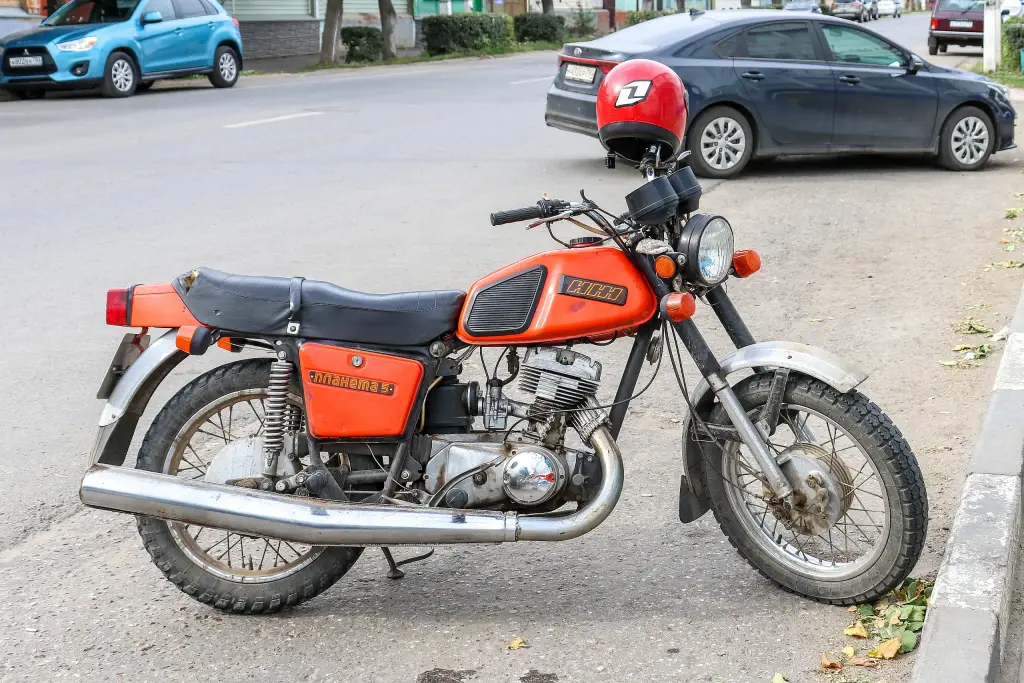
Production of the IZh Planeta began in 1962 on the basis of the IZh-56, and its running gear was unified as far as possible with the IZh Jupiter. Its guaranteed mileage rose by 2,000 km against the IZh-56 and the life of the cylinder-piston group grew by half, thanks to a contact-oil air cleaner. The motorcycle differed from its predecessor in a new fuel tank, an easily removable saddle and new silencers, and stamped-welded mudguards replaced the earlier stamped ones. The chassis and engine followed the familiar Izhevsk pattern: a single-cylinder two-stroke, air-cooled, with loop scavenging, mixture from a carburettor and ignition by a 6-volt system; a pressed crankshaft, a unit crankcase split along the middle with the flywheel chamber in front and the gearbox behind; foot gear lever and kickstarter on the left.
The series
The Planeta began a whole line of motorcycles. The Planeta-2 of 1965–1975 raised power to 15.5 hp and replaced stamped steel wheel hubs with cast aluminium ones. The Planeta-3 of 1970–1977 brought a new shape of fuel tank, tool boxes and mudguards, and two-tone paint on some machines; it had round mudguards for 18-inch wheels instead of the sprung “fish” mudguards, a taller tank with a rounded hump and proper knee grips, a more powerful engine of 18 hp, higher handlebars, and the first turn indicators ever fitted to an IZh. It received the State Quality Mark of the USSR. The Planeta 3-01 followed in 1977–1981 and the 3-02 in 1981–1985.
The Planeta-4 of 1983–1987 had different external forms and a 12-volt electrical system with a three-phase alternator of 100 W; fork travel was increased and the rear suspension improved. It had a shallow circular front mudguard, new switches that let the rider work every control without leaving the bars, a car-type ignition lock and an anti-theft device, and an “emergency start” button that earthed the alternator field winding so the machine could be started with a flat battery. Some machines had painted mudguards and some chromed ones.
The Planeta-5 of 1987–2008 got a new cylinder with a flanged silencer mounting, so a single original silencer on the right replaced the two shared with the Jupiter family, as well as a new tank, front mudguard, instrument panel and tail light, and a twin-leading-shoe front brake; alternator output rose to 140 W. At the very end of the 1980s the Planeta-5 served as the test bed for licensed components mastered at Izhmash: an air-hydraulic fork whose legs could be pumped up with an ordinary tyre pump, cast wheels instead of spoked ones, and a front disc brake, available only together with the air fork. The licensed parts were simplified in the usual way, and the disc brake caliper acquired an alarming habit: at 90–95 per cent pad wear the thinned pads left the caliper and locked the front wheel solid. The last Planeta, a Planeta-7, was built in 2008.
Design and features
- Better than the IZh-56: a longer guarantee, a longer-lived cylinder-piston group and a contact-oil air cleaner.
- Shared running gear: chassis parts unified with the two-cylinder IZh Jupiter.
- Long development: five main versions over forty-six years, ending with the Planeta-5 in 2008.
- Modern electrics by the end: a 12-volt system, a 140 W alternator and an emergency-start button.
- Licensed technology: the Planeta-5 tested air forks, cast wheels and a front disc brake for Izhmash.
IZh Planeta versions
- IZh Planeta (1962–1967): the original model, 405,303 built.
- IZh Planeta-2 (1965–1975): 15.5 hp and cast aluminium wheel hubs.
- IZh Planeta-3 (1970–1977): 18 hp, new bodywork, first turn indicators; 3-01 and 3-02 followed.
- IZh Planeta-4 (1983–1987): 12-volt electrics, 100 W alternator, new controls and ignition lock.
- IZh Planeta-5 (1987–2008): single silencer, twin-leading-shoe brake, 140 W alternator, licensed forks and brakes.
The Planeta was developed from the IZh-56, itself a development of the IZh-49, and it shared its chassis with the IZh Jupiter. More are in the IZh collection.
Sources
- Иж Планета, Russian Wikipedia: history, design, specification, the whole series
- IZh (motorcycle), English Wikipedia: the 350 cc class and the place of the model in the range