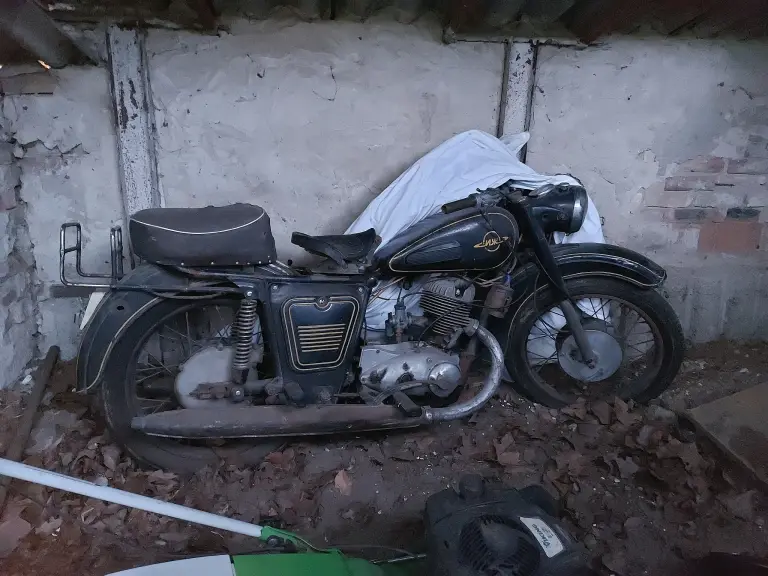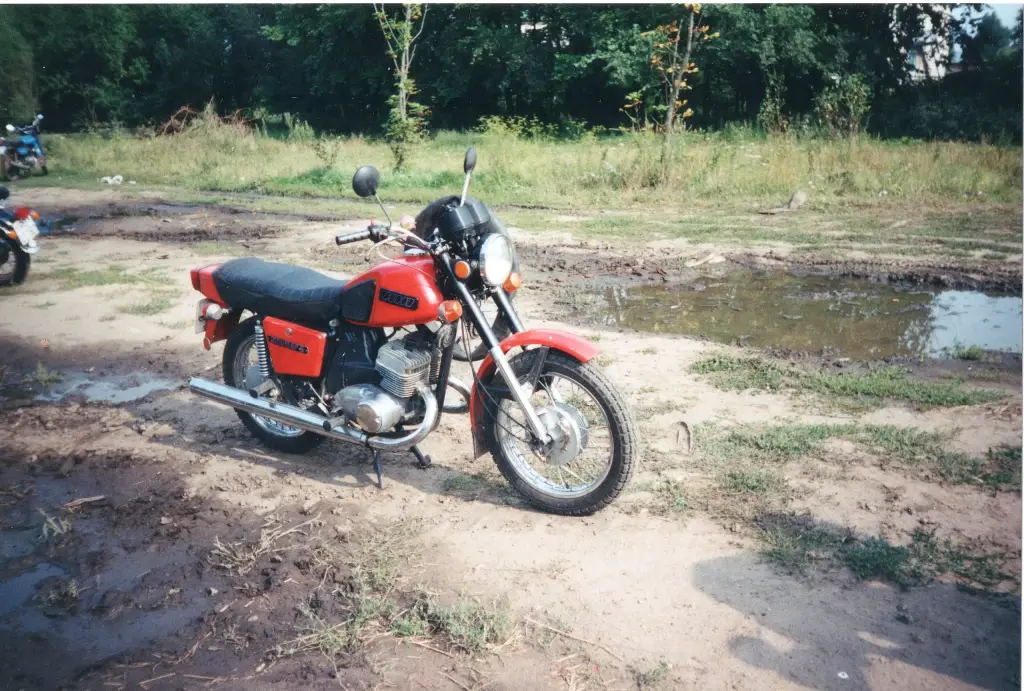
The IZh Jupiter of 1961 was the first Izhevsk motorcycle with a two-cylinder engine. It kept the chassis of the IZh-56 but had an entirely new 350 cc twin of 18 hp, and it began a series that was built, in ever-changing forms, until 2008.
IZh Jupiter at a glance
| Maker | Izhevsk Machine-Building Plant |
|---|---|
| Production | 1961–1966 |
| Built | 477,747 |
| Prototype | DKW RT 350 S of 1955 |
| Engine | two-cylinder two-stroke, air-cooled, 347 cc |
| Bore and stroke | 61.75 × 58 mm |
| Power | 18 hp |
| Gearbox | four-speed |
| Top speed | 110 km/h |
| Dry weight | 160 kg |
| Fuel tank | 16 litres; 400–450 km range |
| Fuel consumption | up to 4 l per 100 km |
History of the IZh Jupiter
A new engine
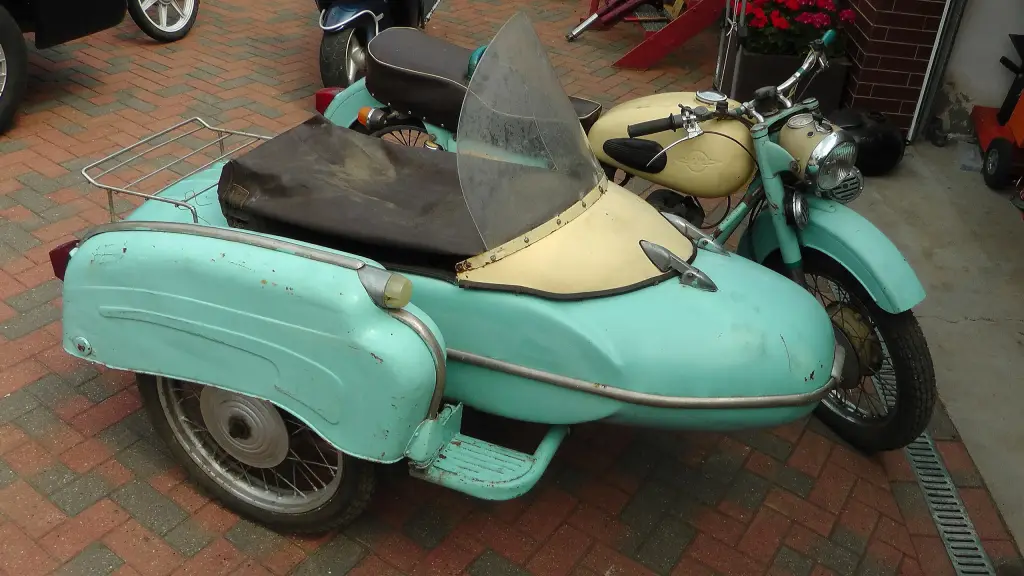
In the second half of 1958 the design bureau was given the task of preparing the IZh Jupiter for production. A prototype had already been shown at the World Exhibition in Brussels in 1957. The model was based on the DKW RT 350 S, a two-cylinder 350 cc machine of 18 hp that DKW had been building since 1955. The new motorcycle was first called IZh-58 and then renamed IZh-Jupiter. The first prototypes gave very good results: engine output was brought to 18 hp, the gearbox was easier to use and bearing lubrication had been improved. Engine production was organised at the Izhevsk Mechanical Plant, and series production of the Jupiter began in the second half of 1961. In all 477,747 were built.
Chassis of the IZh-56, engine all new
The motorcycle kept the running gear of the IZh-56 but had a completely new engine: a two-cylinder two-stroke with the cylinders in a vertical transverse row, air-cooled, with loop scavenging, carburettor mixture and spark ignition. The carburettor was hidden under covers with a metal slide for access when starting, and the air filter was of the contact-oil type. The piston, connecting rod, rings, gudgeon pin, circlips and big-end rollers were unified with the corresponding parts of the K-175 engine. The two-armed foot gear lever and the kickstarter sit on the left of the gearbox casing. Like every later twin, the Jupiter had an automatic clutch release mechanism. The speedometer was driven from the front wheel, unlike the IZh-56, and the sprung front mudguard was fixed by a cast bracket to the lower yoke of the fork, so that mud could not pack under it.
The Jupiter-K and the 1965 engine
A sidecar version, the IZh Jupiter-K, came with the BP-58 chair from the IZh-56K or the newer BP-62. Its top speed was 80 km/h, dry weight 255 kg, width 1,650 mm and track 1,170 mm; the sidecar wheel was sprung by torsion bars and the chair body on springs. In 1965 the motorcycle received the updated engine of the Jupiter-2, which in effect made it a transitional machine between the first and the second generation.
The series it began
The Jupiter began a whole line of two-cylinder motorcycles. The Jupiter-2 of 1965–1971 had 19 hp at 4,900 rpm. The Jupiter-3 of 1971–1977 raised output by almost 40 per cent to 25 hp at 5,700 rpm and received the State Quality Mark of the USSR; the Jupiter-3-01 of 1977–1980 went to 27 hp, and the 3-02 was built in 1979–1981. The Jupiter-4 of 1982–1985 had 28 hp at 6,200 rpm and 3.58 kgf·m of torque, 12-volt electrics and new lighting. The Jupiter-5 (IZh 6.113 and 6.114) of 1985–1988 dropped to 24 hp but pulled better at medium engine speeds and gained an emergency-start button that earthed the alternator field winding for starting with a flat battery. From 1988 the Jupiter-5-01 adopted the new bodywork of the Planeta-5 with a new tank, tool-box lids, seat and instrument panel, nine cooling fins per cylinder instead of seven, and a wider primary chain. From 1993 the Jupiter-5-03 used a liquid-cooled engine of 25 hp, with 1.5–2 litres less fuel per 100 km and 30 per cent less noise. The last Jupiter-5 was built in 2008.
Design and features
- First Izhevsk twin: a 347 cc two-cylinder two-stroke in a vertical transverse row, 18 hp.
- Faster and further: 110 km/h and 400–450 km on a 16-litre tank.
- Practical detail: the front mudguard hung from a cast bracket so mud could not jam it.
- Automatic clutch release: the mechanism every later Izhevsk twin inherited.
- Long series: developed into the Jupiter-2, -3, -4 and -5, the last of them built in 2008.
IZh Jupiter versions
- IZh Jupiter (1961–1966): the original twin, 477,747 built.
- IZh Jupiter-K: sidecar outfit with a BP-58 or BP-62 chair, 80 km/h.
- 1965 Jupiter: the transitional machine with the Jupiter-2 engine.
- IZh Jupiter-2 (1965–1971): 19 hp at 4,900 rpm.
- IZh Jupiter-3 and 3-01 (1971–1980): 25 and later 27 hp, State Quality Mark.
- IZh Jupiter-4 and -5 (1982–2008): 28 hp with 12-volt electrics, then the restyled and finally liquid-cooled Jupiter-5.
The Jupiter shared its chassis with the IZh-56 and its role with the single-cylinder IZh Planeta. The later cruiser-styled model of the range is the IZh Yunker. More are in the IZh collection.
Sources
- Иж Юпитер, Russian Wikipedia: history, design, specification, the whole series
- IZh (motorcycle), English Wikipedia: the 350 cc class and the place of the model in the IZh range