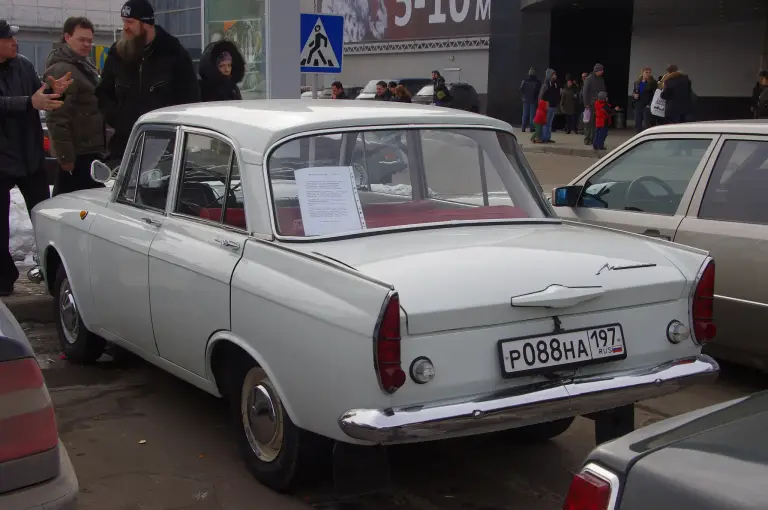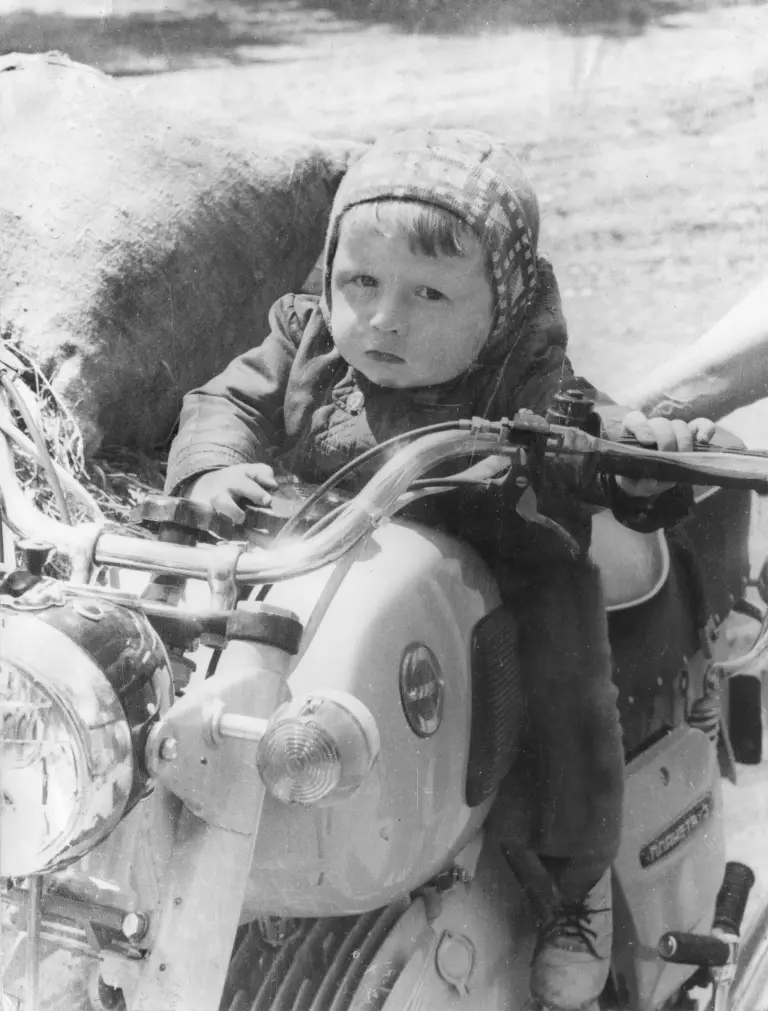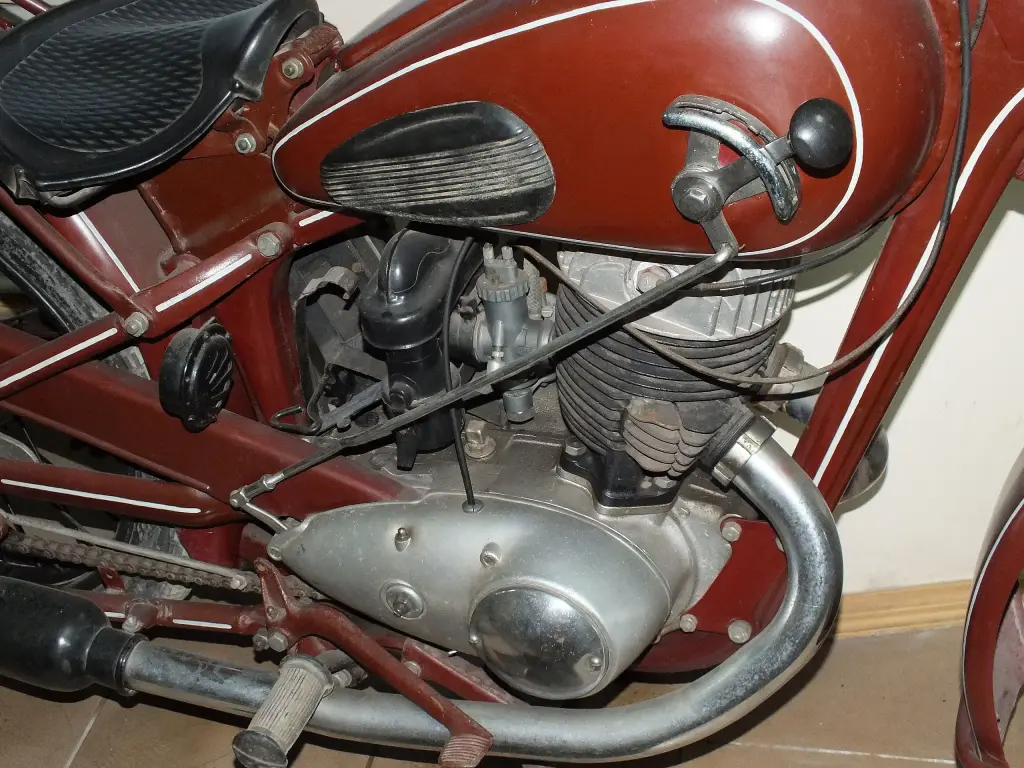
The IZh-49 was the Izhevsk plant’s 350 cc road motorcycle of 1951–1958, a development of the DKW-derived IZh-350 with a telescopic fork and hydraulic rear dampers. It was the first IZh model to pass half a million built, and it became the pattern for later Izhevsk bikes.
IZh-49 at a glance
| Maker | Izhevsk Machine-Building Plant |
|---|---|
| Production | 1951–1958 |
| Engine | single-cylinder two-stroke, air-cooled, 346 cc |
| Power | 11.5 hp at 4,000 rpm |
| Gearbox | four-speed |
| Top speed | 90 km/h |
| Dry weight | 150 kg with the rear saddle |
| Fuel tank | 14 litres |
| Range | 160–180 km |
| Fuel consumption | up to 4.5 l per 100 km |
| Dimensions | 2,120 × 770 × 980 mm |
| Built | 507,603 |
History of the IZh-49
From reparations
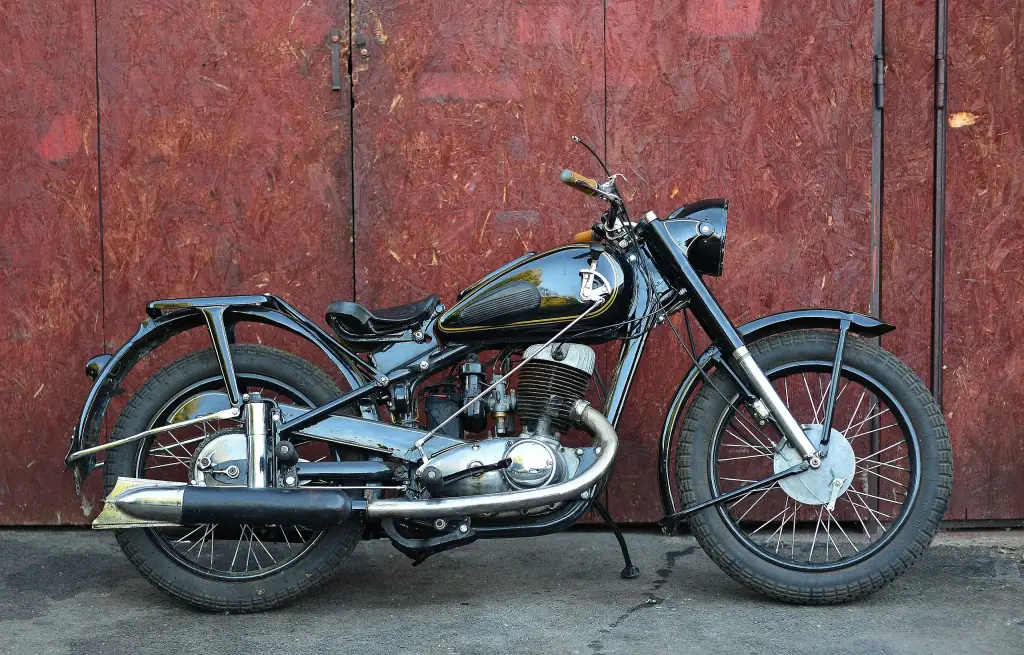
After the war German DKW equipment was taken to the USSR as reparations, and the Izhevsk plant received machine tools. In 1946, under the German chief designer Hermann Weber and other DKW engineers who had been invited, production of the IZh-350 began, based on the DKW NZ 350. In 1951 the plant moved to the IZh-49 without stopping the line, and the new model became very popular. Its designers were A. A. Modzelevsky, S. Ya. Fisher, S. S. Zorin, N. N. Pushin, G. L. Pisarev and others.
The telescopic front fork, the rear suspension with hydraulic dampers and other improvements made the ride more comfortable and the motorcycle better able to cope with bad roads. Besides solo machines, a pilot batch was built with sidecars; an outfit for the IZh-49 was developed in 1956. Production ended in 1958 because the new IZh-56 had been in production since 1955. In all 507,603 IZh-49s were built, making it the first IZh model to pass half a million units, and it served as the base for a series of post-war Izhevsk motorcycles. In 2024 a limited edition of retro-styled electric motorcycles was produced under the name IZh-49 Retro.
How it was built
The engine is a single-cylinder two-stroke, air-cooled, with loop scavenging, mixture from a carburettor and spark ignition. The crankshaft is a pressed assembly, the crankcase is of unit type with the flywheel chamber in front and the gearbox behind, split along the middle. The foot gear lever and the kickstarter are on the left of the gearbox. The front wheel, brake, speedometer drive and mudguard are carried by the moving part of the telescopic fork, and the headlamp shell contains the speedometer, driven through a flexible shaft. The handlebars turn 35 degrees each way and can be fixed in the position the rider prefers. A hand gear lever sector sits on the right of the fuel tank and follows the foot pedal, which is a feature of the IZh design rather than the usual hand-change lever alone. The light unsprung weight and the small change in wheel offset give good stability and handling; the rear wheel sits in a cross-braced fork sprung on spring-hydraulic units. The wheels are quickly detachable but not interchangeable.
Design and features
- Comfort for its class: a telescopic front fork and hydraulic rear suspension instead of the older girder and friction damping.
- Modern engine: an air-cooled 346 cc two-stroke of 11.5 hp at 4,000 rpm.
- Everyday range: a 14-litre tank and 160–180 km on the highway.
- Sidecar work: a pilot batch was built with sidecars, and an outfit followed in 1956.
- Foundation model: the basis for the later Izhevsk road and sports bikes.
IZh-49 versions
- IZh-49 solo: the standard road motorcycle.
- IZh-49 with sidecar: a pilot batch and a 1956 outfit.
- IZh-50A: six-days trials motorcycle based on the IZh-49.
- IZh-50B: motocross version with 16 hp at 4,500 rpm and a lighter chassis.
- IZh-51M: road-racing motorcycle with an experimental variable-volume crankcase.
- IZh-49 Retro (2024): a limited electric motorcycle in retro style.
The IZh-49 was followed by the IZh-56, itself the basis of the IZh Planeta. The Jupiter is described in its own article. More are in the IZh collection.
Sources
- Иж-49, Russian Wikipedia: history, design, specification, sports versions
- IZh (motorcycle), English Wikipedia: place in the IZh range, half-million mark