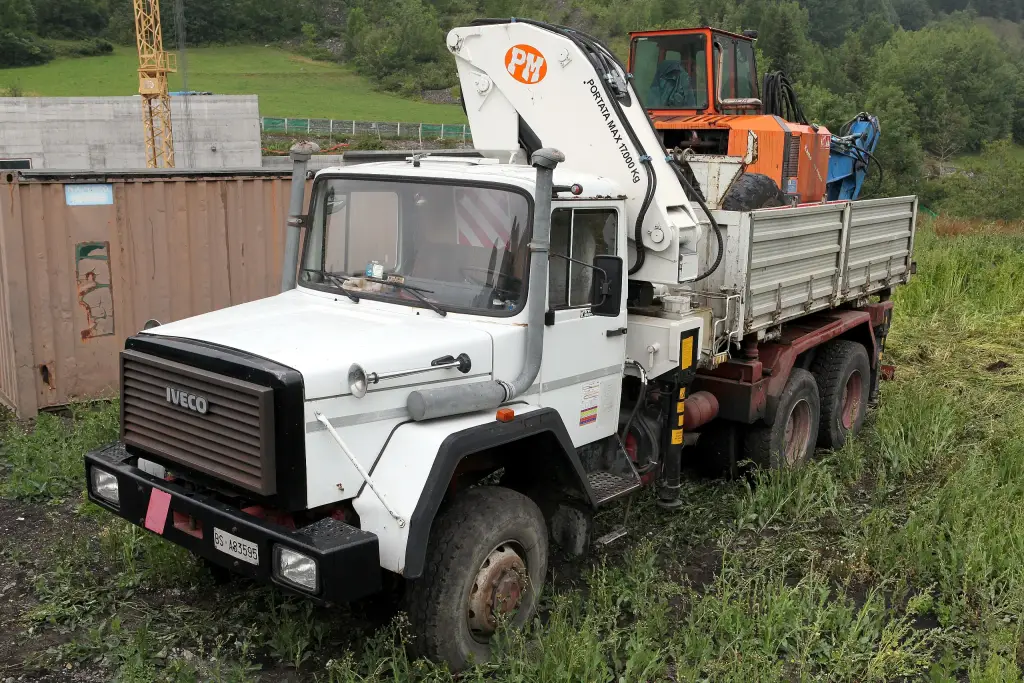
The Iveco 330 was a heavy lorry for quarries and building sites, built from 1979. It was a direct development of the Fiat 300, and its cab became the basis of the later Iveco T series. It was the first European quarry and site truck with an eight-cylinder engine, a V8 of 17,174 cc.
Iveco 330 at a glance
| Maker | Iveco |
|---|---|
| Production | from 1979, sold for 14 years |
| Developed from | Fiat 300 |
| Cab | also the basis of the later Iveco T series |
| Engine | Fiat 8280 V8 of 17,174 cc, 260–310 kW (352–420 hp) |
| Torque | up to 2,050 Nm at 1,100 rpm |
| Gross weight | 40 to 72 tonnes, for off-road use |
| Layouts | 6×4, 6×6, 8×4 and tractor unit |
| Replaced by | Iveco EuroTrakker |
| Also built in | Argentina and Brazil |
| Main market | Italy, because of the weight limits in other countries |
Based on one source: the Italian Wikipedia article.
History of the Iveco 330
The 330 was the direct descendant of the Fiat 300, and its cab served as the starting point for the Iveco T series that followed. The chassis was very stiff, which suited the heavy range from 40 to 72 tonnes and made the lorry a common base for crane conversions. The V8 gave torque of up to 2,050 Nm at only 1,100 rpm.
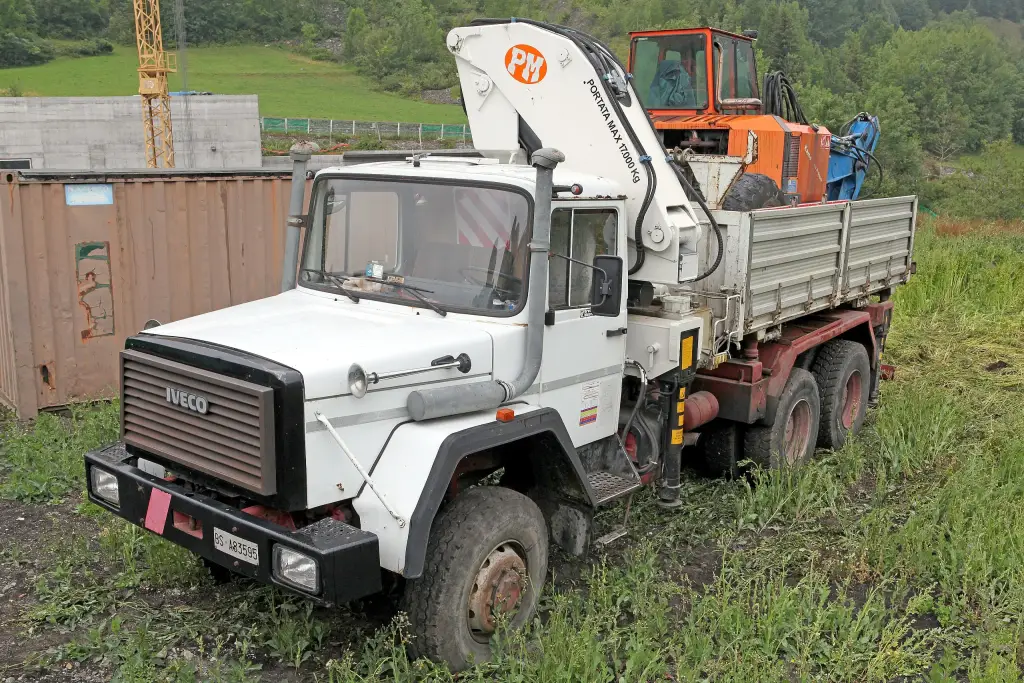
Because of the weight rules in force elsewhere in Europe the 330 was almost entirely an Italian market model: in France, for example, it could not exceed 26 tonnes gross weight. Three-axle 6×4 lorries of 33 tonnes and four-axle 8×4 lorries of 40 tonnes could be told apart by the light bar on the cab roof, visible while the vehicle was moving. The cab roof was reinforced for site work, and the 330 was used as a tipper, as a concrete mixer carrying 9 to 15 cubic metres, and as a tractor unit.
Many examples covered two million kilometres. The same cab later received air conditioning when the Iveco Turbostar was developed from it. After 14 years on sale the 330 was replaced by the Iveco EuroTrakker; the model had also been built in Argentina and Brazil.
Design and features
- First V8 in its class: a 17,174 cc eight-cylinder engine in a European quarry truck.
- Very stiff chassis: designed for 40 to 72 tonnes and often used as the base for cranes.
- Reinforced cab: a stronger roof for site work, with a roof light bar on the heaviest models.
- Long service life: individual vehicles reached two million kilometres.
Iveco 330 versions
- 330F models: sold under the Fiat, OM, Unic and Magirus-Deutz badges in the early years.
- Iveco 330.26 and 330.35: the first Iveco-badged versions, with and without turbocharging.
- 330.35T and 330.36T Turbo: long-cab versions, also in 6×6.
- 330.42 Turbo: the most powerful version of the V8 range.
- Hydrotrans versions: torque-converter transmission offered on several models.
The 330 was replaced by the EuroTrakker, and its cab led to the Turbostar. More Iveco lorries are in the Iveco collection.
Sources
- Iveco 330, Italian Wikipedia: dates, engine, weights, versions, markets