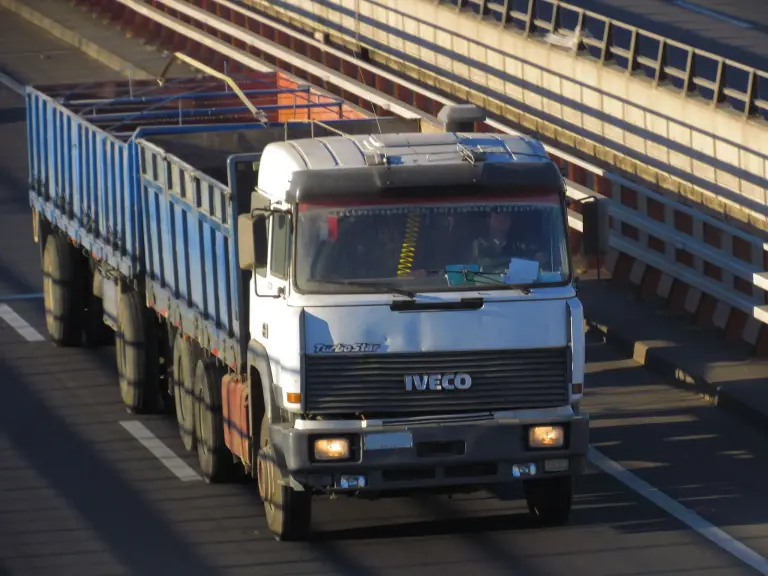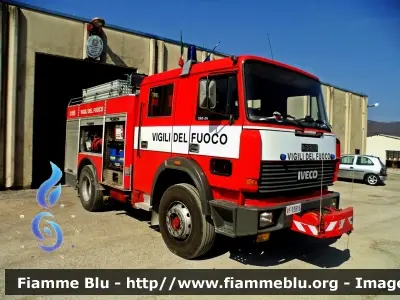
The Iveco 190 Turbo was a heavy, multi-purpose lorry built by Iveco between 1981 and 1989. It belonged to the big Fiat-Iveco heavy family and was the turbocharged answer to customers in countries with difficult terrain, Italy above all, who wanted more power. In 1990 the Turbotech series took its place and covered vehicles from 18 to 44 tonnes.
Iveco 190 Turbo at a glance
| Maker | Iveco, Turin |
|---|---|
| Production | 1981–1989 |
| Replaced by | Iveco Turbotech series, 1990 |
| Six-cylinder engine | Fiat 8210.22, 13,798 cc, 304 hp at 2,000 rpm, 1,324 Nm at 1,200 rpm |
| V8 engine | Fiat-Iveco 8280-22, 17,174 cc, 381 hp at 1,900 rpm, 1,650 Nm at 1,200 rpm |
| Gearboxes | Fuller 12513 with 13 speeds, ZF 16S160 with 16, or Fiat IM 8165 with 8 plus a hydraulic torque converter |
| GVW, 4×2 chassis | 18–19 t depending on the country, plus an 18–20 t trailer |
| GVW, 6×2 chassis | 20–24 t with a steerable, lifting third axle, forming combinations of 38–44 t |
| Tractor version | 190T for semi-trailers, 38–44 t |
| Also built in | Turkey, Argentina, Brazil and Libya |
Based on one source: the Italian Wikipedia article. The English Wikipedia has no page for this model.
History of the Iveco 190 Turbo
In 1980 growing demand for power in countries with difficult topography, Italy among them, pushed Iveco to fit turbocharged engines to its heavy vehicles. Iveco had been the badge on Fiat Veicoli Industriali products since 1975, first alongside the Fiat name and then in its place, and the 190 Turbo was the heavy lorry that carried the new engines.
The model was part of the wide Fiat-Iveco heavy family and kept the double name until 1981 in Latin America, in Argentina and Brazil, where the Iveco badge arrived six years later than in Europe. Buyers could choose between a 13,798 cc Fiat six-cylinder and a 17,174 cc Fiat-Iveco V8, and between three gearboxes, including a Fuller unit with 13 ratios.
The 190 Turbo was assembled outside Europe as well. The Turkish Fiat-Iveco subsidiary Otoyol built the 190.33 Turbo from 1988 to 1993, Iveco Argentina made 532 units of the Fiat-Iveco 190.33 between 1992 and 1998 and added the less powerful 190.29 from 1994, the former Alfa Romeo subsidiary Fiat Diesel built the 190.33 Turbo in Brazil from 1982, and the Libyan Trucks and Bus Co. assembled the range in Tripoli. Production in Europe ended in 1989 and the Turbotech series followed in 1990.
Design and features
- Turbocharging as standard: the whole heavy range moved to turbocharged engines, which is what gave the model its name.
- Two engine families: an inline six of 13,798 cc and a big V8 of 17,174 cc, with up to 381 hp and 1,650 Nm.
- Factory 6×2: the Iveco 220/240 range came from the works with a steerable and lifting third axle, which until then outside specialists had added to 4×2 chassis.
- Wide weight range: from 18-tonne two-axle lorries to 44-tonne road trains and the 190T tractor unit.
Iveco 190 Turbo versions
- 190T: tractor unit for semi-trailers, rated for combinations of 38 to 44 tonnes.
- 6×2 chassis: with a lifting, steerable third axle for 20 to 24 tonnes plus trailer.
- Fiat-Iveco 190.33 (Turkey): built by Otoyol from 1988 to 1993.
- Fiat-Iveco 190.33 and 190.29 (Argentina): 532 units between 1992 and 1998, the 190.29 added from 1994 with the same 13,798 cc six.
The 190 Turbo was followed in the heavy range by the Turbostar, and the engines of the next generation are described in the article on the Cursor family. More Iveco lorries are in the Iveco collection.
Sources
- Iveco 190 Turbo, Italian Wikipedia: dates, engines, gearboxes, weights, production abroad