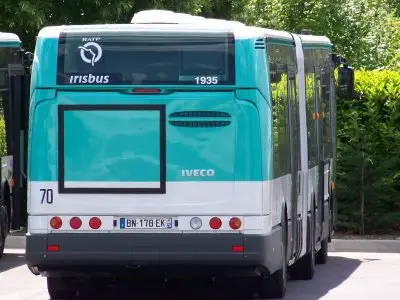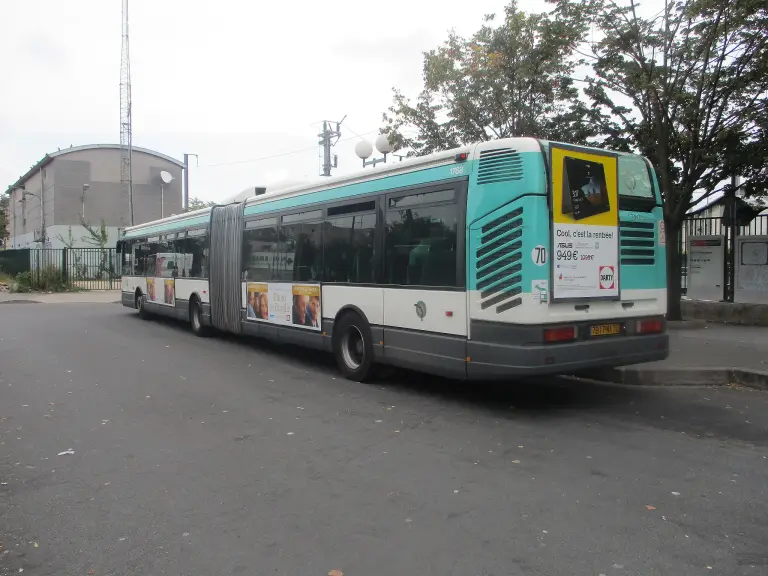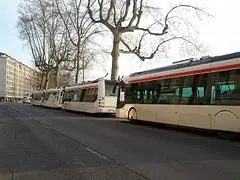
The Irisbus Crossway is an urban and intercity bus that went into series production in 2006. It was the first vehicle of the range to comply with the Euro IV emission standard, and it replaced both the Arway and the Axer; since the 2013 update it has been sold as the Iveco Crossway with Euro VI engines.
Irisbus Crossway at a glance
| Maker | Irisbus, later Iveco Bus |
|---|---|
| Production | since 2006 |
| Class | urban and intercity bus |
| Body | semi-self-supporting, frame construction |
| Layout | rear engine, rear axle driven, ‘pusher’ |
| Suspension | air suspension on all axles |
| Doors | two or three on the right side |
| First version | Euro IV, ABS and ASR as standard equipment |
| Lengths | 10.8 m, 12 m, 12.8 m, 13 m |
| Engines | Iveco Tector 6 and 7, Cursor 8 and 9 |
| Updated version | Iveco Crossway, 2013, Euro VI |
The English Wikipedia article covers the Crossway under both its Irisbus and Iveco Bus names; this page follows the Irisbus years and mentions the 2013 update.
History of the Irisbus Crossway
The Irisbus Crossway, 2006–2013
The Crossway was launched in 2006 and stayed in production as an Irisbus until 2013. It was the first vehicle to comply with the Euro IV emission standards, and ABS and ASR were standard equipment. The bus was offered in four lengths: the 10.8-metre version, built from 2007 as the replacement for the Arway 10.6 m, the 12-metre and 12.8-metre versions, which together replaced the Arway 12.8 m and the Axer 12.8 m, and from 2013 the 13-metre version in place of the 12.8-metre bus.
The body and the powertrain
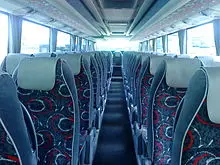
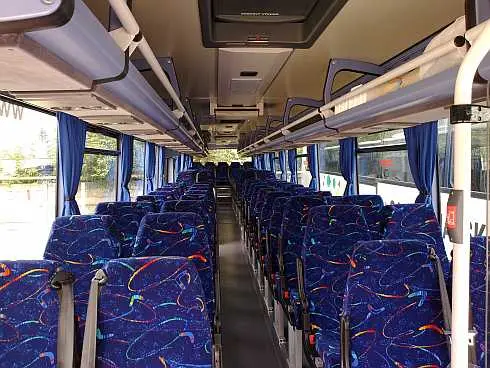
The body was semi-self-supporting, with a frame and the engine and gearbox placed at the rear in the ‘pusher’ layout, driving the rear axle only. All axles used air suspension, the interior was trimmed in cloth, the driver’s cab was integral with the rest of the vehicle and the right side carried two or three doors. The engine range covered the Iveco Tector 6, a 5.9-litre turbocharged and intercooled six-cylinder unit built to Euro IV and V, the Tector 7 of 6.7 litres for Euro V and VI, the Cursor 8 of 7.9 litres for Euro IV, V and EEV and the Cursor 9 of 8.7 litres for Euro V and VI.
Low-entry versions and operators
The low-floor version, the Crossway LE, was launched in 2007 with two variants, City for urban and suburban work and Line for suburban and intercity trips. Operators followed across the continent: the Crossway LE has been used in Tirana since 2010, ÖBB Postbus in Austria ran over 200 buses, Danish operators ran 118 high-floor and 24 low-floor models, Estonia had 88 high-floor and 43 low-floor buses, Connexxion in the Netherlands operated 68 Iveco Crossway Low Entry and TST in Portugal ran 194 Crossway City LE, 17 Crossway City LE CNG and 25 Crossway Line. In Italy the Crossway served TPER in Bologna, ATAC and Ferrovie Nord Milano in Milan, GTT in Turin, Cotral in Lazio, ARST in Sardinia and many other operators, and the United States Army used Crossways as shuttles on bases across Europe.
Design and features
- Euro IV from launch: the first Irisbus model to meet the standard, with ABS and ASR as standard.
- Four lengths: 10.8, 12, 12.8 and, from 2013, 13 metres.
- Air suspension everywhere: all axles used air springs.
- Wide engine choice: Iveco Tector 6 and 7 and Cursor 8 and 9 diesels.
- Crossway LE: a low-entry version in City and Line forms from 2007.
Irisbus Crossway versions
- Crossway 10.8 m (2007–2013): replacement for the Arway 10.6 m.
- Crossway 12 m (2007–2013): the standard intercity length.
- Crossway 12.8 m (2007–2013): replaced by the 13-metre version.
- Crossway LE (from 2007): the low-entry bus in City and Line forms.
- Iveco Crossway (from 2013): Euro VI update with the Pop, Line, HV and Pro variants.
The Crossway took over from the Irisbus Arway and the Irisbus Axer, and it shared the range with the Irisbus Citelis. More buses are in the Irisbus collection.
Video: Irisbus Crossway LE in German service
Video on YouTube.
Sources
- Irisbus Crossway, English Wikipedia: versions, engines, body, operators