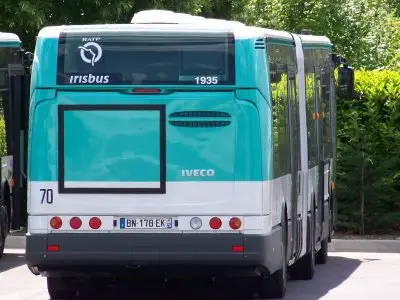
The Irisbus Citelis was a low-floor city bus produced by Irisbus from 2005 to 2013, when it was replaced in production by the Iveco Urbanway. It arrived as the successor of the Agora and was offered in three lengths, as a 10-metre midibus, a 12-metre standard bus and an articulated 18-metre bus, with diesel, CNG and trolleybus versions.
Irisbus Citelis at a glance
| Maker | Irisbus |
|---|---|
| Production | 2005–2013 |
| Class | low-floor city bus |
| Replaces | Irisbus Agora |
| Replaced by | Iveco Urbanway |
| Citelis 10 | 10 m (33 ft) standard bus |
| Citelis 12 | 12 m (39 ft) standard bus |
| Citelis 18 | 18 m (59 ft) articulated bus |
| Engines | Euro 4, Euro 5 and EEV |
| Trolleybus versions | Škoda 24Tr Irisbus (12 m) and 25Tr Irisbus (18 m) |
This page is based on English Wikipedia only, so the details could not be cross-checked against a second source.
History of the Irisbus Citelis
A replacement for the Agora
The Citelis was introduced in 2005 to replace the Agora, the bus that Irisbus had inherited from Renault. Like its predecessor it was a low-floor city bus, but the range was reorganised around three lengths: the Citelis 10 at 10 metres, the Citelis 12 at 12 metres and the articulated Citelis 18 at 18 metres. Buyers could choose between Euro 4, Euro 5 and EEV engines, and the range could also be supplied as trolleybuses drawing power from overhead wires instead of fuel.
The trolleybus versions
The trolleybus Citelis was also sold as the Škoda 24Tr Irisbus in 12-metre form and the Škoda 25Tr Irisbus in 18-metre form, especially in eastern Europe.
Across Europe
Citelis vehicles entered service in Bucharest on the trolleybus network run by STB in 2007 and in Riga, the Latvian capital, in 2006 or 2007 with Rigas Satiksme. They were also used by the RATP in Paris, by VER in Germany, in Brno and Prague, by ATM in Milan, by ATAC in Rome, by Strætó bs in Reykjavík, by EMT-Palma in Mallorca, in Nur-Sultan in Kazakhstan, by TEC in Belgium, in Plovdiv and Varna in Bulgaria, by OASA and OASTH in Greece, by ACTC OCFTC in Lebanon and by DPMK in Košice. In 2012 JGSP Novi Sad bought five Citelis 12 CNG models, and a Citelis 18 CNG chassis was converted to right-hand drive and bodied by Custom Coaches in 2008–2009 for Path Transit in Perth, Western Australia.
Design and features
- Three lengths: Citelis 10, Citelis 12 and the articulated Citelis 18.
- Low floor: the whole range was designed as an accessible city bus.
- Emission choices: Euro 4, Euro 5 and EEV engines, plus CNG versions.
- Trolleybus option: sold as the Škoda 24Tr and 25Tr in eastern Europe.
- Screen fame: a Citelis appears as the character Emmanuel in the Disney film Cars 2.
Irisbus Citelis versions
- Citelis 10 (10 m): the short standard bus.
- Citelis 12 (12 m): the standard city bus, including CNG versions.
- Citelis 18 (18 m): the articulated version, also built as a trolleybus.
- Škoda 24Tr Irisbus: the 12-metre trolleybus version.
- Škoda 25Tr Irisbus: the 18-metre articulated trolleybus version.
- Right-hand-drive Citelis 18: a single CNG chassis bodied by Custom Coaches for Perth.
The Citelis replaced the Irisbus Agora and was followed by the Urbanway; its trolleybus stablemate was the Irisbus Cristalis. More buses are in the Irisbus collection.
Video: Irisbus Citelis 12M CNG
Video on YouTube.
Sources
- Irisbus Citelis, English Wikipedia: range, engines, operators