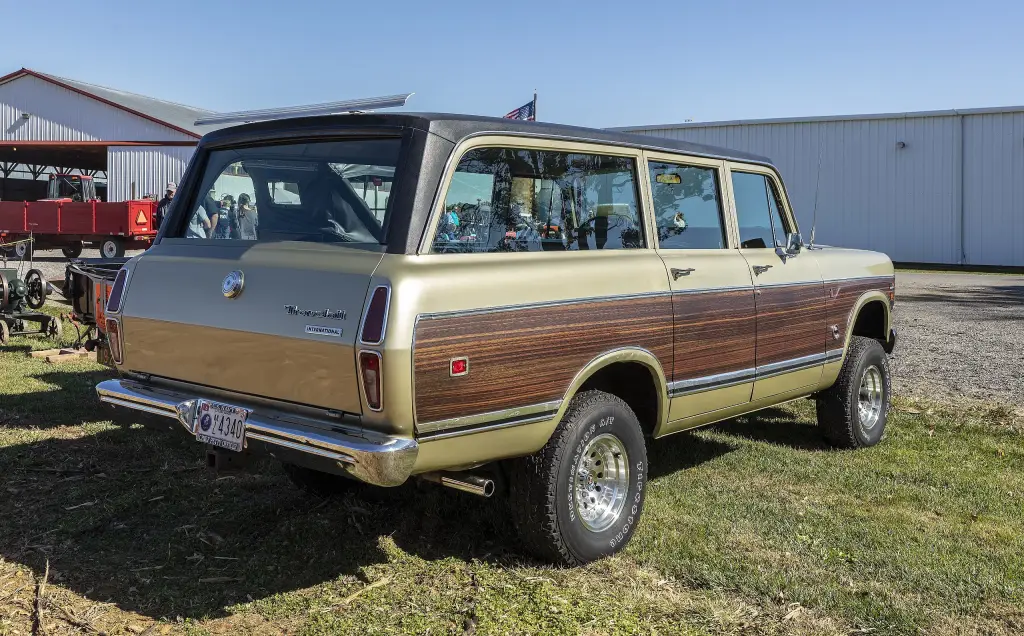
The International Travelall was a station wagon built on a truck chassis by International Harvester from 1953 to 1975. It competed with the Chevrolet Suburban throughout its life, was the first vehicle in the class to offer four passenger doors, and became a forerunner of the modern people carrier and full-size SUV.
International Travelall at a glance
| Maker | International Harvester |
|---|---|
| Production | 1953–1975 |
| Type | truck-based station wagon, forerunner of the full-size SUV |
| Rival | Chevrolet Suburban |
| First generation | 1953–1957, on the R-110 half-ton chassis with a 115-inch wheelbase |
| First generation engine | 220 cu in Silver Diamond six of 100 hp |
| Second generation | 1958–1960 A and B series, with a rear passenger door added in 1958 |
| Third generation | 1961–1968 C series with a 119-inch wheelbase and independent front suspension |
| Fourth generation | 1969–1975, sharing the Light Line pickups |
| End | after the 1975 model year |
Based on one source (English Wikipedia).
History of the International Travelall
First generation (1953–1957)
Before 1953 International Harvester had no station wagon of its own: truck chassis were given wooden station wagon bodies by outside firms, and after the war K-series panel vans were converted into airport people movers with windows and rear seats. An L-series panel truck with windows and rear seats was an early step in the same direction. In 1953, when the R series replaced the L series, International added the Travelall as a metal-bodied station wagon on the half-ton R-110 chassis with a 115-inch wheelbase. It was a windowed panel van with two or three rear seats, powered by the 100 hp 220 cubic inch Silver Diamond six. As on the two-door estate cars of the time, access to the rear seats meant folding up the passenger-side front seat. Twin rear doors were standard and a wagon-style tailgate was optional, and a Travelall badge on the front cowl distinguished it from other Internationals. In 1955 the truck range became the S series and the Travelall moved to the S-110 and the heavier S-120 with the BD 220 engine, and for 1956 four-wheel drive became a factory option.
Second generation (1958–1960)
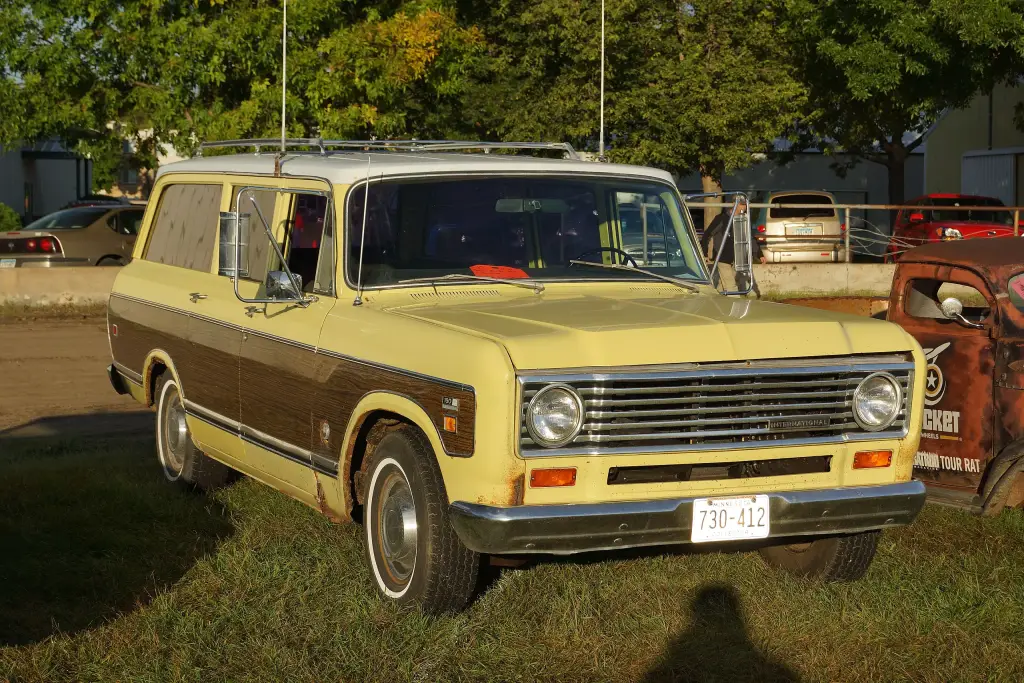
The A series of 1957, named for International Harvester’s fiftieth year of truck production, brought a full redesign and the Travelall’s most important functional change: a second passenger-side door was added to improve rear-seat access. A driver-side rear door was impossible because of the position of the fuel filler. The Travelall was based on the A-100, A-110 and A-120, with four-wheel drive optional on the A-120, and the Silver Diamond 220 engine produced between 113 and 154 hp. For 1959 the A series became the B series with a light facelift, power steering, power brakes and an optional V8. The Travelall was offered in the B-100, B-110 and B-112 half-ton range in two-wheel drive only, while the three-quarter-ton B-120 was the only Travelall of the era with four-wheel drive; a B-122 had uprated springs for a higher gross weight. The B series ran into the 1961 model year, when another facelift turned it into the C series.
Third and fourth generations (1961–1975)
The C-series Travelall of April 1961 brought a new frame and independent front suspension with torsion bars, with the front axle moved four inches forward to stretch the wheelbase to 119 inches. The body sat lower on the frame, the grille became concave and the front end moved to horizontally mounted quad headlamps. Rear doors could be twin panels or a wagon tailgate with an electrically retractable window. The front end was revised almost every other year, and for 1965 the light trucks became the D series. For 1969 a fourth generation arrived and continued to follow the Light Line pickups until International ended Travelall and Light Line production after the 1975 model year. Since the Scout was discontinued in 1980, International has built only medium- and heavy-duty commercial trucks.
Design and features
- Four doors first: the first vehicle in its class with four passenger doors, a rear door in 1958 and a fourth in 1961.
- Truck chassis: the Travelall was always derived from International’s pickup line.
- Suburban rival: it competed with the Chevrolet Suburban for its whole production life.
- Independent suspension: the 1961 C series brought torsion bars and a lower body.
- Long run: four generations between 1953 and 1975.
International Travelall versions
- R-110 Travelall (1953): the original half-ton wagon.
- S-110 and S-120 (1955): S-series versions, with four-wheel drive from 1956.
- A and B series (1958–1960): second generation with a rear passenger door.
- C series (1961–1968): third generation with independent front suspension.
- Fourth generation (1969–1975): the final Travelall, based on the Light Line pickups.
The Travelall was created from the International R series panel truck and shared its range with the C series pickups; the off-road Scout was its smaller stablemate. More vehicles are in the International collection.
Sources
- International Travelall, English Wikipedia: generations, engines, doors, production